
Why Hire a Professional Home Caregiver for Your Family
Why Hire a Professional Home Caregiver for Your Family

Deciding to bring professional help into your home for an aging parent or loved one is rarely simple. Most families start by assuming they can manage everything on their own. But caregiving needs rarely stay the same. They grow, shift, and intensify in ways that catch even the most devoted family members off guard. Understanding why hire a professional home caregiver matters so much comes down to one honest truth: the right support changes outcomes for everyone involved, not just the person receiving care. This article walks you through the signals, the benefits, the options, and the practical steps to make a confident decision.
Table of Contents
- Key takeaways
- Why hire a professional home caregiver: knowing when it’s time
- Core benefits of hiring a professional caregiver
- Comparing care models and service options
- How to hire the right professional caregiver
- My perspective on getting this decision right
- How Helping Hands Home Care supports your family
- FAQ
Key takeaways
| Point | Details |
|---|---|
| Recognize the signs early | Gradual difficulty with daily tasks signals it’s time to explore professional in-home support. |
| Burnout is real and measurable | 78% of family caregivers report burnout, making professional relief not a luxury but a necessity. |
| Agency caregivers offer built-in safety | Vetting, background checks, and insurance reduce risk that private hiring often leaves unaddressed. |
| Multiple funding options exist | Medicaid, respite care programs, and private pay can all contribute to covering professional care costs. |
| Early hiring builds better outcomes | Starting professional care before a crisis allows families and caregivers to build trust gradually. |
Why hire a professional home caregiver: knowing when it’s time
Most families don’t start looking for help after a single dramatic event. They start noticing small things. The refrigerator holds expired food. Bills go unpaid. Your parent grips the handrail a little longer than they used to. These gradual changes in the ability to manage daily tasks are among the clearest signals that outside support is needed.
Harvard Health notes that recognizing difficulty with cooking, cleaning, or driving is one of the earliest and most reliable indicators that in-home help is warranted. The problem is that families often rationalize these changes until a fall, a missed medication, or a health crisis forces the issue.
Here are the key situations that typically signal it’s time to consider professional in-home care:
- Declining personal hygiene or reluctance to bathe, which can indicate both physical difficulty and cognitive change
- Missed medications or confusion about dosing schedules, which creates serious health risks
- Mobility challenges after a fall, surgery, or new diagnosis that limit safe movement around the home
- Increasing isolation as driving becomes unsafe and social connections fade
- Family caregiver exhaustion, where the person providing care is visibly struggling to keep up
One underappreciated reason to act sooner rather than later: starting professional care early allows your loved one to build a relationship with a caregiver before needs become urgent. That familiarity matters enormously when someone is vulnerable.
Pro Tip: Schedule a formal needs assessment with a geriatric care manager or your loved one’s primary physician before you start searching for caregivers. A written assessment gives you a clear baseline and helps you match the right level of care to actual needs, not assumptions.
Core benefits of hiring a professional caregiver
This is where the case for professional in-home care becomes undeniable. The advantages go well beyond convenience.
-
Safety through verified qualifications. Professional caregivers hired through licensed agencies undergo background checks, skills training, and are covered by agency insurance. Reliable, trained, and insured caregivers reduce the legal and physical risks that come with informal arrangements. If something goes wrong in your home, agency coverage protects your family.
-
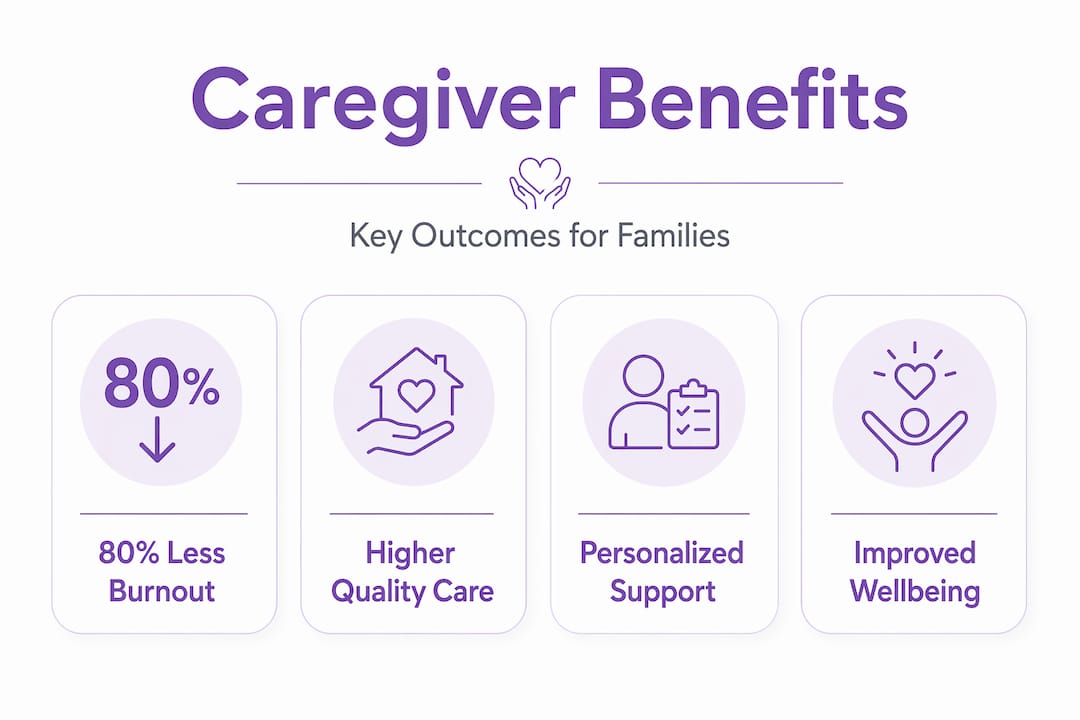
Relief from caregiver burnout. This one is staggering in scale. 78% of family caregivers report experiencing burnout, often on a weekly or daily basis. Burnout is not just fatigue. It affects physical health, relationships, and work performance. Many family caregivers are also juggling employment and other family responsibilities, compounding the strain significantly.
-
Personalized, consistent care. A professional caregiver follows a care plan tailored to your loved one’s specific needs. That consistency, showing up at the same time, knowing preferences, building rapport, produces better outcomes than rotating family coverage.
-
Companionship and emotional support. Loneliness is a documented health risk for older adults. A professional caregiver provides structured social interaction that family visits, however loving, often can’t match in frequency or regularity.
-
Flexible scheduling. Home caregiving services can be arranged for a few hours a week or around the clock, depending on need. That flexibility is something nursing facilities simply cannot offer.
“Burnout stems mainly from unmet caregiver needs. Professional caregivers fill these gaps, positively influencing the health of both the caregiver and the care recipient.” — BMC Nursing, 2026
The importance of professional caregivers becomes clearest when you compare outcomes. Families with professional support report lower rates of caregiver depression, fewer hospitalizations for care recipients, and greater overall satisfaction with the caregiving arrangement.
Comparing care models and service options
Not all professional care works the same way. Understanding your options helps you choose the right fit for your family’s situation and budget.
| Care model | Who manages it | Oversight level | Best for |
|---|---|---|---|
| Licensed agency caregiver | The agency | High (vetting, insurance, backup) | Families wanting full support and reduced liability |
| Consumer-directed Medicaid | The family | Lower (family acts as employer) | Families with time and ability to manage hiring |
| Private hire (independent) | The family | Minimal (family responsible for all checks) | Tight budgets with careful vetting |
| Unpaid family care | Family member | None formal | Early-stage needs or supplemental support |
Licensed agencies handle the vetting, scheduling, and replacement coverage when a caregiver is unavailable. That reliability is worth a lot when your loved one depends on consistent support.
Medicaid is a funding source many families overlook. Medicaid home care covers personal care and support services with eligibility and service availability varying by state. Some states also offer respite care through Medicaid programs, giving family caregivers planned breaks ranging from a few hours to several weeks.
In consumer-directed Medicaid programs, families assume employer responsibilities including documentation and compliance. That added workload is manageable for some families but overwhelming for others already stretched thin.
It’s also worth knowing that Medicaid distinguishes between medical home health care and non-medical personal care, which affects what services are covered and who qualifies. Knowing which category your loved one falls into shapes which funding path makes sense.
Pro Tip: Contact your state’s Area Agency on Aging before assuming you don’t qualify for Medicaid support. Many families discover they are eligible for programs they never knew existed, including caregiver training, respite funding, and home modification assistance.
How to hire the right professional caregiver
Once you’ve decided to move forward, the hiring process itself deserves careful attention. Rushing this step is where families most often run into problems.
-
Clarify the scope of care needed. Does your loved one need help with bathing and dressing only, or do they also need medication management, meal preparation, and transportation? The more specific you are, the better your match will be.
-
Verify credentials and experience. Ask specifically about experience with your loved one’s conditions, whether that’s dementia, Parkinson’s disease, post-surgical recovery, or mobility limitations. General caregiving experience is not the same as condition-specific knowledge.
-
Run a thorough background check. If you’re hiring through an agency, confirm that the agency conducts criminal background checks and verifies references. If you’re hiring privately, you are responsible for this step. Don’t skip it.
-
Assess personality fit. Competence matters, but so does compatibility. A caregiver who is skilled but clashes with your loved one’s personality will struggle to build the trust that makes care effective. Arrange a trial visit before committing.
-
Put expectations in writing. Whether you use an agency contract or a private agreement, document the schedule, duties, pay rate, and protocols for emergencies. Clear written expectations prevent the most common conflicts.
-
Plan for backup coverage. What happens when the caregiver is sick? Agencies typically provide substitutes. Private arrangements often leave families scrambling. Factor this into your decision.
The home health aide services offered by established agencies include all of this structure by default, which is one of the strongest professional caregiver advantages of going the agency route.
My perspective on getting this decision right
I’ve watched families go through this process many times, and the pattern I see most often is waiting too long. Not because families don’t care. They care deeply. But there’s a belief that bringing in outside help is somehow an admission of failure, a signal that the family isn’t doing enough.
That belief costs people dearly. By the time a crisis forces the decision, everyone is already exhausted, the care recipient is often in a worse medical state, and the family is trying to build a caregiving relationship under emergency conditions. That’s the hardest way to do it.
What I’ve found is that families who bring in professional support early, even just a few hours a week, report feeling more in control, not less. The caregiver becomes part of the extended support system rather than a stranger who shows up at the worst moment. And the care recipient adjusts far more gracefully when the change is gradual.
I also want to address the guilt directly. Choosing professional help is not a replacement for love. It’s an expression of it. You’re saying: my loved one deserves consistent, skilled, attentive care, and I’m going to make sure they get it. That’s not stepping back. That’s stepping up.
The families I’ve seen thrive are the ones who treat professional caregiving as a partnership. They stay involved, communicate regularly with the caregiver, and adjust the care plan as needs evolve. The research on unmet caregiving needs makes clear that addressing gaps before visible decline is what produces the best outcomes for everyone.
— Michael
How Helping Hands Home Care supports your family
At Helping Hands Home Care, we know that choosing professional support for a loved one is one of the most personal decisions a family makes. That’s why we built our services around flexibility, compassion, and reliability.
Our home health aide services cover everything from personal care and companionship to medication reminders and mobility assistance. For families facing sudden health changes, our catastrophic care services provide intensive, responsive support when it’s needed most. We also offer professional house cleaning and massage therapy to support the full wellbeing of your loved one at home. Every caregiver we place is vetted, trained, and backed by our agency. Reach out to Helping Hands Home Care today to talk through your family’s needs and find the right level of support.
FAQ
When should you hire a professional home caregiver?
You should consider hiring a professional caregiver when your loved one shows difficulty managing daily tasks like cooking, cleaning, or taking medications safely. Harvard Health recommends not waiting for a crisis, as starting early leads to better outcomes.
What qualifications should a professional caregiver have?
Professional caregivers should have relevant training, verifiable references, a clean background check, and ideally experience with your loved one’s specific health conditions. Agency caregivers typically carry insurance coverage as well.
How does home care compare to a nursing home?
Home care allows seniors to remain in a familiar environment with personalized, one-on-one attention, while nursing homes offer 24-hour medical supervision in a facility setting. Many families find that home care better preserves independence and quality of life for their loved ones.
Can Medicaid help pay for professional home care?
Yes. Medicaid covers personal care and support services in most states, with eligibility and covered services varying by location. Some states also fund respite care through Medicaid, giving family caregivers structured breaks.
How do you prevent caregiver burnout in the family?
Bringing in professional support directly reduces the unmet needs that drive burnout. A 2026 BMC Nursing study found that addressing caregiving gaps improves health outcomes for both the caregiver and the person receiving care.