
Detroit Home Care Economy: Impact and Options in 2026
Detroit Home Care Economy: Impact and Options in 2026

Detroit’s home care economy is defined as the combined system of unpaid family caregiving and paid home care services that supports elderly and disabled residents in living independently at home. The role of home care economy Detroit plays in sustaining seniors is larger than most residents realize. Michigan family caregivers alone provide 1.33 billion unpaid hours of care annually, valued at $27 billion. That figure represents the invisible foundation beneath every formal care arrangement in the region. For Detroit families navigating aging parents, chronic illness, or disability, understanding this system is the first step toward making better decisions.
How does the role of home care economy Detroit shape elder independence?
Home care keeps older adults out of nursing facilities and in their own homes. That outcome matters for dignity, health, and cost. Institutional care carries a far higher price tag than in-home support, and research consistently shows that seniors who age at home report better mental health and stronger social connections.
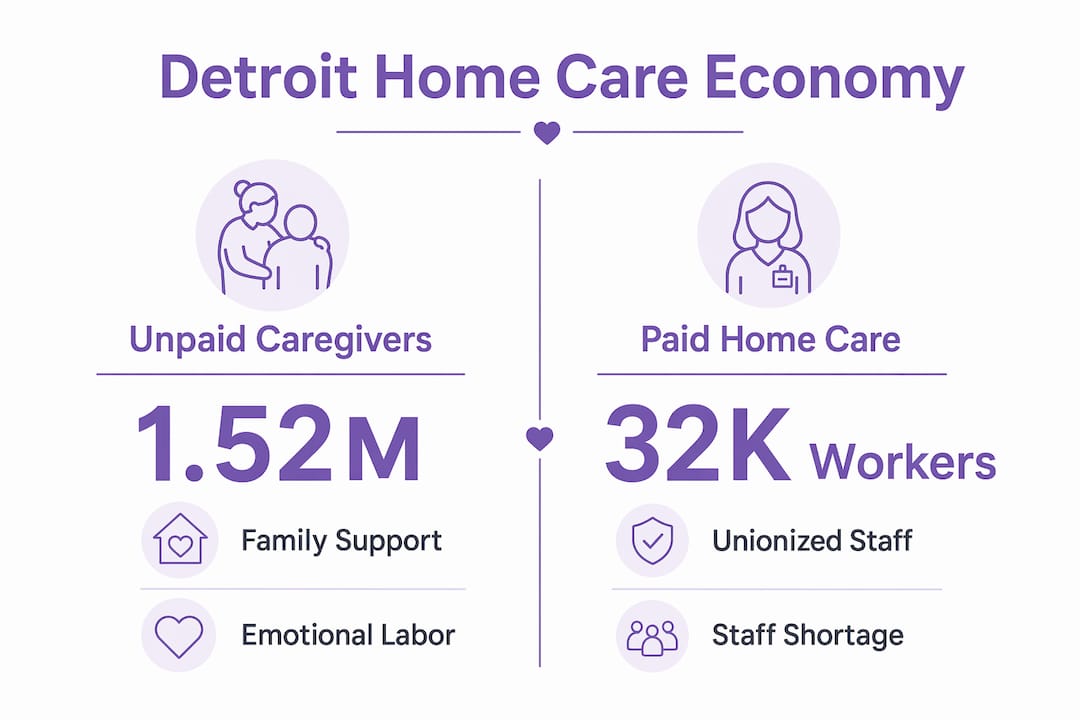
Unpaid family caregivers carry the heaviest load in this system. The 1.52 million Michiganders who provide adult care each year are largely invisible in policy discussions, yet they prevent enormous strain on hospitals and long-term care facilities. Without them, Detroit’s health system would face a care gap it cannot fill with paid workers alone.
The economic benefits of home care in Detroit extend beyond individual families. When seniors avoid emergency room visits and hospital stays, the entire regional health system absorbs lower costs. Programs like Henry Ford Health’s Stay Home Safe initiative demonstrate this directly. Since 2021, more than 270 participants have received home safety modifications through the program, reducing fall-related hospital visits by nearly 50%.
Key benefits of home care for Detroit’s elderly population include:
- Reduced hospitalizations through fall prevention and medication management
- Lower long-term costs compared to assisted living or skilled nursing facilities
- Preserved independence and daily routine for seniors with chronic conditions
- Reduced caregiver burnout when professional support supplements family care
- Stronger community ties because seniors remain in familiar neighborhoods
What are the workforce challenges facing Detroit’s home care industry?
The Detroit home care industry faces a staffing crisis that is already serious and getting worse. Michigan is projected to have more than 32,000 home care jobs vacant in 2026. That shortage is expected to grow to 171,000 unfilled positions by 2034. The gap between demand and available workers threatens care access for thousands of Detroit families.

Low pay and burnout drive most of the turnover. Home care workers are among the lowest-paid in the healthcare sector, and the physical and emotional demands of the job are high. Many workers leave for better-paying roles in retail or food service, taking their training and experience with them.
Three factors that compound Detroit’s home care workforce shortage:
- Wages below living costs. Many home care aides earn wages that do not cover basic expenses in the Detroit metro area, making retention nearly impossible.
- Limited benefits. Most home care positions historically offered no health insurance, paid leave, or retirement contributions, reducing the job’s long-term appeal.
- Isolation and burnout. Workers often care for clients alone, with minimal peer support or professional development, accelerating emotional exhaustion.
A significant shift occurred in october 2025, when 32,000 home care workers in Metro Detroit voted to unionize. The move aims to secure better wages, benefits, and working conditions. Better labor protections reduce turnover and burnout, which directly improves care continuity for Detroit seniors.
Pro Tip: If you are hiring a home care worker directly, ask agencies about their staff turnover rate. A low turnover rate signals better working conditions and more consistent care for your family member.
What support resources are available to Detroit-area caregivers?
Caregivers in Detroit do not need to figure out the system alone. A growing set of resources exists specifically to connect families to local services, respite care, and professional guidance.
The most significant new tool is Mi Caregiver Connection, an online portal launched in late 2025. It links caregivers to all 16 Area Agencies on Aging across Michigan by county. Caregivers enter their location and situation, and the portal surfaces relevant local programs, support groups, and service providers. For Detroit families, this removes the guesswork of knowing where to call first.
Area Agencies on Aging are the backbone of local coordination. They manage respite care programs, caregiver support groups, meal delivery, transportation assistance, and case management services. Wayne, Oakland, and Macomb counties each have their own Area Agency on Aging with distinct program offerings.
Key resources available to Detroit-area caregivers:
- Mi Caregiver Connection (micaregiversconnection.org): County-specific portal for finding local services
- Wayne County Area Agency on Aging: Covers Detroit and surrounding communities with direct case management
- Michigan 2-1-1: A statewide helpline connecting callers to social services, including home care referrals
- AARP Michigan: Offers caregiver training, legal resources, and advocacy support
Pro Tip: Start your search with an intake call to your county’s Area Agency on Aging before contacting individual providers. Case navigation intake helps match your family to the right combination of services, not just the first available provider.
How do home safety programs reduce costs in Detroit’s care system?
Preventive home modifications are one of the most cost-effective tools in Detroit’s home care model. A fall that sends a senior to the emergency room can cost tens of thousands of dollars and often triggers a chain of events leading to permanent institutionalization. Preventing that fall costs a fraction of the price.
Henry Ford Health’s Stay Home Safe program is the clearest local example. The program partners with housing organizations to address social determinants of health, installing grab bars, removing trip hazards, improving lighting, and making other targeted modifications. The results are measurable. Since 2021, the program has served over 270 Detroit-area participants and cut fall-related hospital visits by nearly 50%.
| Intervention | Estimated Benefit |
|---|---|
| Grab bar installation | Reduces bathroom fall risk significantly |
| Trip hazard removal | Lowers general fall frequency at home |
| Improved lighting | Reduces nighttime falls and disorientation |
| Medication management support | Decreases adverse drug events and ER visits |
| Regular home care check-ins | Enables early detection of health changes |
“Preventive home modifications not only improve individual safety but also generate systemic healthcare cost savings in Detroit’s home care model.” — Henry Ford Health, Stay Home Safe Program
The partnership model behind Stay Home Safe is worth noting. Health systems working alongside housing organizations address problems that clinical care alone cannot solve. That collaboration reflects a broader shift in how Detroit approaches elder care, treating the home environment as part of the health system.
What options exist for accessing home health services in Detroit?
Detroit families have several categories of paid home care to choose from, and the right mix depends on the senior’s specific needs. Home health services in Detroit generally fall into three types: personal care, homemaking, and skilled therapy services.
| Service Type | What It Includes | Best For |
|---|---|---|
| Personal care / home health aide | Bathing, dressing, mobility, medication reminders | Seniors with physical limitations or chronic illness |
| Homemaking / housekeeping | Cleaning, laundry, meal preparation, errands | Seniors who are largely independent but need household help |
| Skilled therapy | Physical, occupational, or speech therapy at home | Post-hospitalization recovery or managing specific conditions |
Choosing between an agency and an independent provider involves real tradeoffs. Agencies handle background checks, insurance, and backup coverage when a worker is sick. Independent providers often cost less but place more administrative responsibility on the family.
When evaluating home care options in Detroit, caregivers should ask:
- Is the agency licensed by the Michigan Department of Health and Human Services?
- Does the agency carry liability insurance and workers’ compensation coverage?
- How does the agency handle emergencies or worker absences?
- What is the minimum hours requirement per visit or per week?
Cost and availability remain the two biggest barriers for Detroit families. Home care is a growing industry in Detroit, with local agencies started by community members responding to rising demand. That growth is good for access, but it also means quality varies widely. Checking references and verifying licensing before signing any agreement protects your family member.
Key Takeaways
Detroit’s home care economy depends equally on unpaid family caregivers and paid home care workers, and strengthening both sides is the only path to sustainable elder care in the region.
| Point | Details |
|---|---|
| Unpaid caregiving anchors the system | Michigan’s 1.52 million family caregivers provide $27 billion in unpaid care, preventing institutional overload. |
| Workforce shortages are urgent | Michigan faces 32,000+ vacant home care jobs in 2026, rising to 171,000 by 2034 without intervention. |
| Unionization changes the equation | The 2025 Metro Detroit unionization of 32,000 workers aims to improve wages and reduce turnover. |
| Prevention saves money and health | Henry Ford Health’s Stay Home Safe program cut fall-related hospital visits by nearly 50% since 2021. |
| Mi Caregiver Connection simplifies access | The 2025 portal links Detroit caregivers to all 16 Michigan Area Agencies on Aging by county. |
Detroit’s home care future depends on who we support now
The part of this story that gets the least attention is the family caregiver. Not the agency, not the policy, not the union vote. The adult child who rearranges their work schedule, skips vacations, and quietly absorbs the physical and emotional weight of caring for a parent. That person is the real engine of Detroit’s care system, and they are largely unsupported.
I have seen families wait until a crisis forces their hand before they look for help. A fall, a hospitalization, a moment where the informal system breaks down. By that point, options are narrower and stress is higher. The Mi Caregiver Connection portal and Area Agencies on Aging exist precisely to prevent that scenario, but most families do not find them until it is too late.
The 2025 unionization of Metro Detroit’s home care workers is genuinely significant. Not because unions solve every problem, but because workforce instability is the single biggest threat to care quality. When workers earn better wages and have real protections, they stay longer. When they stay longer, seniors get consistent care from someone who knows their routines and preferences. That continuity matters more than most families realize until they lose it.
Detroit’s home care industry is growing, and local agencies are responding to real community demand. The challenge now is making sure that growth produces quality, not just volume. Families deserve providers who are trained, stable, and accountable. Workers deserve conditions that make the job sustainable. Both things can be true at the same time.
— Michael
How Helping-hands-home-care serves Detroit families at home
Detroit families looking for professional, reliable in-home support have a local option built specifically for seniors. Helping-hands-home-care provides home health aide services for elderly clients who need personal care, mobility support, and daily living assistance in their own homes.
Beyond personal care, Helping-hands-home-care also offers house cleaning services and in-home massage therapy for seniors who benefit from a full range of supportive care. Whether your family needs a few hours of help each week or a more structured daily care plan, Helping-hands-home-care works with you to build the right arrangement. Contact Helping-hands-home-care directly to discuss your family’s specific needs and get a care plan that fits your situation.
FAQ
What is the home care economy in Detroit?
The home care economy in Detroit combines unpaid family caregiving with paid home care services to support elderly and disabled residents. Michigan’s 1.52 million family caregivers provide the majority of this care, supplemented by paid home health aides, homemakers, and therapists.
How do I access home care services in Detroit?
Start with an intake call to your county’s Area Agency on Aging or use the Mi Caregiver Connection portal to find local services. From there, you can get matched to licensed agencies, respite care programs, and other supports specific to your situation.
What is the Stay Home Safe program in Detroit?
Stay Home Safe is a Henry Ford Health program that installs home safety modifications for Detroit-area seniors to prevent falls. Since 2021, it has served over 270 participants and reduced fall-related hospital visits by nearly 50%.
Why is there a home care worker shortage in Detroit?
Michigan faces a projected shortage of more than 32,000 home care jobs in 2026, driven by low wages, limited benefits, and high burnout rates. The shortage is expected to reach 171,000 unfilled positions by 2034 without significant changes to pay and working conditions.
What did the 2025 home care worker unionization mean for Detroit?
In october 2025, 32,000 Metro Detroit home care workers voted to unionize, securing better wages and labor protections. The move is expected to reduce turnover and improve care consistency for Detroit seniors over time.
Recommended
- Top 5 Helpinghandhealthcare.com Alternatives Providers 2026 | Helping Hands Home Care
- What Is the Home Care Industry? A 2026 Family Guide | Helping Hands Home Care
- Michigan Winter Home Care Challenges: A Caregiver’s Guide | Helping Hands Home Care
- Top 6 Procareunlimited.com Alternatives Providers 2026 | Helping Hands Home Care