
Difference Between Home Care Types: Family Guide 2026
Difference Between Home Care Types: Family Guide 2026

Home care is defined as professional support services delivered in a person’s own home, and the difference between home care types comes down to one core distinction: whether the services are medical or non-medical. Home health care, non-medical home care, and hospice care each serve a different purpose, require different eligibility criteria, and are funded through entirely different channels. Families who understand these distinctions avoid costly surprises and get their loved ones the right level of support from the start. This guide breaks down each type clearly so you can make a confident, informed decision.
What are the main differences between home care types?
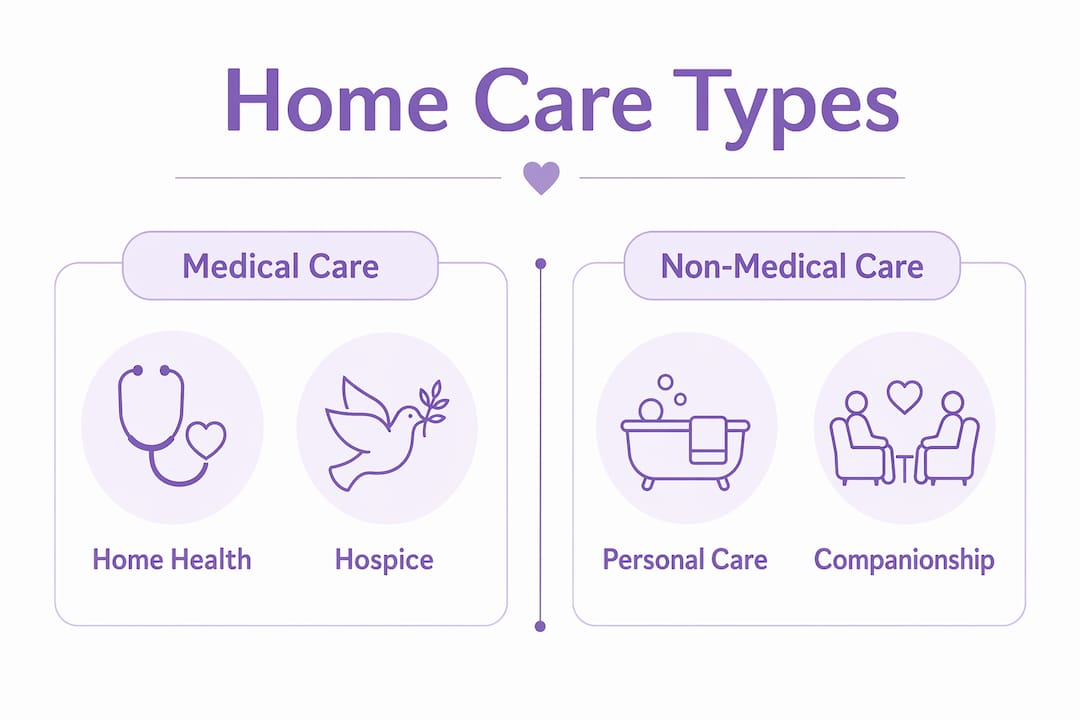
The three primary categories of home care are home health care, non-medical home care, and hospice care. Each one occupies a distinct role in elderly care, and confusing them is one of the most common mistakes families make when planning support for an aging parent or spouse.
Home health care is skilled medical care delivered at home following a physician’s order. It typically includes services like wound care, physical therapy, occupational therapy, speech therapy, and skilled nursing assessments. Home health visits last between 30 and 90 minutes and are designed around a specific recovery or treatment goal. This type of care is time-limited and goal-oriented. Once a patient meets their recovery benchmarks, home health services end.

Non-medical home care is the most widely used category and covers daily living support without any physician involvement. Home care aides assist with activities of daily living (ADLs) such as bathing, dressing, grooming, meal preparation, light housekeeping, and companionship. No doctor’s order is required to start services. Families can arrange non-medical care directly through an agency or an independent caregiver. Support can range from a few hours per week to full 24/7 live-in coverage, depending on need.
Hospice care is specialized end-of-life comfort care for individuals with a terminal diagnosis and a prognosis of six months or less. Hospice is 100% Medicare-covered and delivered by an interdisciplinary team that includes nurses, social workers, chaplains, and home health aides. The focus shifts entirely from curative treatment to symptom management, pain relief, and emotional support for both the patient and the family. Hospice can be provided at home, in a facility, or in a dedicated hospice center.
Here is a quick reference for the three types:
- Home health care: Requires physician order, skilled medical services, time-limited, Medicare-eligible
- Non-medical home care: No physician order needed, ADL and IADL assistance, ongoing, primarily private pay
- Hospice care: Terminal diagnosis required, comfort-focused, interdisciplinary team, fully Medicare-covered
Understanding these categories is the foundation for every financial and logistical decision that follows.
How do costs, funding, and eligibility differ among home care types?
The funding structure for each home care type is where families most often get caught off guard. Medicare covers home health care and hospice care under specific conditions, but Medicare does not cover non-medical home care directly. That gap surprises many families who assume their parent’s Medicare plan will pay for a home aide helping with bathing and meals. It does not.
Medicare coverage for home health and hospice
To qualify for Medicare-covered home health care, a patient must be certified as homebound by a physician, have a documented skilled need (nursing, therapy, or speech pathology), and be under an active plan of care. Medicare’s “homebound” and “skilled need” requirements are rigorously defined and have generated legal precedents that affect eligibility decisions. Meeting one criterion without the other disqualifies a patient entirely.
Hospice eligibility under Medicare requires two physicians to certify a terminal prognosis of six months or less, and the patient must formally elect hospice care by waiving curative treatment. Once enrolled, Medicare covers virtually all hospice-related costs including medications, equipment, and caregiver support.
Paying for non-medical home care
Non-medical home care is almost always private pay, meaning families pay out of pocket. In major metro areas like Houston, private home care costs between $25 and $32 per hour in 2026, with most agencies requiring a minimum four-hour shift per visit. At four hours per day, five days a week, that adds up to $2,000 to $2,560 monthly at minimum. That figure rises sharply for families needing daily or overnight coverage.
Funding sources for non-medical care include long-term care (LTC) insurance, Medicaid waiver programs (which vary by state), and VA benefits for eligible veterans and their spouses. Families should contact their state’s Medicaid office and a VA benefits counselor early, since approval timelines can stretch for months.
Pro Tip: When a loved one completes a Medicare-covered home health episode, the transition to private pay non-medical care can happen within days. The same agency often handles both but bills them separately under completely different eligibility rules. Ask your agency to walk you through both billing tracks before the Medicare episode ends so there is no gap in care.
| Care type | Primary funding | Eligibility trigger |
|---|---|---|
| Home health care | Medicare Part A/B | Physician order, homebound status, skilled need |
| Non-medical home care | Private pay, LTC insurance, Medicaid waiver, VA | No clinical requirement |
| Hospice care | Medicare (100% covered) | Terminal prognosis of 6 months or less |
What practical differences exist between home care agencies and independent caregivers?
Once a family decides they need non-medical home care, the next question is whether to hire through an agency or find an independent caregiver. This is one of the most consequential decisions in home care planning, and the difference between home care agencies and independent hires goes well beyond cost.
Home care agencies manage payroll, handle background checks, carry liability insurance, and take on employer responsibilities on behalf of the family. When a caregiver calls in sick, the agency sends a replacement. Families who hire independently become the legal employer of record, which means they are responsible for payroll taxes, workers’ compensation, and compliance with labor laws. Most families do not realize this until they receive an IRS notice.
Here are the key practical differences to weigh:
- Liability: Agencies carry general liability and workers’ compensation insurance. Independent hires expose families to legal and financial risk if a caregiver is injured on the job.
- Background checks: Reputable agencies screen all caregivers before placement. With independent hires, the family must conduct their own screening.
- Backup coverage: Agencies provide backup caregivers when a regular caregiver is unavailable. Independent arrangements have no built-in backup.
- Cost: Independent caregivers typically charge less per hour than agency rates, but the hidden costs of employer compliance often close that gap.
- Consistency: Agencies may rotate caregivers, which some elderly clients find disruptive. Independent hires offer a consistent face but zero redundancy.
Pro Tip: If you choose an independent caregiver to save money, use a payroll service like Poppins Payroll or SurePayroll to handle tax withholding and filings. The cost is modest and it keeps your family legally protected.
The regulatory distinctions between roles such as home health aide, personal care aide, and companion also affect what tasks a caregiver is legally permitted to perform. In some states, a companion cannot assist with medication reminders or personal hygiene without a different license classification. Hiring through a licensed agency reduces the risk of unknowingly violating these rules.
How do families decide which home care type fits their situation?
Choosing the right type of care, or the right combination, starts with an honest assessment of your loved one’s current needs and likely trajectory. Most families end up using more than one type over time, and clear distinctions between medical and non-medical care help avoid costly misunderstandings when coordinating multiple services.
Follow these steps to match care type to situation:
- Assess the medical picture. Does your loved one have an active diagnosis requiring skilled nursing or therapy? If yes, home health care is the starting point. Contact their primary care physician to initiate a referral.
- Identify daily living gaps. Even if home health care is in place, it does not cover help with bathing, meals, or companionship. Non-medical home care fills those gaps and can run concurrently with a home health episode.
- Clarify the prognosis. If a physician has indicated a terminal diagnosis, ask directly whether hospice is appropriate. Many families wait too long to have this conversation and miss weeks of covered support.
- Map your funding sources. Check LTC insurance policies, VA eligibility, and your state’s Medicaid waiver program before committing to private pay. Some funding sources require advance enrollment.
- Plan for transitions. Private home care offers flexible schedules that adjust as needs change, from a few hours per week to full-time live-in support. Build that flexibility into your initial agreement so you are not renegotiating from scratch every few months.
A common real-world scenario: a parent is discharged from the hospital after a hip replacement. Medicare-covered home health care begins immediately, with a physical therapist visiting three times per week. Simultaneously, the family arranges non-medical home care through an agency for four hours each morning to help with bathing and breakfast. When the Medicare home health episode ends at six weeks, the non-medical care continues and expands. That layered approach is both practical and cost-effective.
Maintaining independence through private home care preserves familiar routines and personal relationships in ways that residential placement cannot. For many elderly individuals, staying home with the right support is both the preferred and the clinically appropriate choice.
Key takeaways
Choosing the right home care type requires matching medical need, funding source, and daily living requirements to the correct service category from the start.
| Point | Details |
|---|---|
| Medical vs. non-medical distinction | Home health care requires a physician order; non-medical home care does not. |
| Medicare coverage gaps | Medicare covers home health and hospice but does not pay for non-medical aide services. |
| Agency vs. independent hire | Agencies handle liability and backup coverage; independent hires make families the legal employer. |
| Cost planning for non-medical care | Private pay rates run $25 to $32 per hour in 2026, with four-hour minimums per visit. |
| Layered care is common | Most families use home health and non-medical care simultaneously or in sequence. |
What I’ve learned from watching families navigate this decision
After years of working alongside families in the home care space, the pattern I see most often is this: families arrive at a care decision in crisis mode, after a hospitalization or a fall, and they reach for whatever option is in front of them. That usually means accepting whatever the hospital discharge planner recommends without understanding what it covers or what it costs.
The families who fare best are the ones who ask one simple question early: “Is this medical or non-medical care?” That single question unlocks the right funding conversation, the right agency conversation, and the right expectations about duration and scope. It sounds obvious, but the terminology in this industry is genuinely confusing. “Home health” and “home care” sound interchangeable. They are not.
I also think the hospice conversation is one of the most underused tools in elderly care. Families often associate hospice with giving up, when in reality it is one of the most supportive and well-funded care options available. Patients on hospice frequently report better quality of life and more consistent support than those who continue aggressive treatment. Starting that conversation earlier, not later, is almost always the right call.
The other thing I would tell any caregiver reading this: build flexibility into whatever arrangement you set up. Needs change, sometimes quickly. An agency that can scale from four hours a day to full-time coverage without a new contract negotiation is worth more than a slightly lower hourly rate from a provider who cannot adapt.
— Michael
How Helping Hands Home Care supports your family
When you are ready to move from understanding your options to actually arranging care, Helping Hands Home Care is built for exactly this moment. Whether your loved one needs a home health aide for daily personal care, light housekeeping support through our house cleaning services, or therapeutic relief through in-home massage therapy, Helping Hands Home Care offers personalized plans that adjust as your family’s needs evolve.
Every care plan at Helping Hands Home Care starts with a conversation, not a sales pitch. Our team helps families identify the right level of support, coordinate with existing medical providers, and build a schedule that works. Explore the full range of services or reach out today to speak with a care coordinator who can walk you through your options without pressure.
FAQ
What is the main difference between home health care and home care?
Home health care is skilled medical care requiring a physician’s order, covering services like nursing and physical therapy. Home care (non-medical) assists with daily living tasks like bathing and meal preparation and requires no physician involvement.
Does Medicare pay for non-medical home care?
Medicare does not cover non-medical home care directly. It covers skilled home health services only when a patient is homebound and has a documented medical need, and it covers hospice care for terminal patients.
How much does non-medical home care cost in 2026?
Private non-medical home care costs between $25 and $32 per hour in major metro areas, with most agencies requiring a minimum four-hour shift per visit. Costs vary by location, level of care, and whether you hire through an agency or independently.
When should a family consider hospice care?
Hospice care is appropriate when a physician certifies a terminal prognosis of six months or less and the patient chooses comfort-focused care over curative treatment. It is fully covered by Medicare and includes nursing, aide support, and emotional counseling for the whole family.
Can a loved one receive home health care and non-medical home care at the same time?
Yes. Home health care and non-medical home care can run concurrently because they serve different functions. A physical therapist may visit three times per week under Medicare while a private aide provides daily personal care support under a separate arrangement.