
Home Care Industry Best Practices for Quality and Compliance
Home Care Industry Best Practices for Quality and Compliance

Home care industry best practices are established methods and standards that guarantee quality, safety, and compliance when delivering personalized care in home settings. Agencies that treat these practices as optional discover quickly that regulatory penalties, staff turnover, and poor patient outcomes follow. The frameworks that matter most include Medicare’s OASIS reporting system, the Joint Commission International (JCI) accreditation standards, the CDC’s hand hygiene protocols, and the CMS-mandated Quality Assurance and Performance Improvement (QAPI) program. Mastering these frameworks is not a one-time project. It is a continuous operational commitment that separates high-performing agencies from those that merely survive.
1. Documentation and reporting standards that protect compliance
Accurate, timely documentation is the backbone of any compliant home care operation. CMS mandates that Medicare-certified home health agencies submit OASIS assessments and HH CAHPS data, with a 90% compliance rate calculated using the Quality Assessments Only (QAO) metric. That 90% threshold is not a soft target. Falling below it triggers reimbursement cuts that can destabilize an agency’s finances within a single reporting cycle.
OASIS, which stands for Outcome and Assessment Information Set, requires matched assessment pairs to form complete quality episodes of care. Matching assessments include Start of Care, Resumption of Care, and End of Care scenarios. A missing or late submission in any of these pairs breaks the episode and counts against your compliance rate. High compliance depends on reliable processes, not individual clinician memory.
- Assign a dedicated documentation coordinator to track submission deadlines across all active patients.
- Build internal audit cycles at 30, 60, and 90 days to catch incomplete assessment pairs before the CMS reporting window closes.
- Use electronic health record (EHR) systems with built-in OASIS prompts to reduce field-level errors.
- Train clinical staff on the specific conditions that trigger each assessment type, not just the general OASIS process.
Pro Tip: Map every clinical workflow to its corresponding OASIS assessment trigger. When staff understand why a specific visit generates a required assessment, completion rates rise without additional supervision.
2. How to implement infection control and hand hygiene protocols
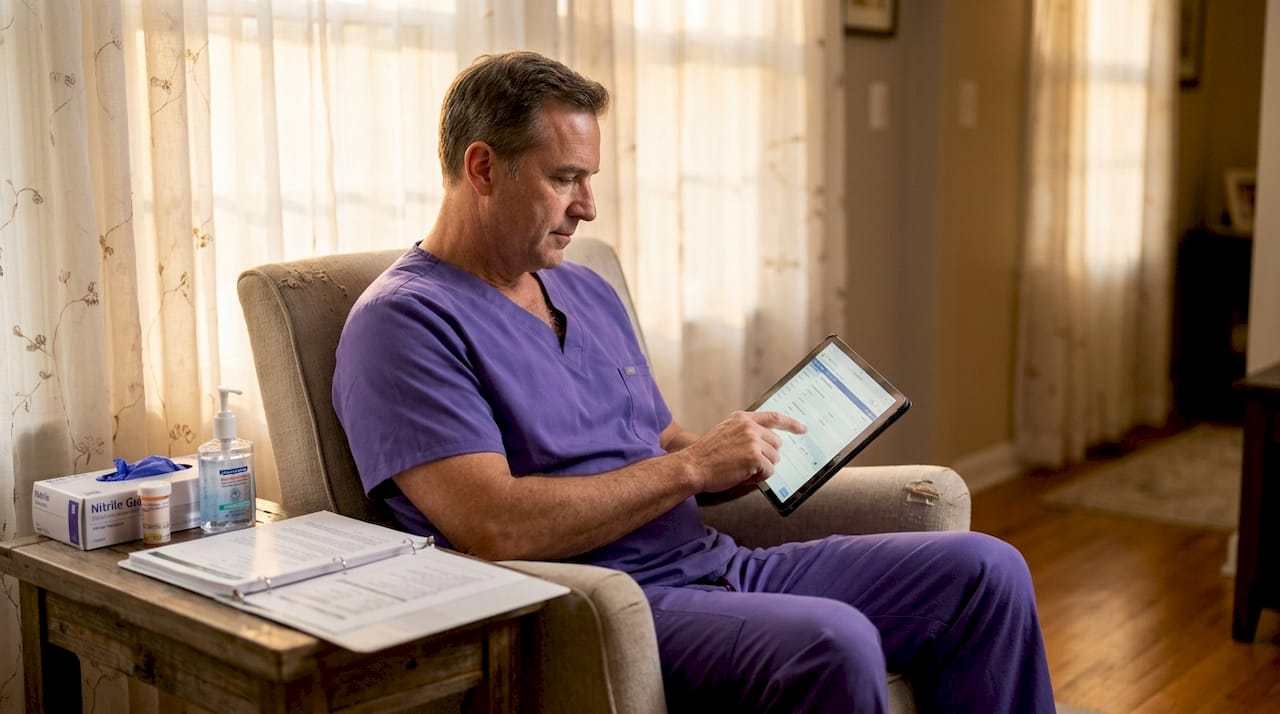
Infection control is one of the most underestimated risks in home care because the environment is uncontrolled. Unlike a hospital, a client’s home may lack a sink near the care area, proper lighting, or consistent product availability. JCI accreditation standards require accredited organizations to provide health care workers with accessible alcohol-based hand products, while also recognizing soap and water as an equally valid alternative.
The CDC specifies that effective hand hygiene means rubbing hands with an alcohol-based sanitizer containing at least 60% alcohol for 20 seconds, or washing with soap and water when hands are visibly soiled. That distinction matters in home care because caregivers often handle personal care tasks that require soap and water, not just a quick sanitizer application. Training staff on when to use each method is as important as ensuring both are available.
- Conduct a home environment assessment at the start of each care relationship to identify hand hygiene access points.
- Equip every caregiver’s kit with a personal bottle of alcohol-based hand rub containing at least 60% alcohol.
- Establish a clear protocol for when soap and water is required versus when hand rub is sufficient.
- Document hand hygiene compliance during supervisory visits, not just during formal audits.
- Retrain any caregiver who receives a compliance flag within 48 hours, not at the next scheduled training cycle.
“Hand hygiene compliance in home care is an operational design problem, not just a training problem. Where the product is stored, who carries it, and how the workflow is structured all determine whether caregivers actually use it.” — JCI guidance on infection prevention design
Pro Tip: Place hand hygiene compliance on the agenda of every team meeting, not just infection control reviews. Normalizing the conversation reduces the stigma of reporting lapses and catches problems earlier.
3. Organizational management practices that drive quality improvement
Quality improvement in home care requires a formal structure, not good intentions. CMS requires a QAPI program as a condition of participation for all Medicare-certified home health agencies, regardless of size or location. QAPI combines retrospective quality assurance with forward-looking performance improvement, which means your agency must both review what went wrong and build systems to prevent recurrence.
JCI Home Care accreditation standards, now in their second edition, increase the focus on patient-centered care and organizational governance. These standards cover everything from how leadership communicates safety priorities to how staff document patient preferences. Accreditation is not just a credential. It is a structured accountability system that forces agencies to align their daily operations with measurable quality benchmarks.
- Designate a QAPI coordinator who reports directly to agency leadership, not through a mid-level manager.
- Review QAPI data monthly at the leadership level, with documented action plans for any metric below target.
- Align your internal quality measures with the 2028 Medicaid HCBS Quality Measure Set, which CMS is developing to standardize metrics around respectful treatment, safety, and individually tailored care.
- Use patient satisfaction surveys as a QAPI data source, not just a marketing tool.
| Management practice | Why it matters |
|---|---|
| Monthly QAPI leadership review | Catches performance gaps before they become compliance violations |
| JCI accreditation alignment | Provides a structured framework for patient-centered governance |
| HCBS quality measure tracking | Prepares agencies for 2028 Medicaid reporting requirements |
| Patient satisfaction integration | Converts subjective feedback into measurable quality indicators |
4. Operational practices that improve caregiving effectiveness
Operational excellence in home care comes down to three factors: scheduling reliability, technology adoption, and caregiver support. Agencies that treat scheduling as an administrative task rather than a clinical function create gaps in care continuity that directly harm patient outcomes. Consistent caregiver assignment, where the same aide visits the same client, reduces medication errors, improves trust, and lowers hospital readmission rates.
Digital tools for scheduling, documentation, and communication have moved from optional to necessary. EHR platforms designed for home care, such as those built around OASIS workflows, reduce documentation time and improve data accuracy. When caregivers spend less time on paperwork, they spend more time on direct care. That shift is measurable in both patient satisfaction scores and staff retention rates.
Caregiver burnout is the single largest threat to workforce stability in the home care sector. Agencies that provide regular supervision, peer support programs, and clear career pathways retain staff at significantly higher rates than those that treat caregivers as interchangeable. The staffing dynamics that affect hospital systems apply equally to home care agencies, where unfilled shifts directly translate to missed care visits.
| Operational area | Standard approach | High-performing approach |
|---|---|---|
| Scheduling | Fill open shifts reactively | Assign consistent caregivers proactively |
| Documentation | Paper or generic EHR | OASIS-integrated digital platform |
| Staff support | Annual performance review | Monthly supervision with peer mentoring |
| Data use | Retrospective reporting | Real-time dashboard monitoring |
Pro Tip: Review your caregiver retention data alongside your patient outcome data quarterly. The two metrics move together. When retention drops, quality follows within 60 to 90 days.
5. Aligning documentation workflows with accreditation standards
The gap between good care and defensible care is documentation. Auditable best practices require aligning clinical documentation and workflows with patient-centered care standards to produce consistent, review-ready evidence. Agencies that document well-meaning but inconsistent care fail audits not because their care was poor, but because their records cannot prove it was adequate.
Mapping each clinical workflow to its corresponding accreditation or regulatory standard is the most direct way to close this gap. For example, every hand hygiene protocol should reference the specific JCI or CDC standard it satisfies. Every OASIS submission should be traceable to the clinical visit that generated it. This level of specificity transforms documentation from a compliance burden into a quality asset. For agencies pursuing home care operational excellence, workflow mapping also reveals inefficiencies that reduce both cost and error rates.
Key takeaways
Effective home care quality standards require integrating regulatory compliance, clinical protocols, and operational systems into a single, consistently executed framework.
| Point | Details |
|---|---|
| OASIS compliance is non-negotiable | CMS requires a 90% QAO compliance rate; falling short triggers direct reimbursement penalties. |
| Hand hygiene is an operational design issue | Product placement and workflow structure determine compliance more than training alone. |
| QAPI is mandatory, not optional | All Medicare-certified home health agencies must maintain a QAPI program as a condition of participation. |
| Documentation must be audit-ready | Aligning workflows to JCI and CMS standards produces defensible, review-ready quality evidence. |
| Caregiver retention drives patient outcomes | Consistent caregiver assignment reduces errors and improves patient satisfaction measurably. |
What I’ve learned from watching agencies get compliance wrong
After years of observing how home care agencies approach quality and compliance, the pattern I see most often is this: agencies invest heavily in training but almost nothing in operational design. They teach caregivers the right hand hygiene technique but never ask whether the sanitizer is actually within reach during a care visit. They train staff on OASIS but never audit whether matched assessment pairs are being submitted on time. The result is a workforce that knows the right answer but operates in a system that makes the right answer hard to execute.
The agencies that consistently outperform their peers share one characteristic. Their leadership treats compliance as a system design problem, not a personnel problem. When a documentation error occurs, the first question is not “who made this mistake?” It is “what in our workflow allowed this mistake to happen?” That shift in framing changes everything, from how errors are reported to how quickly they are corrected.
Technology adoption is the other area where I see consistent underinvestment. Agencies that still rely on paper documentation or generic scheduling software are not just inefficient. They are creating compliance risk with every shift. OASIS-integrated platforms, real-time supervision tools, and digital communication systems are not luxuries. They are the infrastructure that makes consistent, auditable care delivery possible at scale.
The home care services for seniors that families trust most are the ones where operational discipline is invisible to the client but visible in every quality metric. That is the standard worth building toward.
— Michael
How Helping Hands Home Care puts these practices to work
Helping Hands Home Care delivers home health aide services built around the compliance frameworks and clinical standards described in this article. Every caregiver on the Helping Hands team is trained on OASIS documentation requirements, infection control protocols aligned with CDC and JCI guidelines, and the patient-centered care principles that drive QAPI compliance.
For families and agencies seeking care that meets and exceeds home care quality standards, Helping Hands Home Care offers a full spectrum of services, from skilled personal care to therapeutic massage and home cleaning support. The goal is not just regulatory compliance. It is care that clients and families can trust every single day. Visit Helping Hands Home Care to learn how the team supports quality outcomes for elderly clients.
FAQ
What is the OASIS compliance threshold for Medicare home health agencies?
CMS requires home health agencies to meet a 90% compliance rate using the Quality Assessments Only metric, which tracks matched assessment pairs forming complete quality episodes of care. Falling below this threshold results in reimbursement penalties.
When should home care workers use soap and water instead of hand sanitizer?
The CDC specifies that soap and water is required when hands are visibly soiled. Alcohol-based hand rubs containing at least 60% alcohol are appropriate for routine hand hygiene when hands are not visibly contaminated.
Is a QAPI program required for all home health agencies?
Yes. CMS mandates a QAPI program as a condition of participation for all Medicare-certified home health agencies, regardless of agency size or geographic location. The program must combine quality assurance review with active performance improvement.
What does JCI Home Care accreditation cover?
JCI Home Care accreditation, now in its second edition, covers patient-centered care protocols and organizational management standards. It includes measurable elements for quality improvement, patient safety, and leadership accountability across the full care operation.
How does the 2028 Medicaid HCBS Quality Measure Set affect home care agencies?
CMS is developing this measure set to standardize quality metrics for Medicaid-funded home and community-based services, with emphasis on respectful treatment, safety from abuse, and individually tailored care. Agencies should begin aligning their training and staffing practices with these measures now to avoid compliance gaps when the standards take effect.