
At Home Companions: A Family Guide to Companion Care
At Home Companions: A Family Guide to Companion Care
At-home companions are trained, non-medical caregivers who provide scheduled social support, light household help, transportation, and safety supervision for older adults or homebound individuals. The industry term is “companion care,” and it sits one tier below personal care or home health on the care continuum. If your loved one needs company, help around the house, and someone to notice if something seems off, companion care is likely the right fit.
Three things to know before you call anyone:
- Scope: Non-medical only. Companions talk, cook, drive, tidy, and check in, but they do not administer medications or perform wound care.
- Cost: Typical rates run $18–$32 per hour, depending on location and schedule.
- Medicare: Standard Medicare generally does not cover companion care. Medicaid waivers and some Medicare Advantage plans may help.
The fastest next step is a free in-home assessment with Helping-hands-home-care, which serves the metro Detroit area and can usually schedule a consult within days.
Key Takeaways
Companion care is a non-medical, scheduled service that addresses loneliness, daily routine support, and safety monitoring, and choosing the right agency depends on the quality of its assessment process, caregiver vetting, and documentation practices.
| Point | Details |
|---|---|
| What companion care covers | Non-medical support: conversation, meal prep, housekeeping, errands, transportation, and safety checks. |
| Typical cost range | Hourly rates generally fall between $18 and $32, with monthly costs varying by schedule. |
| Medicare coverage | Standard Medicare does not cover companion care; check Medicaid waivers, VA Aid & Attendance, and Medicare Advantage plans. |
| Key hiring red flag | Any agency that skips an in-home assessment before quoting a package is not building a real care plan. |
| Helping-hands-home-care | Serves metro Detroit with structured assessments, matched caregivers, shift documentation, and bundled home services. |
Table of Contents
- What do at-home companions actually do?
- Who benefits from companion care, and what does the research show?
- How do you choose a reputable companion-care agency?
- What does companion care cost, and who pays for it?
- How Helping-hands-home-care delivers companion services
- Trust signals: what Helping-hands-home-care verifies before a caregiver enters your home
- Your rights and responsibilities as a client or family member
- How to monitor quality after you hire
- Why companion care is the most underused tool in aging-in-place planning
- Helping-hands-home-care: local companion care in metro Detroit
- Sources
What do at-home companions actually do?
Companion care covers a wide range of daily support tasks, and knowing where it stops is just as useful as knowing where it starts.
Day-to-day, in-home companions typically handle: conversation and social engagement, meal preparation, light housekeeping, errands and grocery runs, transportation to appointments, medication reminders (not administration), and routine safety checks. For someone with early cognitive decline, a companion might also redirect confusion, support a daily routine, and alert family members when something seems different.
What companions do not do: administer injections or IV medications, perform wound care, provide physical or occupational therapy, or take on the hands-on bathing and dressing tasks that fall under personal care. Crossing those lines requires a different license and a different service tier. Helping-hands-home-care’s home health aide services cover the clinical gap when a loved one’s needs grow.
The table below shows how the three tiers compare at a glance.
| Care type | Typical tasks | Licensing required |
|---|---|---|
| Companion care | Conversation, meal prep, housekeeping, errands, transportation, medication reminders | None (non-medical) |
| Personal care | All companion tasks plus bathing, dressing, grooming, toileting | State-certified aide (CNA or HHA) |
| Home health | Skilled nursing, wound care, therapy, medication administration | Licensed nurse or therapist |
For families weighing light housekeeping as a standalone add-on, Helping-hands-home-care also offers dedicated in-home cleaning visits separate from companion hours.
Who benefits from companion care, and what does the research show?
Companion care tends to deliver the most value for four groups: seniors living alone, adults in early-stage cognitive decline, people recovering from surgery or illness, and adults with physical disabilities who are largely independent but need consistent support.
The loneliness angle is where the evidence gets genuinely interesting. A PMC-published study examined a companion-care program paired with 531 SSBCI recipients (average age 74). Participants also reported modest reductions in mentally and physically unhealthy days. The researchers note the evidence is promising and warrants replication at scale, but the direction is consistent.
Statistic: Many older adults improved their loneliness score after eight or more weeks of companion care, with an average improvement on the loneliness scale.
Pro Tip: Use companion care as a targeted loneliness intervention, not just a convenience. Schedule visits at the times your loved one is most isolated, typically late morning or early afternoon on weekdays, and loop in their primary care provider so companion observations feed into chronic disease management.
The Dwellify Home guide to companion care makes a point worth repeating: continuity matters more than cost-per-hour. Older adults, especially those with mild cognitive impairment, adjust better and feel safer with the same caregiver over time. Familiarity is not a soft benefit; it is a safety feature.

How do you choose a reputable companion-care agency?
The selection process matters more than most families realize. A good agency will not quote you a package over the phone before seeing your loved one; if one does, that is your first red flag.
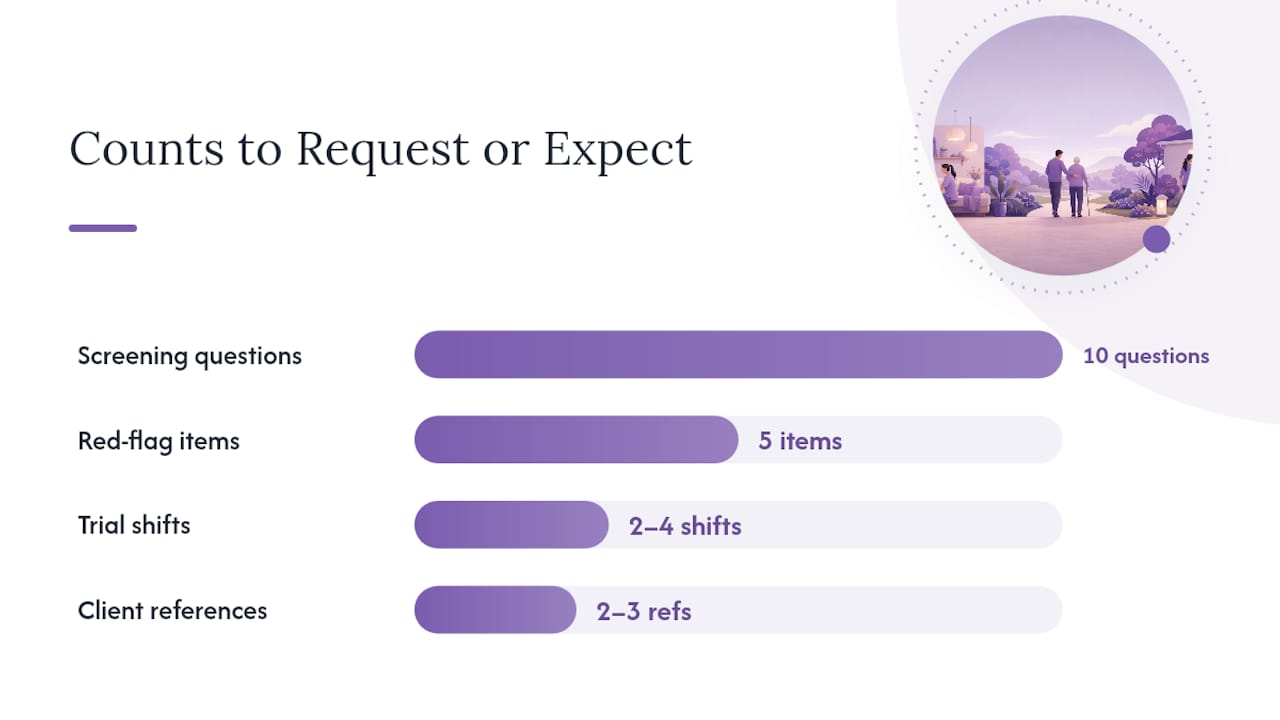
Ten questions worth asking every agency:
- How do you conduct the initial in-home assessment, and who leads it?
- What does your caregiver screening process include (background checks, reference verification, driving record)?
- What training do companions receive before their first solo visit?
- How is the caregiver-to-client match made, and can we request a change?
- What happens if our regular caregiver is sick or unavailable?
- Are visits documented, and how does the family access those notes?
- What is your escalation protocol if a companion notices a health concern?
- Are your caregivers employees or independent contractors, and are they bonded and insured?
- What is your pricing model, and is there a written care agreement?
- Can you provide two or three client references we can call?
According to A Place for Mom’s hiring guide, families should prioritize the quality of communication and the in-home assessment above all else. An agency that skips the assessment is selling a product, not a care plan.
Red flags to watch for:
- No in-home assessment offered before signing a contract
- Vague or evasive answers about background-check procedures
- Refusal to provide client references
- No system for visit documentation or shift notes
- Resistance to a written care agreement
Next Step In Care recommends families also establish clear written agreements and defined escalation protocols from day one, not after a problem surfaces.
Pro Tip: Before committing to a long-term arrangement, ask for 2–4 trial shifts with explicit feedback check-ins after each one. MySageBeam’s caregiver hiring guide recommends writing a one-page role description and asking behavioral interview questions, which gives you a concrete baseline for evaluating fit.
What does companion care cost, and who pays for it?
Hourly rates for in-home companion care typically fall between $18 and $32 per hour, with geographic variation pulling costs higher in metro areas. Overnight and live-in arrangements are priced differently, usually as flat daily or weekly rates.
These are illustrative estimates based on the median of the reported $18–$32 range. Actual rates vary by provider and location.
Who pays:
- Private pay: Most companion care is paid out of pocket by the client or family.
- Medicaid HCBS waivers: Many states offer Home and Community-Based Services waivers that cover companion care for eligible low-income adults. Eligibility and covered hours vary significantly by state.
- VA Aid & Attendance: Veterans and surviving spouses who qualify may receive a pension supplement that can be applied to companion care costs.
- Long-term care insurance: Policies vary widely. Check whether your policy covers non-medical companion services specifically, since some only trigger for personal care or skilled nursing.
- Medicare Advantage (Part C): Standard Medicare does not cover companion care. Some Medicare Advantage plans include supplemental benefits that may cover limited non-medical home support. Coverage depends entirely on the specific plan.
Pro Tip: Before assuming Medicare won’t help at all, check the specific Medicare Advantage plan your loved one carries. Some plans include supplemental home-support benefits under SSBCI or similar programs. The XactInsure Medicare education resource breaks down how Medicare Advantage supplemental benefits work and what to look for in a plan’s Evidence of Coverage document.
How Helping-hands-home-care delivers companion services
Helping-hands-home-care follows a structured process designed to match the right caregiver to each client before the first visit, not after.
The process, step by step:
- Free phone consult: A care coordinator discusses your loved one’s situation, daily routine, and primary concerns.
- In-home assessment: A coordinator visits the home to observe the environment, meet the client, and identify specific needs and preferences.
- Written care plan: Based on the assessment, a documented plan outlines scheduled tasks, visit frequency, and any special considerations.
- Caregiver matching: Helping-hands-home-care selects a companion based on personality fit, skills, and schedule compatibility.
- Ongoing supervision and documentation: Supervisors review shift notes, check in with families, and adjust the care plan as needs change.
Companion-aligned services at Helping-hands-home-care include companionship visits, light housekeeping, meal preparation, and transportation. For clients whose needs extend beyond companion care, the agency also offers home health aide services and in-home therapeutic massage for comfort and well-being.
Helping-hands-home-care serves the metro Detroit area. Scheduling is typically available within a short lead time after the initial assessment. Reach out through the Helping-hands-home-care website to start the conversation.
Trust signals: what Helping-hands-home-care verifies before a caregiver enters your home
Every agency claims to do background checks. What separates a reliable provider is the specificity of those checks and the ongoing quality systems behind them.
What families should expect a reputable agency to document:
- Criminal background check and sex offender registry search
- Driving record check (for companions who provide transportation)
- Reference verification with at least two prior employers or clients
- Proof of bonding and liability insurance
- Documented caregiver training and orientation records
- Signed visit notes after each shift
- Supervisor check-ins at defined intervals
- A written escalation protocol for health or safety concerns
Families who want a deeper checklist for evaluating agency practices can start with the Next Step In Care family guide, which covers what to expect from companions and how to coordinate across care providers.
Your rights and responsibilities as a client or family member
Companion care is a service relationship, and both sides have defined roles. Knowing yours protects your loved one and keeps the arrangement working.
Client and family rights include:
- Receiving a written care agreement before services begin
- Knowing the name and qualifications of the assigned caregiver
- Requesting a caregiver change without penalty
- Accessing visit documentation and shift notes
- Ending the arrangement with reasonable notice per the contract terms
- Filing a complaint with the agency or, for licensed agencies, with the state’s home care licensing board
Family responsibilities include:
- Providing accurate information about the client’s health, behavior, and home environment during the assessment
- Communicating changes in the client’s condition promptly
- Treating caregivers with respect and maintaining a safe work environment
- Paying invoices on the agreed schedule
- Giving adequate notice when canceling or rescheduling visits
One thing families often underestimate: the caregiver’s ability to do their job well depends directly on the quality of information they receive. A companion who does not know about a client’s fall history or medication sensitivities cannot take appropriate precautions. The A Place for Mom hiring guide emphasizes that a structured intake and honest disclosure at the start prevents most of the friction families encounter later.
How to monitor quality after you hire
Hiring a companion is the beginning, not the finish line. Quality assurance is an ongoing process, and families who stay engaged get better outcomes.
Practical monitoring methods:
- Review shift notes weekly. A reliable agency provides written documentation after each visit. Gaps or vague entries (“visited client, all fine”) are worth questioning.
- Call or visit unannounced occasionally. Not to catch anyone out, but to see the natural dynamic between caregiver and client.
- Ask your loved one directly. Even clients with mild cognitive decline can usually express whether they feel comfortable with a caregiver.
- Schedule a 30-day check-in with the agency supervisor. Discuss what is working, what has changed, and whether the care plan needs updating.
- Watch for behavioral changes in your loved one. Withdrawal, anxiety before visits, or reluctance to be alone with the caregiver are signals worth taking seriously.
Agencies should have a formal quality-assurance process, including supervisor home visits at defined intervals and a documented process for handling complaints. If an agency cannot describe its QA process clearly, that is a gap worth probing before you sign anything.
Why companion care is the most underused tool in aging-in-place planning
Most families wait too long. By the time they call an agency, a parent has already had a fall, a health scare, or a noticeable decline in mood and engagement. Companion care works best as a preventive measure, not a crisis response.
The research on loneliness and chronic illness is clear enough to act on: social isolation accelerates health decline in older adults, and a structured companion relationship addresses that directly. What the research does not tell you, but experience does, is that the right companion changes the texture of a person’s day. A client who dreaded mornings starts having something to look forward to. That shift is hard to quantify but easy to observe.
Families sometimes resist companion care because it feels like an admission that something is wrong. It is the opposite. Bringing in a companion while a parent is still largely independent gives them time to build a relationship with the caregiver before they genuinely need more help. That continuity, the same face, the same routine, is what makes the transition to higher levels of care less disorienting when it eventually comes.
Helping-hands-home-care: local companion care in metro Detroit
Families in metro Detroit do not have to sort through a national directory or guess at quality. Helping-hands-home-care offers in-home companion care with a structured assessment, trained caregivers, and documented visits, backed by bundled services including meal preparation, light housekeeping, and therapeutic massage.

What sets Helping-hands-home-care apart from a generic staffing arrangement is the written care plan and ongoing supervision built into every engagement. You are not hiring a stranger off a list; you are working with a local agency that assesses your loved one’s home, matches a caregiver to their personality and routine, and stays accountable through shift documentation and supervisor check-ins.
To get started, visit Helping-hands-home-care to schedule a free in-home assessment. The assessment is the first step toward a written care plan and a matched caregiver, usually within days of your initial call.
Sources
- USING COMPANION CARE TO ADDRESS THE DUAL BURDEN OF LONELINESS AND CHRONIC ILLNESS - PMC
- In-Home Companion Care: Costs, Services & Guide (2026) | AveeCare
- How to Hire an In-Home Caregiver
- UHF Next Step in Care | For Family Caregivers - Guide to working together with home health aides, personal care attendants, companions, and homemakers.
- How to interview and hire an in‑home caregiver for an aging parent