
Macomb County In-Home Care Options: 2026 Guide
Macomb County In-Home Care Options: 2026 Guide
In-home care is defined as professional or family-provided support that helps elderly adults manage daily activities and health needs inside their own home. Macomb County in-home care options span three major program categories: Medicaid’s Home Help Program for non-medical personal care, Medicare home health for skilled nursing and therapy, and MI Choice Waiver for higher-acuity needs. Each program targets a different level of care intensity. Knowing which one fits your family member’s situation is the fastest way to get the right support in place.
What types of in-home care services are available in macomb county?
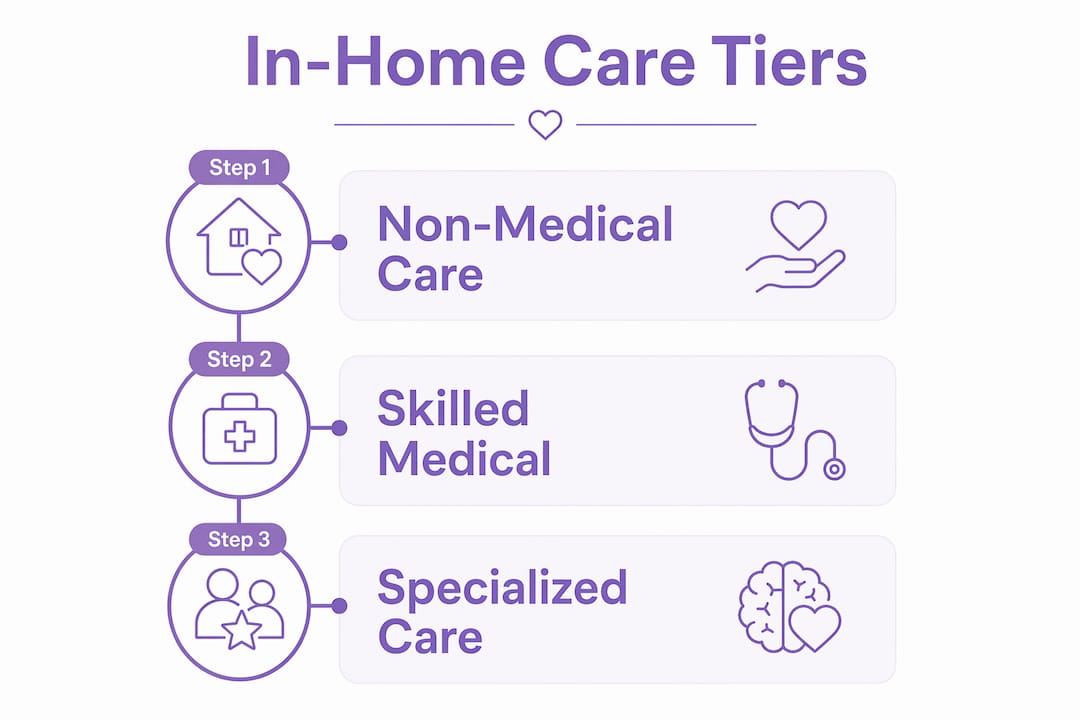
Families typically sort in-home care needs into three tiers: non-medical ADL assistance, intermittent skilled medical services, and nursing-facility-level care delivered at home. Each tier maps to a specific program, and understanding the difference saves weeks of confusion during the application process.
Non-medical personal care
Michigan’s Home Help Program pays for non-medical personal care that assists with activities of daily living (ADLs) and some instrumental activities of daily living (IADLs). The program covers bathing, dressing, toileting, transferring, eating, meal preparation, medication reminders, and light housekeeping. There is no waitlist for Home Help, which makes it one of the most accessible entry points for Macomb County families. Services are authorized based on a formal needs assessment and an individualized service plan.

Skilled medical home care
Medicare home health covers skilled nursing, physical therapy, occupational therapy, speech therapy, and home health aide services when tied to a physician’s certification and an intermittent skilled need. The patient must be homebound and receiving care through a Medicare-certified agency. Medicare does not cover 24-hour care or custodial services provided independently of a skilled visit. Agencies serving Metro Detroit and surrounding counties, including Macomb, provide skilled nursing and therapy for recovery from illness, injury, or surgery.
Specialized and higher-acuity care
The MI Choice Waiver is a 1915© Home and Community-Based Services waiver designed for seniors who need nursing-facility-level care but want to remain at home. It covers personal care, respite, home modifications, and even allows hiring a spouse as a paid caregiver under the Self-Determination Option. This is a critical distinction from Home Help, which excludes spouses from the paid caregiver role.
| Service Type | Program | Covers | Waitlist |
|---|---|---|---|
| Non-medical personal care | Medicaid Home Help | ADLs, IADLs, meal prep | None |
| Skilled nursing and therapy | Medicare Home Health | Nursing, PT, OT, speech | None |
| High-acuity home care | MI Choice Waiver | Personal care, respite, modifications | Yes |
| Integrated dual-eligible care | MI Coordinated Health | Medicare + Medicaid combined | None |
Pro Tip: If your family member needs both non-medical help and skilled nursing, they may qualify for Home Help and Medicare home health at the same time. These programs can run concurrently as long as the services do not overlap.
How do you determine eligibility for macomb county programs?
Matching your family member to the right program starts with an honest assessment of what they can and cannot do independently. ADLs include bathing, dressing, eating, toileting, and mobility. IADLs include managing medications, preparing meals, and handling household tasks. The more limitations present, the more intensive the program required.
Here is a practical way to approach eligibility:
- List every task your family member struggles with. Separate ADL limitations from IADL limitations. This list becomes the foundation of the MDHHS needs assessment.
- Check Medicaid eligibility first. Home Help requires Michigan Medicaid enrollment. Income and asset limits apply. Contact the Michigan Department of Health and Human Services (MDHHS) to confirm eligibility before applying.
- Assess whether skilled care is needed. If a physician has recently ordered nursing visits, wound care, or therapy, Medicare home health may apply. The physician must certify a plan of care and confirm the patient is homebound.
- Evaluate MI Choice Waiver criteria. This waiver targets individuals who would otherwise require nursing facility placement. A formal level-of-care assessment determines eligibility. Note that MI Choice does carry a waitlist in some regions.
- Check for dual-eligible status. Macomb County is included in Michigan’s MI Coordinated Health (MICH) plan, which launched in 2026 and integrates Medicare Parts A, B, and D with Medicaid, including long-term services. MICH carries no premiums and typically no copays for qualifying individuals.
One detail families frequently miss: spouses cannot be paid caregivers under the Home Help Program. This surprises many applicants and delays care planning. If a spouse is the primary caregiver, the MI Choice Self-Determination Option is the correct program to pursue.
Pro Tip: Gather three months of bank statements, proof of income, and your family member’s medical records before contacting MDHHS. Having these documents ready shortens the application timeline significantly.
How do you apply for in-home care services in macomb county?
The application process involves multiple agencies and steps, but it follows a predictable sequence. Moving through it methodically prevents the most common delays.
- Contact MDHHS. Call or visit the Macomb County MDHHS office to begin a Medicaid application or to request a Home Help assessment. You can also apply online through the MI Bridges portal.
- Complete the needs assessment. An MDHHS caseworker will conduct a functional assessment to determine which ADLs and IADLs require support. The authorized service plan is built from this assessment.
- Enroll your caregiver. If a family member will provide care, they must enroll in the Medicaid provider portal, pass a background check, and register in the CHAMPS system. MDHHS pays enrolled caregivers directly via W-2.
- Set up electronic visit verification. Michigan requires caregivers to log hours through the MI Time system. This is a federal compliance requirement, not optional. Failure to comply delays payment.
- For Medicare home health, get a physician referral. The physician must certify the plan of care and confirm homebound status. The referral goes to a Medicare-certified agency, which then schedules an intake assessment.
- For MI Choice, contact your local Area Agency on Aging. In Macomb County, the Area Agency on Aging 1-B manages MI Choice Waiver enrollment. They coordinate the level-of-care assessment and waitlist placement if applicable.
Common pitfalls to avoid:
- Skipping the formal assessment and assuming eligibility based on age alone
- Hiring a caregiver before completing Medicaid enrollment, which voids reimbursement
- Missing electronic visit verification deadlines, which interrupts payment
- Failing to notify MDHHS of changes in the care recipient’s condition or income
Family vs. professional caregivers: which is right for your situation?
Choosing between a family caregiver and a professional home care agency is one of the most personal decisions in this process. Both options have real advantages and real limitations.
Non-spouse family members can be paid under the Home Help Program at a 2026 rate of $17.13 per hour. That rate combines Michigan’s minimum wage with a Medicaid pass-through amount. This makes paid family caregiving a financially viable option for many Macomb County households. Spouses, however, must use the MI Choice Self-Determination Option to receive payment.
Family caregiver advantages:
- Familiar relationship reduces stress for the care recipient
- Flexible scheduling around family routines
- Eligible for Medicaid payment under Home Help or MI Choice
Family caregiver considerations:
- Requires formal enrollment, background checks, and time verification compliance
- Caregiver burnout is a real risk without respite support built into the plan
- Spouses are excluded from Home Help payment rules
Professional agency advantages:
- Agencies handle scheduling, backup coverage, and compliance
- Staff are trained in dementia care, post-surgery recovery, and specialized needs
- Easier to scale care up or down as needs change
Professional agency considerations:
- Higher hourly cost if not covered by Medicaid or Medicare
- Less personal relationship with the care recipient initially
For a detailed walkthrough of the hiring process, the guide on hiring an in-home caregiver covers both family and agency routes step by step.
Pro Tip: Even if a family member provides most of the care, consider adding a professional agency for a few hours per week. This gives the family caregiver scheduled time off and reduces the risk of burnout, which is the leading reason care arrangements break down.
What challenges should you expect with macomb county home care?
Accessing in-home care services in Macomb County is manageable, but several friction points catch families off guard. Knowing them in advance makes the process far less stressful.
- MI Choice waitlists. Unlike Home Help, MI Choice carries a waitlist in some areas. Apply early, even if your family member does not yet need that level of care. The Area Agency on Aging 1-B can advise on current wait times.
- Medicare coverage gaps. Medicare home health does not cover custodial care provided outside of a skilled visit. Families who expect Medicare to pay for ongoing personal care assistance are often disappointed. Understanding the difference between home care types prevents this misunderstanding.
- Coordinating multiple programs. A senior may receive Home Help for personal care and Medicare home health for skilled nursing simultaneously. Keeping track of two separate authorization systems, two sets of providers, and two billing processes requires organization. A simple shared calendar and a designated family point of contact help significantly.
- Caregiver turnover. Professional agencies experience staff changes. Build a relationship with the agency supervisor, not just the individual caregiver, so transitions are handled smoothly.
- Program changes after reassessment. MDHHS reassesses Home Help recipients periodically. A change in health status can increase or decrease authorized hours. Attend every reassessment and bring updated medical documentation.
Key takeaways
Matching your family member’s care needs to the right Macomb County program is the single most important step in building a sustainable, affordable care plan.
| Point | Details |
|---|---|
| Three-tier care model | Match care needs to Home Help, Medicare home health, or MI Choice based on care intensity. |
| No waitlist for Home Help | Medicaid’s Home Help Program has no waitlist and covers ADLs, IADLs, and light housekeeping. |
| Spouse payment rules | Spouses cannot be paid under Home Help; use MI Choice Self-Determination instead. |
| Family caregiver pay rate | Non-spouse family caregivers earn $17.13 per hour in 2026 under Medicaid Home Help. |
| MICH for dual eligibles | Macomb County residents eligible for both Medicare and Medicaid can enroll in MI Coordinated Health for integrated, low-cost coverage. |
What i’ve learned watching families navigate this system
Most families I’ve seen come into this process with one assumption that costs them time: they believe Medicare covers everything. It does not. Medicare home health is powerful for recovery from surgery or acute illness, but it stops the moment skilled care is no longer needed. The ongoing personal care that most elderly adults need every day falls squarely on Medicaid programs like Home Help.
The second thing I’ve noticed is that families wait too long to apply. Home Help has no waitlist, so there is no reason to delay. MI Choice does have a waitlist, which means applying six months before you think you need it is not early. It is exactly right.
The paid family caregiver rules are genuinely confusing, and the spouse exclusion under Home Help catches people off guard every time. If a spouse is the primary caregiver, MI Choice Self-Determination is the path forward. Knowing this before you apply saves weeks of back-and-forth with MDHHS.
My honest advice: treat this like a project with a checklist, not a phone call you make once. Document every conversation, keep copies of every form, and designate one family member to own the process. The families who do that get care in place faster and with far less frustration.
— Michael
How Helping-hands-home-care supports macomb county families
Helping-hands-home-care provides personal care, housekeeping, and massage therapy services for elderly adults in Macomb County. Whether your family member needs help with daily activities or supplemental support alongside a Medicaid or Medicare program, the team at Helping-hands-home-care builds a care plan around your specific situation.
Explore the full range of home care services available through Helping-hands-home-care, or learn more about home health aide support for Medicaid-funded personal care in Macomb County. Contact Helping-hands-home-care directly to schedule a consultation and get a personalized recommendation based on your family member’s needs and program eligibility.
FAQ
What is in-home care for elderly adults?
In-home care is professional or family-provided support that helps elderly adults with daily activities, personal care, and health management inside their own home. Services range from non-medical ADL assistance to skilled nursing and therapy.
Does medicare cover in-home personal care in macomb county?
Medicare covers skilled nursing and therapy at home but does not cover ongoing custodial personal care unless it is provided alongside a skilled visit. Non-medical daily assistance is covered by Medicaid’s Home Help Program instead.
Can a family member get paid to care for a parent in macomb county?
Yes. Non-spouse family members can be paid $17.13 per hour in 2026 under Michigan’s Home Help Program after completing Medicaid enrollment, a background check, and electronic visit verification registration.
Is there a waitlist for macomb county in-home care programs?
Michigan’s Home Help Program has no waitlist. The MI Choice Waiver, which covers higher-acuity care, does carry a waitlist in some areas, so applying early through the Area Agency on Aging 1-B is strongly recommended.
What is MI coordinated health and who qualifies in macomb county?
MI Coordinated Health (MICH) is a 2026 integrated plan for Macomb County residents who qualify for both Medicare and Medicaid. It combines Medicare Parts A, B, and D with Medicaid long-term services, with no premiums and typically no copays.
Recommended
- Top 5 Helpinghandhealthcare.com Alternatives Providers 2026 | Helping Hands Home Care
- Top 6 Procareunlimited.com Alternatives Providers 2026 | Helping Hands Home Care
- Home Care Services for Seniors: A Family Guide | Helping Hands Home Care
- Helping Hands Home Care | Compassionate Support, Every Step of the Way.