
What a Structured Care Schedule Does for Seniors and Dementia Patients
What a Structured Care Schedule Does for Seniors and Dementia Patients

A structured care schedule reliably reduces anxiety and agitation, improves sleep quality, boosts engagement and cognition, cuts behavioral symptoms in dementia, and lowers the hours a family caregiver spends managing crises rather than living. These aren’t soft claims. A randomized trial of activity scheduling in community-dwelling adults with dementia found caregiver hours dropped by roughly one hour per day (https://alz-journals.onlinelibrary.wiley.com/doi/10.1002/alz.036353), with moderate effect sizes for reduced caregiver burden and behavioral symptoms.
That single hour matters more than it sounds. Over a month, it’s 30 hours back. Over a year, it can be the difference between a caregiver holding a job and quitting one.
Early success on a structured schedule usually looks small: fewer “sundowning” episodes in the late afternoon, a parent who eats breakfast without being coaxed, a night without three wake-ups. Those are the signals worth tracking before you look for anything dramatic.
- Reduced anxiety and agitation from predictable anchor points
- Better sleep from consistent wake, meal, and light timing
- Sharper engagement through scheduled, meaningful activity
- Fewer behavioral and psychological symptoms of dementia
- Measurably lower caregiver hours and burden
If you’re building one from scratch, skip ahead to the step-by-step section below. If you want the evidence first, keep reading.
Key Takeaways
A structured care schedule reduces anxiety, improves sleep, boosts engagement, lowers dementia behavioral symptoms, and cuts caregiver hours by roughly one hour daily in controlled trials.
| Point | Details |
|---|---|
| Anchor points over rigid timing | Use consistent meals, wake times, and activities rather than a minute-by-minute clock. |
| Caregiver hours drop measurably | Activity scheduling trials show about a one-hour daily reduction in required caregiving. |
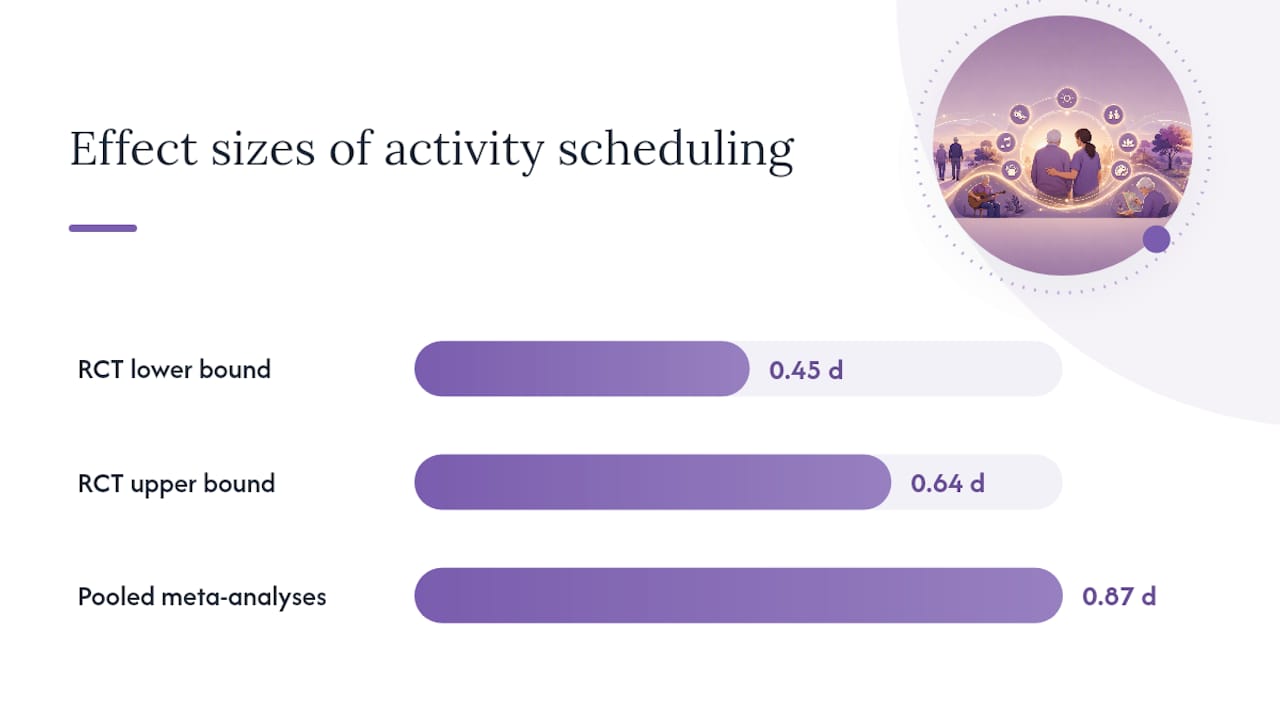
| Effect sizes are moderate to large | Behavioral symptom and burden improvements range from Cohen’s d 0.45 to 0.87 across studies. |
| Personalize, don’t standardize | National Institute on Aging guidance stresses flexible plans tailored to the individual. |
| Track concrete metrics | Watch sleep, mood logs, activity participation, and caregiver hours to judge success. |
Table of Contents
- Benefits of a Structured Care Schedule for Health and Wellbeing
- What the Research Actually Shows
- Why Structure Works: The Behavioral Science Behind It
- How to Build a Structured Care Schedule That Actually Sticks
- Common Mistakes and How to Know the Schedule Is Working
- How Helping-hands-home-care Supports a Structured Routine
- Ready to Put a Structured Schedule Into Practice?
- An Editorial Take on Structure Versus Rigidity
- Frequently Asked Questions
- Sources
Benefits of a Structured Care Schedule for Health and Wellbeing
The advantages of care scheduling show up in five distinct areas, and each one has a mechanism behind it, not just an association.
Reduced anxiety and agitation
Predictability calms the nervous system. When a senior knows breakfast follows waking, and a walk follows breakfast, the brain doesn’t have to work to figure out what’s next. For someone with dementia, that uncertainty is a major driver of agitation. Anchor points, consistent, meaningful markers like a morning coffee ritual or a set lunch hour, give the day a shape the person can lean on even when memory can’t be trusted.

Better sleep and circadian regulation
Sleep problems in older adults are rarely random. They’re often the downstream effect of an inconsistent day: naps at odd hours, meals at variable times, and unpredictable light exposure. A structured care schedule that anchors wake time, meals, and outdoor or bright-light time reinforces the body’s internal clock. Sleep tends to consolidate when the inputs that regulate it, light, food, activity, happen at the same time daily.
Cognitive and functional engagement
Scheduled, purposeful activity isn’t busywork. Activity scheduling, a technique borrowed from behavioral treatment for depression, has been adapted for dementia care with strong results. A pooled analysis of activity-scheduling trials found large effects on activity engagement itself, and the randomized trial on activity scheduling showed improved participation alongside reduced behavioral symptoms. The mechanism is habit training: repeated, structured practice at tasks like dressing or grooming can surface skills a person still has but rarely uses unprompted.
Fewer behavioral and psychological symptoms
Clinicians refer to agitation, wandering, resistance to care, and mood swings in dementia collectively as BPSD, behavioral and psychological symptoms of dementia. These symptoms often spike when routines break down, not randomly. The same trial that measured caregiver hours also found moderate effect sizes, in the range of Cohen’s d 0.45 to 0.64, for reductions in these symptoms when structured activity scheduling replaced unstructured days.
Lower caregiver burden and better secondary outcomes
This is the benefit families feel first. A schedule that anticipates medication windows, meals, and activity means fewer emergency decisions and less improvisation. Improvisation is where caregiver burnout lives. Secondary gains follow naturally: medications get taken on time because the window is built into the day, and nutrition improves because meals aren’t skipped during chaotic stretches.
Quick snapshot of measurable impact: Activity scheduling trials link structured routines to about one fewer hour of required caregiving per day and moderate reductions in both behavioral symptoms and caregiver strain, according to the community-dwelling dementia trial.
- Anxiety and agitation: reduced through predictable anchor points
- Sleep: improved via consistent circadian cues
- Cognition and engagement: boosted by structured, meaningful activity
- BPSD: measurably lower with activity scheduling
- Caregiver burden: reduced hours and lower reported strain
What the Research Actually Shows
The strongest evidence for structured care advantages comes from a 100-participant randomized controlled trial of activity scheduling in community-dwelling older adults with dementia, split into 50 experimental and 50 control participants. Caregiver hours in the experimental group fell by about one hour per day (https://alz-journals.onlinelibrary.wiley.com/doi/10.1002/alz.036353), and effect sizes for caregiver burden and behavioral symptoms landed between 0.45 and 0.64, a moderate range by conventional standards.
A separate randomized trial reinforced the pattern: activity scheduling improved participation, reduced behavioral and psychological symptoms, and lowered caregiving demand, with meta-analyses of activity scheduling showing pooled effects on activity engagement reaching as high as 0.87 in some analyses. That’s a large effect by research standards, on par with what you’d expect from a well-run behavioral intervention in clinical psychology.
That’s the honest caveat. A clinical review of non-pharmacological interventions found inconsistent results across different outcome measures, which is why the National Institute on Aging recommends personalized, flexible plans built around anchor points rather than one-size-fits-all timetables.
| Study | Sample | Key measured outcome |
|---|---|---|
| Activity scheduling RCT (community-dwelling adults with dementia) | 100 participants (50/50 split) | Caregiver hours dropped ~1.0/day; effect sizes 0.45 to 0.64 |
| RCT of activity scheduling for older adult caregiving | Randomized design, meta-analytic support | Improved participation, reduced BPSD, pooled effects up to 0.87 |
| Non-pharmacological interventions review | Systematic review, multiple studies | Mixed results; short-term gains in mood and cognition when personalized |
What does a Cohen’s d of 0.45 to 0.64 mean in practical terms? It’s not a cure, and it won’t erase dementia’s course. It’s the kind of shift that turns three bad afternoons a week into one, or that lets a caregiver sleep through the night more often than not. Moderate effects, compounded daily over months, are how families actually experience relief.
Why Structure Works: The Behavioral Science Behind It
Structured caregiving benefits trace back to a handful of well-understood mechanisms, not magic.
Decision fatigue reduction is the biggest one. Every choice a caregiver or a person with dementia has to make, what to eat, when to bathe, what to do next, draws on a limited pool of mental energy. A fixed rhythm for the basics removes dozens of small decisions from the day, freeing that energy for the choices that actually need judgment.
Habit training and procedural memory explain why routines work even as short-term memory fails. Procedural memory, the kind that governs learned physical sequences, tends to survive longer than episodic memory in dementia. A behavioral rehabilitation study in nursing home residents found that repeated cueing at the same time and place increased participation in daily activities and reduced disruptive behavior, even among residents with severe cognitive impairment.
Environmental anchors, regular meals, consistent light exposure, familiar social contact, act as orientation markers when internal time-sense is unreliable. A senior who can’t tell you what day it is often still knows that lunch means the day is halfway over.
Activity and social engagement support mood directly. Isolation compounds cognitive decline, while scheduled contact, even something as simple as a daily phone call at the same hour, gives structure a social dimension that pure timing can’t provide.
- Automate small choices to conserve cognitive energy for what matters
- Use repeated cues to activate procedural memory, not instructions
- Anchor the day with meals, light, and social contact, not a clock
- Build in daily engagement to protect mood and slow isolation
Pro Tip: Don’t aim for a rigid timetable. Aim for a rhythm: the same three or four anchor points every day, with everything else flexible around them.
How to Build a Structured Care Schedule That Actually Sticks
Designing a workable schedule starts with anchors and works outward. Here’s the order that holds up in practice.
- Set your anchor points first. Wake time, meals, medication windows, and bedtime. These four or five markers are the skeleton; everything else hangs off them.
- Add one or two meaningful activities daily. A walk, a puzzle, folding laundry, whatever the person still enjoys or can partially do. Use activity scheduling: introduce the activity at the same time each day so it becomes expected rather than negotiated.
- Apply habit training to daily living tasks. For dressing, bathing, or grooming, use the same sequence and cues every time. Visual cues, like laying out clothes in the order they go on, work better than verbal instructions for someone with dementia.
- Simplify choices at decision points. Offer two outfits, not a closet. Offer two meal options, not a menu. This is decision fatigue reduction applied directly.
- Build in flexibility and fallback options. Plan a backup activity for bad days, and accept that the schedule bends around health, mood, and weather. Rigidity is where these plans break.
- Schedule caregiver breaks with the same seriousness as medication times. Caregiver burnout undermines the whole structure faster than any single missed nap.
- Visual schedules with pictures or large print for those with visual or cognitive limits
- Phone or tablet reminders for medication and appointment windows
- A simple checklist taped inside a cabinet for morning and evening routines
- A written care-plan template to revisit and adjust monthly
If you want a starting point rather than a blank page, Helping-hands-home-care’s professional home care plan examples walk through real daily structures families have used, and the ADL support guide breaks down habit training techniques for dressing, bathing, and grooming specifically.
Common Mistakes and How to Know the Schedule Is Working
The most common failure mode is over-rigidity. A schedule built like a military timetable, minute-by-minute transitions, no room for a bad day, tends to increase distress rather than reduce it, especially for someone with dementia who can’t always meet a strict clock. Watch for signs the schedule itself is the problem: more resistance at transition points, not less, or agitation that spikes right before a scheduled activity rather than during unstructured time.
Access and equity gaps are real too. Not every family has a smartphone app or a home health aide on call. Low-cost alternatives still work: a simple wall calendar, a landline call at the same hour each day from a neighbor or family member, or paper checklists taped where they’re visible. Programs through Medicare and Medicaid services can also help offset costs for families who qualify.
Track a handful of concrete indicators rather than guessing:
- Mood and behavior logs, even a one-line note per day
- Sleep quality, hours and number of night wakings
- Activity participation, did the planned activity happen
- Caregiver hours per day, rising or falling
- Missed medication doses
The community-dwelling dementia trial used caregiver hours as its primary outcome measure precisely because it’s concrete and easy to track week over week. If caregiver hours are climbing despite a schedule in place, or if behavioral symptoms are getting worse rather than better, that’s the signal to loop in a physician or care manager rather than keep adjusting alone.
How Helping-hands-home-care Supports a Structured Routine
Building the schedule is one thing. Sustaining it every single day is another, and that’s usually where families need backup.
- Home health aides handle the daily anchor points directly, morning routines, medication timing, and ADL support, so the schedule doesn’t depend on one exhausted family member.
- House cleaning services keep the home environment safe and predictable, reducing fall hazards and clutter that can disrupt routine.
- Meal preparation locks in consistent meal timing, one of the strongest anchors for circadian regulation and medication adherence.
- Therapeutic massage can be scheduled into the week to support comfort, mobility, and relaxation as part of a broader routine.
For families weighing structure options further, the guide on dementia care types at home and the home preparation safety guide both cover practical groundwork worth reading before finalizing a schedule.
Ready to Put a Structured Schedule Into Practice?
Reading about structured care advantages is one step. Having someone actually run the anchor points every day is the part that keeps families from burning out. Helping-hands-home-care’s home health aide services build daily routines around medication timing, meals, and meaningful activity for seniors across the metro Detroit area, so the structure holds even on the days a family caregiver can’t be there. Pairing that with house cleaning services keeps the home environment safe enough that the routine doesn’t get derailed by clutter or fall risk. If comfort and mobility are part of the goal, therapeutic massage fits naturally into a weekly rhythm too.
An Editorial Take on Structure Versus Rigidity
The evidence here doesn’t support the popular idea that more structure is always better. It supports something narrower and more useful: the right anchors, applied consistently, beat both chaos and rigidity. Where conventional advice falls short is treating “schedule” as synonymous with “timetable.” The trials that actually moved the needle on caregiver hours and behavioral symptoms weren’t built on strict clock time. They were built on predictable sequences and meaningful activity.
What gets overlooked most is the flexibility clause. Families often abandon structure entirely after one bad day, when the fix was never rigidity in the first place, it was building a fallback option into the plan from the start. Prioritize the four or five anchor points that matter most: waking, meals, medication, and one activity the person genuinely enjoys. Everything else can bend. That’s not a compromise on the research. It’s what the research actually recommends.
Frequently Asked Questions
What are the main benefits of a structured care schedule for someone with dementia? The core advantages of care scheduling include reduced anxiety and agitation, better sleep, improved engagement and cognition, fewer behavioral and psychological symptoms, and measurably lower caregiver hours, supported by randomized trial data.
How strict does a structured care schedule need to be? It shouldn’t be strict at all in the sense of exact clock times. Effective structured caregiving benefits come from consistent anchor points, meals, wake time, activities, not rigid minute-by-minute timing, which can increase distress rather than reduce it.
Can a structured schedule really reduce caregiver burden? Yes. A randomized trial found activity scheduling reduced caregiver hours by about one hour per day, with moderate effect sizes for reduced caregiver burden and behavioral symptoms in dementia.
How do I know if a care routine is actually working? Track sleep quality, mood and behavior logs, activity participation, missed medications, and caregiver hours. Improvement in most of these over two to four weeks suggests the structured care advantages are taking hold.
Should I adjust the schedule if my parent resists it? Resistance at transition points often signals over-rigidity rather than a bad idea. Build in flexibility and fallback activities first; if resistance persists or worsens, involve a physician or care manager for a medical review.
This article is general information, not a substitute for advice from a qualified doctor. Consult a qualified healthcare professional about your own circumstances before acting on anything here.
Sources
- Activity scheduling for community-dwelling older adults with dementia (trial report)
- A randomized control trial of activity scheduling for caring for older adults with dementia
- NIA dementia care and caregiver guidance
- Non-pharmacological interventions for people living with dementia (clinical review)
Recommended
- How Cleaning Services Protect Elderly Safety at Home | Helping Hands Home Care
- Types of Dementia Care at Home: A Family Guide | Helping Hands Home Care
- How to Prepare Home for Caregiver: 2026 Safety Guide | Helping Hands Home Care
- In-Home Cleaning Benefits for Elderly: 2026 Guide | Helping Hands Home Care