
How to Choose the Right Home Care Agency for Your Family
How to Choose the Right Home Care Agency for Your Family

The most important decision you’ll make when selecting a home care agency involves key factors like licensing, staff screening, care plan personalization, supervision protocols, caregiver continuity, and cost transparency. Get those right, and you’ve eliminated most of the risk. Skip even one, and you may find yourself scrambling to switch agencies mid-care, which is disruptive for everyone, especially your loved one.
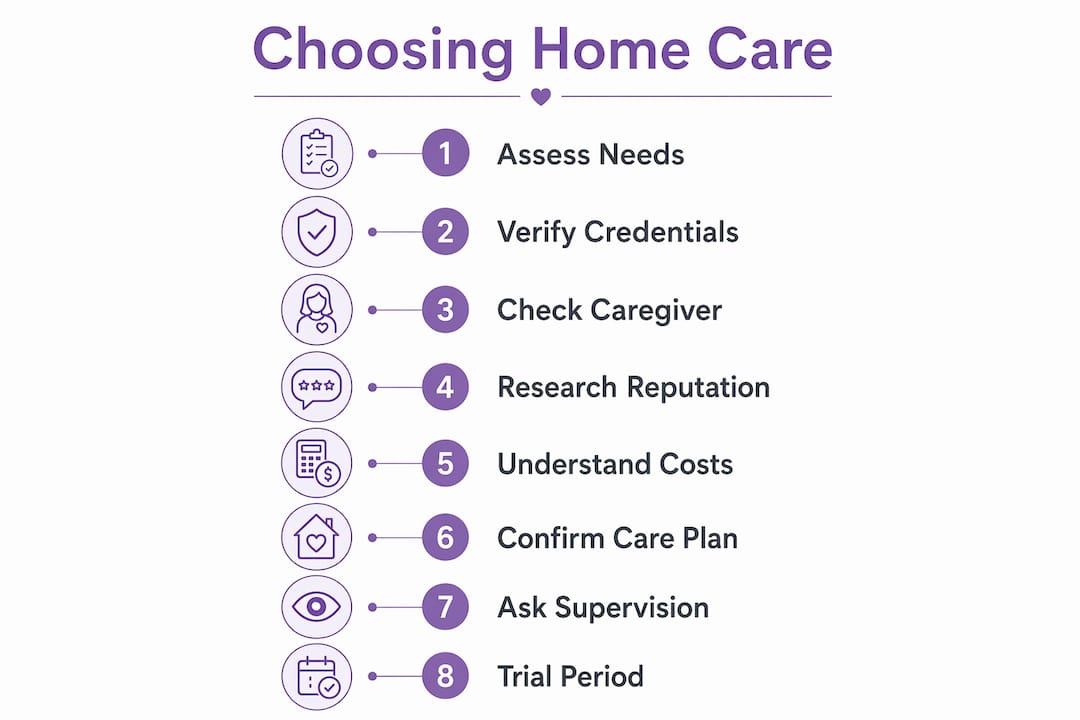
Here’s a quick checklist to anchor your evaluation before diving deeper:
- Licensing and certification: Confirm state licensure and Medicare/Medicaid certification
- Staff screening: National criminal background checks, reference verification, and ongoing training
- Written care plan: Personalized, family-reviewed, and updated regularly
- Supervision protocols: Formal written policy with defined visit or contact frequency
- Caregiver continuity: Ask directly about retention rates and backup staff procedures
- Cost transparency: Written fee schedule, billing terms, and accepted payment types before signing
- Emergency access: Live contact available 24 hours a day, 7 days a week
Table of Contents
- 1. How do you assess your loved one’s care needs before choosing an agency?
- 2. How do you verify an agency’s qualifications and certifications?
- 3. What should you look for in caregiver credentials and agency support?
- 4. How do you research an agency’s reputation and client feedback?
- 5. How do you understand home care costs and avoid hidden fees?
- 6. Why does a personalized written care plan matter so much?
- 7. What questions should you ask agencies about supervision and emergency coverage?
- 8. How should you arrange and evaluate a trial care period?
- Helping-hands-home-care offers the care your family deserves
- Key Takeaways
1. How do you assess your loved one’s care needs before choosing an agency?
Start here, before you call a single agency. The type of care your loved one needs determines which agencies are even worth contacting. Personal care covers bathing, dressing, and meal preparation. Skilled nursing involves wound care, medication management, or post-surgical monitoring. Specialized care addresses conditions like dementia, Parkinson’s, or stroke recovery. These are not interchangeable services, and not every agency offers all three.
Once you know the care type, figure out the schedule. Does your loved one need a few hours of help each morning, or round-the-clock supervision? Some agencies require minimum weekly hours, so your schedule needs to match their model before you commit.
Budget planning is where families often get caught off guard. Payment options are complex, typically involving a mix of long-term care insurance, VA benefits, Medicaid, and out-of-pocket spending. Clarifying what your insurance actually covers before signing any agreement prevents financial surprises down the road. For a detailed breakdown of what to expect, the Medicare options guide from XactInsure is a useful starting point for families navigating coverage.
Key questions to answer before contacting agencies:
- What type of care is needed: personal, skilled, or specialized?
- How many hours per day or week, and on which days?
- What is the realistic monthly budget, including insurance offsets?
- Are there language, cultural, or dietary preferences to accommodate?
2. How do you verify an agency’s qualifications and certifications?
Licensing sets a legal floor, not a quality ceiling. A state license tells you an agency met minimum standards to operate. It does not tell you whether they deliver good care. Licensing establishes minimum legal standards but does not guarantee quality; accreditation and client feedback fill that gap.

Medicare certification is a meaningful differentiator. Medicare-certified home health agencies must meet federal Conditions of Participation, which include supervisory visit requirements that many non-medical home care providers simply are not held to. You can verify Medicare certification directly through Medicare Care Compare, the official federal database. Hospital discharge planners are required to provide unbiased agency lists, but independently verifying quality scores through Medicare Care Compare is always worth doing yourself.
Accreditation from bodies like The Joint Commission or the Accreditation Commission for Health Care (ACHC) signals that an agency voluntarily submitted to a higher standard of review. It is not required, but its presence is a positive indicator.
What to verify before moving forward:
- State licensure (check your state’s health department registry)
- Medicare and/or Medicaid certification via Medicare Care Compare
- Voluntary accreditation from The Joint Commission or ACHC
- Whether caregivers are W-2 employees or 1099 contractors
That last point carries real legal weight. Using 1099 contractors often shifts payroll and injury liabilities onto the client family. An agency that employs its caregivers directly takes on those responsibilities, which is a meaningful protection for you.
3. What should you look for in caregiver credentials and agency support?
An agency is only as good as the people it sends into your home. Start with screening. A reputable agency conducts comprehensive national criminal background checks on every caregiver, not just local county-level searches. Confirming that the agency runs national background checks, verifies references, carries bonding and liability insurance, and provides written care plans before starting care is a non-negotiable vetting step.

Beyond screening, ask about ongoing training. Caregivers working with dementia patients, for example, should have specific dementia care training, not just general home care certification. Ask whether training is required annually and whether it covers condition-specific scenarios.
Supervision matters just as much as initial screening. A reputable agency maintains a formal written supervision protocol that specifies how often supervisors visit or contact caregivers in the field. Transparency here is a direct indicator of accountability.
Questions to ask about staff and support:
- Are background checks national in scope?
- What certifications do caregivers hold, and how is training updated?
- How often do supervisors check in on active caregivers?
- What happens if a caregiver calls in sick or doesn’t show up?
4. How do you research an agency’s reputation and client feedback?
Online reviews are a starting point, not the whole picture. Google ratings and reviews can surface patterns, but a single bad review means less than a pattern of complaints about the same issue, such as missed shifts or poor communication. Look for recurring themes across multiple platforms before drawing conclusions.
Ask the agency directly for client references, and actually call them. Ask those references whether the same caregiver showed up consistently, how the agency handled problems, and whether they would hire the agency again. Those three questions reveal more than any star rating.
Caregiver retention rates are a vital but often overlooked measure. High turnover correlates with lower client satisfaction and disrupted routines. An agency that has kept its caregivers for years is telling you something real about its work environment and management.
What to look for across reputation sources:
- Consistent praise or complaints across Google, Yelp, and senior care directories
- Willingness to provide and stand behind client references
- Transparency in how the agency handles complaints and resolves disputes
- Length of time in business and caregiver retention as stability signals
Pro Tip: Ask the agency for its average caregiver tenure. An agency where caregivers stay for two or more years is a fundamentally different operation than one with constant turnover, regardless of what its marketing materials say.
5. How do you understand home care costs and avoid hidden fees?
Get everything in writing before you sign. A trustworthy agency provides a clear, itemized fee schedule upfront, including hourly rates, overtime charges, holiday rates, and minimum service hour requirements. Vague verbal estimates are a warning sign.
Contract review should cover cancellation policies, fee change notifications, minimum service hours, and no-show guarantees. Written contracts protect you from unexpected costs and staffing gaps. If an agency resists putting terms in writing, that tells you something.
Payment sources vary widely. Long-term care insurance, VA benefits, and Medicaid each have different eligibility rules and coverage limits. For a full picture of how to navigate home care payment options, including what each source typically covers, it’s worth reviewing the specifics before your first agency call.
Cost and billing checklist:
- Written fee schedule with all rate categories included
- Accepted payment types: private pay, long-term care insurance, VA benefits, Medicaid
- Cancellation and no-show policies in writing
- Process for notifying families of rate changes
6. Why does a personalized written care plan matter so much?
A care plan is not a formality. It is the document that defines what your loved one receives, when, and how. A thorough written care plan includes daily tasks, medical needs, emergency contacts, dietary preferences, and behavioral notes. It should also specify who in the family reviews and approves it. A personalized written care plan that includes family input and regular revisions promotes better outcomes and gives families a concrete reference point when something goes wrong.
Caregiver continuity ties directly to care plan effectiveness. When the same caregiver works with your loved one consistently, they learn that person’s routines, preferences, and early warning signs. Continuity of the same caregiver greatly benefits seniors, and agencies with frequent staff turnover disrupt that trust and familiarity.
Care plans should also evolve. A plan written in January may not reflect your loved one’s condition in July. Ask the agency how often plans are formally reviewed and what triggers an unscheduled update, such as a hospitalization or a significant change in condition.
What a strong care plan includes:
- Daily tasks and care schedule with specific caregiver assignments
- Medical needs, medications, and condition-specific protocols
- Emergency contacts and escalation procedures
- Family review process and revision schedule
For practical examples of what a well-structured plan looks like, the professional care plan examples from Helping-hands-home-care show how these documents translate into day-to-day care.
7. What questions should you ask agencies about supervision and emergency coverage?
The vetting conversation with an agency should go beyond brochure-level answers. Ask specific questions and pay attention to how the agency responds. Hesitation or vague answers to direct questions about supervision and emergency protocols are red flags.
Effective agencies provide 24/7 availability of a live contact for emergencies with clear escalation procedures and defined response times. An answering machine after hours is not adequate for families managing serious health conditions.
High caregiver turnover is a critical red flag because inadequate backup staff causes care disruptions when caregivers are sick or unavailable. Ask agencies for documented retention rates and their specific no-show replacement policy, including how quickly a replacement arrives.
Questions to ask directly:
- What is your process when a caregiver doesn’t show up for a scheduled shift?
- Do you have a written supervision protocol, and can I see it?
- Who do I call at 2 AM if there’s an emergency?
- Are your caregivers bonded and insured under your agency’s policy?
- What is your average caregiver tenure?
Pro Tip: Ask whether the agency has ever had a caregiver-related incident and how it was handled. An agency that answers this question openly and describes a clear resolution process is far more trustworthy than one that claims it has never had a problem.
Red flags to watch for: unclear or verbal-only contract terms, no written supervision policy, no 24/7 live contact, and resistance to providing client references or caregiver background check documentation.
8. How should you arrange and evaluate a trial care period?
A trial period is one of the most practical tools available to families, and most reputable agencies will accommodate one. Trial lengths can vary and provide a real-world look at how the agency operates once the sales conversation is over.
Before the trial starts, confirm in writing that the trial period has defined terms, including the length, the specific caregiver assigned, and the process for ending the arrangement if it isn’t working. Some agencies have minimum hour commitments even during trials, so clarify that upfront.
During the trial, observe how the caregiver interacts with your loved one, whether they arrive on time, and how they document their visits. Ask your loved one directly how they feel about the caregiver, if they are able to communicate that. Watch how the agency responds when you raise a concern, because that response tells you more about the agency’s culture than any marketing material.
After the trial, evaluate three things: caregiver consistency, communication quality from the agency, and whether the care plan was actually followed. If all three hold up, you have a strong foundation. If any one of them fell short, that pattern will likely continue.
Helping-hands-home-care offers the care your family deserves
Finding quality home care takes real effort, and the stakes are high. Once you’ve worked through the evaluation process, the next step is connecting with a provider that actually delivers on what it promises.

Helping-hands-home-care provides professional in-home care for elderly adults, with a focus on personal attention, caregiver consistency, and transparent communication with families. Beyond daily personal care and home health aide services, Helping-hands-home-care also offers house cleaning and therapeutic massage, so families can address multiple needs through a single trusted provider rather than coordinating across several separate services. Every care arrangement starts with a personalized written care plan developed with family input, which is exactly the standard this article outlines. To learn more or schedule a consultation, visit Helping-hands-home-care and take the first step toward care your family can count on.
Key Takeaways
Choosing the right home care agency requires verifying licensing and staff credentials, demanding a written care plan with family input, and confirming 24/7 emergency access before signing any agreement.
| Point | Details |
|---|---|
| Verify credentials first | Confirm state licensure, Medicare certification, and national background checks before any other step. |
| Caregiver continuity matters | High turnover disrupts routines; ask for documented retention rates and backup staff policies. |
| Written care plan is required | A personalized, family-reviewed care plan with a revision schedule protects your loved one’s quality of care. |
| Understand employment status | W-2 employees keep liability with the agency; 1099 contractors can shift legal and tax responsibilities to your family. |
| Helping-hands-home-care | Offers personalized in-home care with written care plans, caregiver consistency, and services including home health aide, cleaning, and massage. |
Recommended
- Why Hire a Professional Home Caregiver for Your Family | Helping Hands Home Care
- Home Care Services for Seniors: A Family Guide | Helping Hands Home Care
- Talking to Parents About Home Care: A Family Guide | Helping Hands Home Care
- Difference Between Home Care Types: Family Guide 2026 | Helping Hands Home Care