
Your Senior's Emergency Plan Should Be the Agency's Job, Not Yours
Your Senior’s Emergency Plan Should Be the Agency’s Job, Not Yours

Yes, your home care agency should be the one building and maintaining your senior’s emergency plan, not you scrambling with a legal pad during a hurricane watch. Under 42 CFR § 484.102, Medicare-certified home health agencies are required to maintain an emergency preparedness program that includes individualized patient provisions, not a generic pamphlet. If your provider can’t produce a signed, patient-specific plan on request, that’s a gap worth closing this week.
Do this in the next a few days:
- Request a copy of your relative’s individualized emergency plan from the patient record.
- Schedule (or confirm) an in-home safety and mobility assessment if one has not happened in the last year.
- Get written signoff showing who at the agency owns this plan and when it was last updated.
Key Takeaways
A signed, individualized emergency plan stored in the patient record, backed by 42 CFR § 484.102 obligations, is the single factor that separates real preparedness from a compliance formality.
| Point | Details |
|---|---|
| Verify plan location | Confirm your relative’s plan is documented in the patient record, not just discussed verbally. |
| Check equipment backup | Ask about generator or battery plans for any powered medical device your relative depends on. |
| Confirm staffing tiers | Get specifics on backup caregiver arrangements and how the agency prioritizes clients during a crisis. |
| Require annual signoffs | Push for yearly reviews with dated signatures from the agency, caregiver, and family. |
| Work with an agency that documents it | Helping Hands Home Care builds individualized, signed emergency plans as part of standard home health aide coordination. |
Table of Contents
- What a Provider-Managed Emergency Plan for Seniors Must Include
- How to Get the Agency to Create and Sign an Emergency Plan
- What Questions Should You Ask to Verify the Plan Works?
- Warning Signs Your Agency’s Emergency Plan Falls Short
- Who Signs Off, and How Often Should the Plan Be Reviewed?
- A Fillable Emergency Plan Template You Can Hand the Agency
- Frequently Asked Questions
- Sources
What a Provider-Managed Emergency Plan for Seniors Must Include
A real emergency plan for seniors isn’t a one-page disaster flyer. It’s a working document tied to one person’s body, medications, and mobility. Here’s what should be sitting in the patient record right now.
- Patient-specific mobility data: transfer weight, assistive devices, bedbound status, and any cognitive impairment notes that affect how caregivers respond.
- Medical equipment dependencies: oxygen concentrators, ventilators, or infusion pumps, plus a battery or generator backup plan for each device that needs power.
- Full medication list with a continuity plan: who physically carries the medications during an evacuation, refrigeration needs, and how controlled substances are handled.
- Evacuation and transport details: named destinations, special-needs shelter arrangements, and who is responsible for arranging accessible transportation.
- Backup staffing and prioritization tiers: how the agency keeps care going when regular caregivers can’t reach a client.
- A communication chain: primary and backup contacts, and a documented method for reaching clients when phone lines are down.
Pro Tip: Ask specifically whether your relative’s equipment dependencies are flagged for priority checks. A field-tested approach used by home care providers checks clients on life-sustaining devices within a very short time of an emergency, complex-medication clients within a few hours, and clients needing help with daily activities within several hours, according to industry guidance from Aveecare. If your agency can’t tell you which tier your loved one falls into, that’s your answer.
Documentation matters as much as content. Some states go further than federal rules: Florida law requires agencies to keep prioritized patient lists available to county health departments on request, a level of accountability every family should expect somewhere in writing.
How to Get the Agency to Create and Sign an Emergency Plan
Getting a plan built isn’t about hoping it happens during onboarding paperwork. It’s about asking for it directly and following through until it’s signed.
- Request a written emergency assessment separate from the general care plan.
- Demand the plan be entered into the patient record, not kept as a verbal understanding between staff.
- Schedule an annual review date on the calendar, along with any drill or test the agency runs.
- Confirm who signs off: an agency representative, the primary caregiver, and the patient or their legally authorized representative when possible.
Bring these to the meeting: the current medication list, a rundown of power-dependent equipment, copies of power of attorney and health care proxy documents, and an updated emergency contact list. Walk out with clear answers on who evacuates the client, which transportation vendor or EMS arrangement applies, and where medications travel during transit.
Pro Tip: Ask for a completion date at the first meeting. A reasonable target is a couple of weeks after the initial assessment for a fully signed, documented plan. Anything open-ended (“we’ll get to it”) is a sign the request needs to go up the chain.
What Questions Should You Ask to Verify the Plan Works?
A plan sounds good on paper until someone tests it with specifics. Ask these directly and write down the answers.
- “Where exactly is my relative’s individualized plan stored, and can I get a copy?”
- “Who provides backup care if the regular caregiver can’t get here during a storm or road closure?”
- “Do you have a generator or battery plan for oxygen concentrators or other powered equipment?”
- “What special-needs shelter or evacuation destination is on file, and who arranges the ride?”
- “How do you coordinate with local EMS or emergency management for clients like mine?”
If any answer is vague, ask for it in writing within a set number of days. A verbal “we’ll figure it out” is not documentation, and it won’t hold up when it matters most.
Warning Signs Your Agency’s Emergency Plan Falls Short
Some plans exist only to check a compliance box. Watch for these patterns.
- A generic, agency-wide plan with no mention of your relative’s specific mobility, equipment, or medication needs.
- No documented medication continuity or transport plan for prescriptions during an evacuation.
- No prioritized patient list, and no written agreement with EMS or a special-needs shelter.
- Caregivers instructed to “use your judgment” with no actual protocol behind it.
Pro Tip: If you spot even one of these, ask for a written correction with a deadline. If the agency stalls, escalate to a supervisor and, if needed, your state’s home health licensing body. Research on home care disaster planning has found that plans vary widely in quality and are rarely tested or adapted after real events, so a plan that’s never been drilled is more common than it should be.
Who Signs Off, and How Often Should the Plan Be Reviewed?
Clear ownership prevents the “I thought someone else handled that” gap during an actual emergency.
| Role | Responsibility |
|---|---|
| Agency emergency coordinator | Builds and maintains the individualized plan in the patient record |
| On-call supervisor | Activates backup staffing and communicates during active emergencies |
| Primary caregiver | Executes the plan day-to-day and flags outdated details |
| Family liaison | Confirms signoffs and requests updates after life changes |
| External partners (EMS, shelters) | Fulfill written agreements for transport and special-needs sheltering |
- Signatures belong at intake and at every annual update, recorded directly in the patient file.
- Reviews should happen at least annually, after any care transition, and following a real weather event or service disruption.
- If a required signature or update is missing, escalate first to the agency’s emergency coordinator, then to leadership if the gap isn’t fixed quickly.
Scholarly work on home care leadership notes that agencies are well positioned to support communities during disasters but often need clearer, actionable strategies beyond broad regulatory language, which is exactly why families pushing for specifics helps more than accepting a boilerplate answer.
A Fillable Emergency Plan Template You Can Hand the Agency
Handing the agency a simple template at intake speeds things up and closes gaps before they become problems.
Fields to include:
- Client name and ID
- Mobility status and required assistive devices
- Equipment dependencies and power backup plan
- Full medication list with dosing instructions
- Evacuation destination(s) and special-needs shelter, if applicable
- Transportation arrangement (vendor name or EMS agreement)
- Backup caregiver names and phone numbers
- Power contingency plan for medical devices
Signature lines for the agency representative, the primary family contact, and the patient or legally authorized representative round out the page.
Pro Tip: Ask for both a paper copy in the home (taped inside a kitchen cabinet works well) and a digital copy stored where the family can access it during a power outage. Helping Hands Home Care’s professional care plan examples show what a completed version looks like in practice, and the same template works at intake and at every annual review.
Why We Push Agencies to Own This, Not Families
Family-built emergency plans fall apart under stress because they’re rarely tied to the medical record or backed by staffing commitments. An agency-managed plan survives a crisis because it’s documented, signed, and someone’s job depends on updating it. That’s the standard we hold ourselves to at Helping Hands Home Care, drawing on internal care plan practices built for the realities of home-bound seniors. [Michael’s background in elderly care coordination shapes how seriously we treat this].
How Helping Hands Home Care Builds This Plan With You
If your current agency can’t produce a signed, individualized plan, or you’re setting up in-home care for the first time, this is exactly what Helping Hands Home Care handles as part of ongoing home health aide coordination. Our aides work directly with families to document mobility limitations, medication schedules, and equipment dependencies, and our house cleaning service helps prepare the home itself, clearing pathways and organizing supplies before an evacuation ever becomes necessary. You can see what a completed plan looks like in our professional home care plan examples. The next step is simple: schedule an in-home assessment with Helping Hands Home Care and ask us to build or review your relative’s individualized emergency plan before the next storm season, not after it.

Frequently Asked Questions
Does my home care agency have to create an emergency plan for my senior by law? If the agency is Medicare-certified, yes. 42 CFR § 484.102 requires an emergency preparedness program with individualized patient provisions. Some states, like Florida, add further requirements around prioritized patient lists.
What’s the difference between a general disaster plan and an individualized emergency plan for seniors? A general plan covers agency-wide procedures. An individualized plan documents your specific relative’s mobility limitations, medications, equipment, and evacuation arrangements inside their own patient record.
How often should the agency update the emergency plan? At least annually, plus after any care transition or major weather event. Ask for the review date in writing and confirm it’s tracked, not just promised.
What if the agency’s plan is generic or missing key details? Request a written correction with a deadline. If nothing changes, escalate to agency leadership or your state’s home health licensing office.
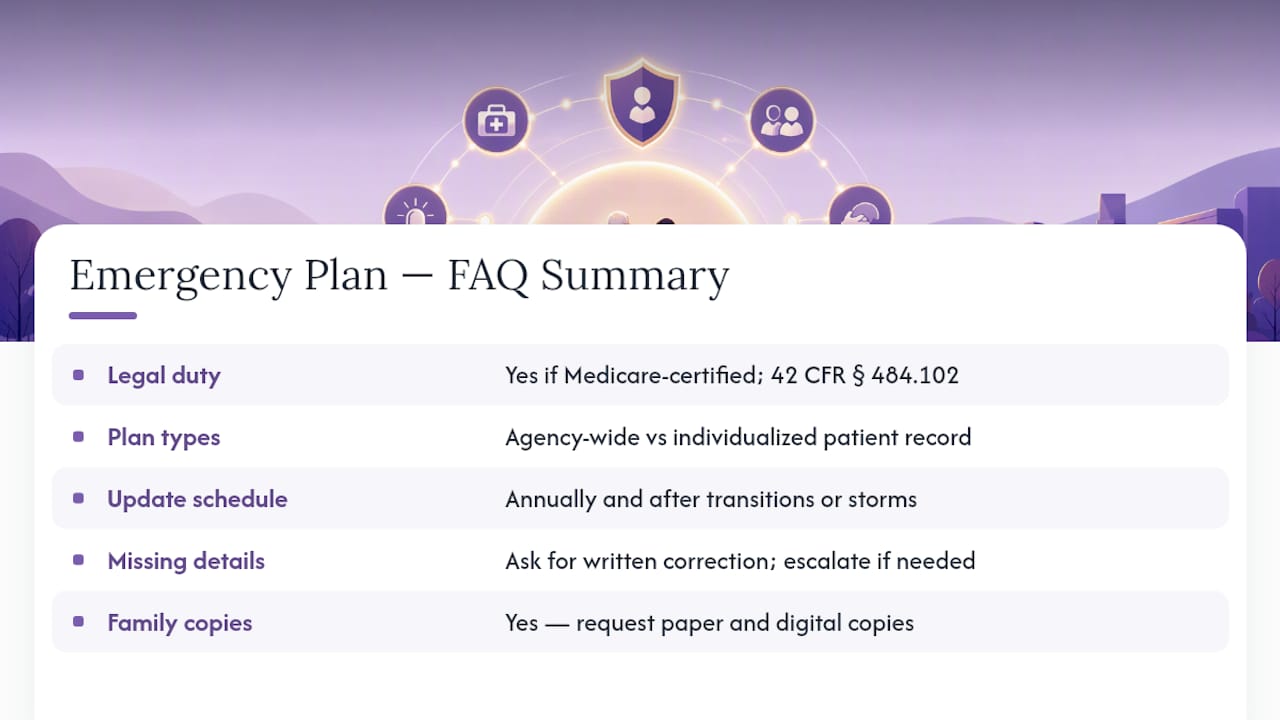
Can family members request a copy of the signed emergency plan? Yes. Ask where it’s stored in the patient record and request both a paper copy for the home and a digital copy you can access if the power goes out.
Sources
- 42 CFR § 484.102 - Condition of participation: Emergency preparedness
- Evidence of Disaster Planning by Home Care Providers: An Integrative Literature Review (PMC)
- Home Care Emergency Preparedness: Disaster Planning & Business Continuity Guide (2026)
- Disaster Preparedness in Home Care