
Hourly Home Care Rates in 2026: What You'll Actually Pay
Hourly Home Care Rates in 2026: What You’ll Actually Pay

The national median hourly rate for private-pay in-home care sits at $34 an hour in 2026, with most families paying somewhere between $25 and $44 depending on their state and the level of care needed. That single number is your starting point for building a real budget, not just a rough guess.
Home care costs aren’t holding steady, either. Prices climbed 7.9% year-over-year between May 2025 and May 2026, well ahead of general inflation. If you’re planning care for a parent who might need help for an extended period, build in an annual increase rather than assuming today’s quote holds; for more on planning and comparing costs, see practical housing and care options.
To turn an hourly rate into a monthly number, multiply the hourly rate by weekly hours, then by 4.33 (the average number of weeks in a month). Twenty hours a week at around $34 an hour converts to approximately $2,900 a month before any nights, weekends, or specialized-care premiums.
- National median: $34/hour
- Typical range: $25 to $44/hour depending on state and care type
- Quick formula: hourly rate × weekly hours × 4.33 = monthly cost
- Helping-hands-home-care serves families across metro Detroit with home health aide, cleaning, meal prep, and massage services billed hourly or per visit
Key Takeaways
Budgeting for hourly home care works best when you anchor to the national median, adjust for your state and care level, and convert hours into a monthly figure before you commit to a schedule.
| Point | Details |
|---|---|
| National median anchor | Use $34/hour as your baseline, adjusting up or down within the $25 to $44 state range. |
| Rates keep rising | Home care prices rose 7.9% year-over-year, so build in an annual increase when budgeting. |
| Convert hours to months | Multiply hourly rate by weekly hours by 4.33 to estimate a realistic monthly cost. |
| Coverage has real limits | Medicare excludes custodial care; Medicaid HCBS waivers vary by state and require checking local eligibility. |
| Helping-hands-home-care | Offers hourly home health aide, cleaning, meal prep, and massage services across metro Detroit, priced to match the care level you actually need. |
Table of Contents
- Hourly Home Care Rates by State and Region
- What Drives Hourly Rates Up or Down
- Typical Rates by Care Type: Companion to Skilled Nursing
- Converting Hourly Rates to a Monthly Budget
- Who Pays: Medicare, Medicaid, VA Benefits, and Insurance
- Agency Care vs. Hiring a Caregiver Privately
- How to Negotiate Better Hourly Rates and Package Deals
- What This Data Actually Means for Your Budget
- Get an Hourly Home Care Estimate for Metro Detroit
- Sources
Hourly Home Care Rates by State and Region
Where you live changes your budget more than almost any other factor. The $25 to $44 per hour spread reported across state medians isn’t a rounding error. It reflects real differences in what caregivers earn and what it costs agencies to keep them staffed.
States with tighter labor markets for direct-care workers tend to sit at the top of that range. States with a younger workforce and lower elderly dependency ratios tend to land closer to the bottom, since there’s more competition among caregivers for hours, which keeps wages, and therefore rates, lower. Chicago Fed research ties much of this variation directly to regional labor supply rather than cost of living alone.
Metro areas usually run higher than rural counties within the same state, mostly because of higher minimum wage floors and steeper competition for aides among hospitals, assisted living facilities, and home care agencies. A rural county two hours outside Detroit might see rates several dollars below the city itself, even though both fall under Michigan’s statewide averages.
Pro Tip: Don’t rely on a single national number when budgeting. Look up your specific state’s median through a cost-of-care survey, then adjust up or down based on whether you’re in a metro core or a surrounding suburb or rural area.
A few ways to check your local numbers before you call anyone:
- State-specific cost-of-care surveys, updated annually by major long-term care insurers and senior care platforms
- BLS regional wage data for home health aides and personal care aides, broken out by metro area
- Interactive state-by-state maps that let you compare your area against neighboring states
What Drives Hourly Rates Up or Down
A quoted rate isn’t arbitrary. Four factors explain almost all of the gap between what you’re offered and the national median.
- Regional wage baselines. BLS data shows caregiver wages vary widely by metro area, and agencies price around those local wage floors.
- Service intensity. Companion care costs less per hour than personal care, and personal care costs less than skilled nursing, because each tier requires more training and carries more liability.
- Schedule and timing. Overnight shifts, weekends, and holidays commonly carry a premium above weekday daytime rates, and most agencies enforce a minimum visit length.
- Agency overhead. Licensing, insurance, background checks, supervision, and payroll taxes all get baked into the hourly rate you’re quoted, which is part of why agency rates run higher than what an individual caregiver might charge directly.
Once you know which of these four is pushing your quote above or below the median, you can ask smarter questions when you’re comparing providers.
Typical Rates by Care Type: Companion to Skilled Nursing
Not every hour of home care costs the same, because not every hour requires the same skill. Think of it as four tiers, each with its own band:
- Companion care (conversation, light housekeeping, errands): generally the lowest tier, often running below the $34 national median
- Personal care (bathing, dressing, mobility assistance): typically sits at or slightly above the median
- Memory and dementia care: usually commands a premium because specialized behavior-management training and lower staff turnover raise the cost of maintaining a dedicated dementia-trained caregiver pool
- Skilled nursing (wound care, medication management, tasks requiring an RN or LPN): the highest tier by a meaningful margin, since it requires licensed clinical staff
Expect an additional premium of a few dollars an hour for overnight shifts, weekends, and major holidays across every tier. Most agencies also enforce a minimum visit length of two to four hours, so a one-hour visit rarely exists at the advertised hourly rate. If you need short, frequent check-ins rather than long blocks of care, that minimum can push your effective per-hour cost noticeably higher than the quoted rate suggests.
Converting Hourly Rates to a Monthly Budget
The math is simple once you pick the right multiplier. For an average month, multiply weekly hours by the hourly rate, then by 4.33. For a more conservative estimate that assumes exactly four full weeks, use 4 instead. Cost-of-care tools like CareScout’s calculator use a similar average-month approach when converting hourly quotes into monthly projections.
Here’s how that plays out at different care levels, using the national $34/hour median alongside the low and high ends of the typical range:
Three things to keep in mind when you build your own version of this table:
- Live-in care isn’t priced as 24 separate hourly units. It’s typically quoted as a flat daily or weekly rate, which usually works out cheaper per hour than round-the-clock hourly billing.
- Rotating-shift models (two or three caregivers splitting a week) can trigger overtime rules if one caregiver’s hours cross 40 in a week, so ask agencies how they staff longer schedules.
- Read the contract for how minimum visit length and holiday premiums stack, since a five-day holiday week can quietly add hundreds of dollars to a monthly estimate.
Who Pays: Medicare, Medicaid, VA Benefits, and Insurance
Medicare’s rules surprise a lot of families. Medicare covers skilled home health services only when a physician orders them and a certified home health agency delivers them. It generally does not cover custodial care, meaning bathing, dressing, meal prep, or companionship billed by the hour. Our Medicare home care guide breaks down exactly where that line falls.
Medicaid works differently. Home and Community-Based Services waivers can cover in-home supports for people who qualify, but eligibility rules, waitlists, and covered services vary significantly by state. Check our Medicaid benefits breakdown for what that looks like in practice.
Beyond those two programs:
- VA Aid & Attendance can help eligible veterans and surviving spouses offset hourly care costs
- Long-term care insurance policies often reimburse a portion of hourly home care, depending on the policy’s daily benefit and elimination period
- Some medical and dependent-care expenses may qualify for IRS deductions or credits, so keep detailed records of what you pay and why
Our payment options guide and insurance overview walk through how to combine these sources into one plan.
Agency Care vs. Hiring a Caregiver Privately
Hiring an independent caregiver directly usually costs less per hour than going through an agency, sometimes by several dollars, because you’re not paying for the agency’s overhead, insurance, and administrative layer. That savings comes with real trade-offs.

When you hire privately, you become the employer. That means handling payroll taxes, workers’ compensation coverage, background checks, and liability if the caregiver gets injured on the job or if care goes wrong. You’re also responsible for finding backup coverage the moment your caregiver calls in sick or takes vacation, with no agency bench to pull from.
Agencies charge more per hour, but that rate typically includes a bonded, insured, background-checked caregiver, a supervisor who handles scheduling conflicts, and a replacement caregiver if yours is unavailable. For families managing care from a distance, or for anyone without the time to manage payroll and scheduling themselves, that built-in redundancy is often worth the higher hourly rate.
The right choice depends on how much administrative work you’re willing to take on versus how much you’re willing to pay someone else to take on it for you. Families dealing with a sudden hospital discharge or a fast-declining diagnosis usually don’t have the bandwidth to become a part-time HR department, which is where agency staffing earns its premium.
How to Negotiate Better Hourly Rates and Package Deals
Hourly home care rates aren’t always fixed the way they’re presented in a first quote. A few approaches tend to work:
Ask about volume discounts. Agencies often quote a lower effective hourly rate for clients booking 30-plus hours a week, since it reduces their own scheduling overhead compared to juggling several short-hour clients.
Bundle services where it makes sense. If you need personal care alongside light housekeeping or meal prep, ask whether bundling those into one caregiver’s visit reduces the total hourly cost compared to hiring separately for each task.
Compare minimum visit policies before signing. A two-hour minimum versus a four-hour minimum can change your monthly total by hundreds of dollars if you only need short daily check-ins.
Lock in a rate for a defined term. Given that home care prices are rising faster than general inflation, ask whether an agency will hold your rate for six or twelve months rather than adjusting it at their next general increase.
Get multiple quotes for the same schedule. Rates for identical care levels can vary meaningfully between agencies serving the same zip code, so a second or third quote gives you real leverage in the conversation.
What This Data Actually Means for Your Budget
Most guides treat the national median as if it’s what everyone pays. It isn’t. The real value of a number like $34 an hour is as a sanity check, not a quote. If an agency in a low-wage-market state quotes you $50 an hour for companion care, that’s worth questioning directly, not accepting because it “sounds like home care pricing.”
The bigger blind spot in most budgeting advice is the minimum visit rule. Families fixate on the hourly rate and forget that a two-hour minimum on a service they only need for 45 minutes effectively triples their real cost per task. Ask about minimums before you ask about the rate.
I’d also push back on the instinct to default to the cheapest option purely because it’s private-pay and unlicensed. Saving a few dollars an hour on a caregiver with no backup plan, no insurance, and no supervision is a bad trade the first time that caregiver doesn’t show up. Price the redundancy, not just the hour.
Prioritize this order: figure out your care tier first, check what Medicaid or VA benefits might offset, then shop rates within that tier. Shopping rates before you know your tier is how families end up either overpaying for companion-level help or underpaying for care that actually needs a trained aide.
— Michael
Get an Hourly Home Care Estimate for Metro Detroit
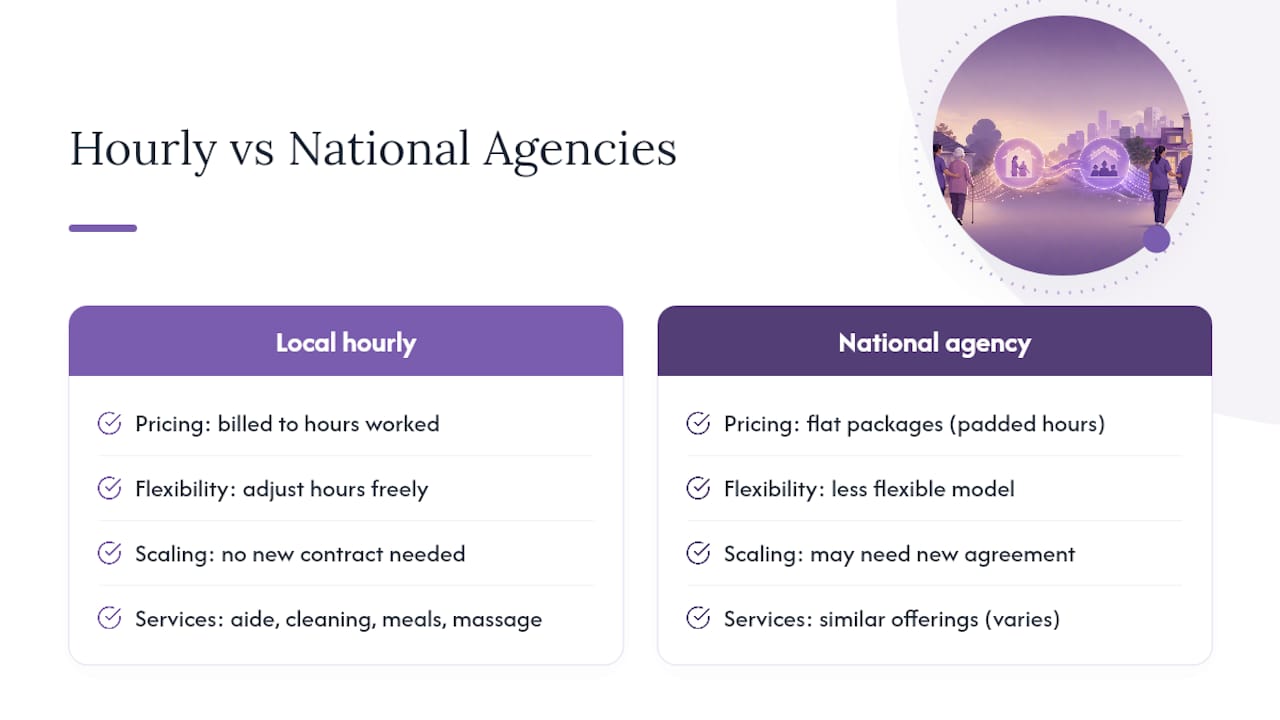
Helping-hands-home-care prices its services by the hour or per visit, so the budget math in this guide translates directly into a real quote instead of a rough estimate you have to convert yourself. Families across metro Detroit use us for home health aide support, house cleaning, meal prep, and therapeutic massage, and every service is billed transparently against the hours actually worked, not a flat package that pads in hours you don’t need.

What sets a local, hourly-billed model apart from a large national agency is flexibility: you can start with a few hours a week for companion or personal care and adjust as needs change, without renegotiating a long-term contract. If a parent’s needs shift from occasional check-ins to daily personal care, the hourly structure scales with that change instead of forcing a new agreement.
If you’ve run the numbers in this guide and want a real quote instead of an estimate, request a home health aide consultation through our home health aide services page and get an hourly rate specific to your loved one’s care level and schedule.
This article is general information, not a substitute for advice from a qualified financial advisor. Consult a qualified financial professional about your own circumstances before acting on anything here.
Sources
- Sharp rise in home care prices puts older adults at risk (AARP)
- Medicare coverage of home health services
- Medicaid home and community-based services (HCBS)
- Home health aides and personal care aides — BLS
Recommended
- Home Care vs Nursing Home: 2026 Cost and Care Guide | Helping Hands Home Care
- Home Care Payment Options for Seniors: 2026 Guide | Helping Hands Home Care
- Home Care Costs Comparison Guide for Families (by State) | Helping Hands Home Care
- Top 6 Procareunlimited.com Alternatives Providers 2026 | Helping Hands Home Care