
Medicaid Home Care Benefits Explained for Families
Medicaid Home Care Benefits Explained for Families

Medicaid home care benefits are Medicaid-funded programs that pay for personal care and support services delivered inside a senior’s home, helping them stay independent and avoid nursing home placement. These benefits cover a wide range of home care services covered by Medicaid, from bathing assistance to case management, but only for people who meet strict financial and medical criteria. Programs like the 1915© waiver and the 1915(i) state plan HCBS option define what services are available and who can access them. Understanding how these programs work is the first step to getting your elderly relative the care they need.
What are Medicaid home care benefits and who do they cover?
Medicaid home care is a clinical benefit, not an automatic entitlement based on age or low income alone. To receive Medicaid home health benefits, a person must demonstrate a nursing-home level of care need, meaning their daily functioning is significantly impaired. That standard is assessed by a state-appointed evaluator, not a doctor or family member. The program exists specifically to keep eligible seniors at home rather than in institutional settings.
Two federal frameworks deliver most of these benefits. The 1915© Home and Community-Based Services (HCBS) waiver is a state-run program that operates outside the standard Medicaid plan and can limit enrollment. The 1915(i) state plan option is built directly into a state’s Medicaid plan, making it a permanent benefit with broader access. Both programs fund similar services, but they differ significantly in how families access them and how long they may wait.

What financial and medical eligibility criteria must be met for Medicaid home care?
Eligibility for Medicaid home care requires satisfying two separate tests: one financial and one medical. Failing either one disqualifies an applicant, regardless of how great the need appears.
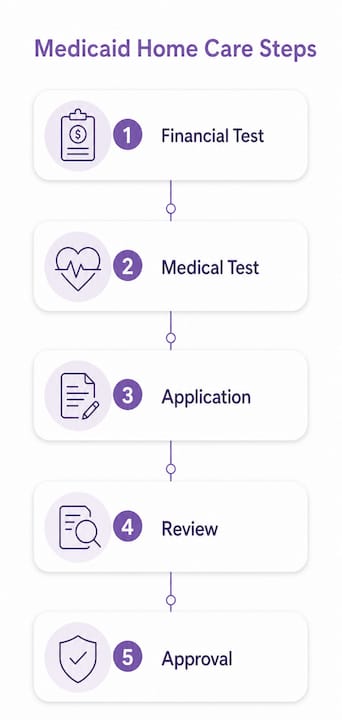
Financial limits and spousal protections
Medicaid long-term care eligibility sets income limits at approximately $2,829 per month for a single applicant, which equals 300% of the federal Supplemental Security Income (SSI) rate. Asset limits for a single applicant sit at approximately $2,000. Spouses who remain at home receive protection through what Medicaid calls the “community spouse resource allowance,” which can shield up to approximately $148,620 in assets. That protection prevents a healthy spouse from being left financially destitute while their partner receives care.
Medical necessity and ADL assessments
Medical eligibility is evaluated through a functional assessment of ADLs, which stands for Activities of Daily Living. These include bathing, dressing, eating, toileting, and transferring from a bed to a chair. Most states require documented limitations in 2–3 ADLs or a diagnosis of cognitive impairment such as dementia. A state-appointed assessor conducts this evaluation in person, often at the applicant’s home.
Key eligibility facts to keep in mind:
- Both financial and medical criteria must be satisfied simultaneously.
- Income and asset thresholds vary by state, so your state’s Medicaid office sets the exact numbers.
- Cognitive impairment alone can qualify a person even if physical ADL limitations are mild.
- Married applicants benefit from spousal asset protections that single applicants do not receive.
Pro Tip: Document your relative’s care needs on their worst days, not their best. Assessors evaluate the level of care needed across the full range of daily functioning, and underreporting is the leading cause of denials.
What home care services does Medicaid typically cover?
HCBS waivers cover a broad menu of services designed to keep seniors safely at home. The exact list depends on the state and the specific program, but most approved plans include a core set of services.
Core services available under most programs
- Personal care: Assistance with bathing, grooming, dressing, and toileting.
- Home health aide services: Skilled support with medication reminders and basic health monitoring.
- Homemaker services: Help with meal preparation, laundry, and light housekeeping.
- Case management: A coordinator who organizes and monitors the full care plan.
- Respite care: Temporary relief for family caregivers, provided either at home or at a facility.
Extended services under 1915© waivers
Beyond the core list, 1915© waivers frequently add adult day health programs, home modifications such as grab bars and wheelchair ramps, and assistive technology like medical alert devices. These additions reflect the program’s goal of addressing the full environment in which a senior lives, not just their personal hygiene.
Person-centered planning is the federal standard for building a Medicaid home care plan. That means the plan must reflect the individual’s specific goals, preferences, and safety needs rather than a generic template. Families have the right to participate in this planning process and request services that match their relative’s actual daily routine.
Pro Tip: Ask the case manager to include home care plan examples in the initial meeting. Seeing real service plans helps families identify gaps and request the right supports from the start.
Conflict-free case management is federally required under both 1915© and 1915(i) programs. The assessor who recommends services cannot financially benefit from those recommendations. That rule protects families from being steered toward unnecessary or overpriced services.
How are Medicaid home care applications processed?
The application process has several distinct stages, and each one carries its own risk of delay. Knowing the sequence helps families prepare and avoid common mistakes.
- Gather financial documentation. Collect bank statements, tax returns, property records, and proof of income. Medicaid reviews a 60-month look-back period for asset transfers to check whether assets were given away to meet the $2,000 limit. Any transfer flagged during this review can trigger a penalty period that delays benefits.
- Compile medical records. Collect physician notes, hospital discharge summaries, and any existing care assessments. These records support the medical necessity claim before the state assessor visits.
- Submit the application. File with the state Medicaid office or a designated enrollment broker. Some states allow online submission; others require paper forms.
- Complete the functional assessment. A state-appointed assessor visits the applicant at home and evaluates ADL limitations and cognitive status. This is the single most important step in the process.
- Receive an eligibility determination. The state issues a written decision. If approved, the applicant is either enrolled immediately or placed on a waiting list.
- Prepare for renewals. Medicaid home care benefits require annual renewal with updated financial and medical documentation. Missing a renewal deadline can terminate services and force a full reapplication.
Over 700,000 people currently sit on Medicaid HCBS waiver waiting lists nationwide. That number reflects the gap between demand and available slots under 1915© programs. Waiting periods can stretch from several months to several years depending on the state.
Pro Tip: Apply as early as possible, even before a crisis occurs. Waiting until a hospitalization or fall forces the issue means your relative may wait months for services while their condition worsens.
What are the key differences between waiver programs and state plan HCBS options?
The choice between a 1915© waiver and a 1915(i) state plan option is one of the most consequential decisions families face. The two programs fund similar services but operate under very different rules.
The 1915(i) state plan option carries no enrollment caps and no waiting lists. Because it is embedded in the state’s permanent Medicaid plan, it cannot be eliminated by a budget decision the way a waiver can. That stability makes it the preferred route when a state offers it.
Key distinctions between the two program types:
- Enrollment caps: 1915© waivers cap enrollment and maintain waiting lists. 1915(i) state plans do not cap enrollment.
- Permanence: 1915© waivers require federal renewal every five years. 1915(i) is a permanent state plan benefit.
- Income eligibility: 1915(i) programs may use different income thresholds than standard Medicaid, sometimes allowing higher-income applicants to qualify.
- Service menus: Both programs cover personal care and case management, but waiver service menus are often broader and more customized.
- Conflict-free case management: Both programs require it under federal law.
Families should check their state’s Medicaid website to confirm which programs are active. Some states offer both options; others offer only one. Dual eligibility for Medicare and Medicaid can also open additional funding pathways worth exploring with a benefits counselor. The home care eligibility guide from Helping-hands-home-care provides a practical starting point for understanding which criteria apply in your state.
Key Takeaways
Medicaid home care benefits require meeting both financial and medical eligibility thresholds, and approval does not guarantee immediate enrollment due to widespread waiting lists.
| Point | Details |
|---|---|
| Dual eligibility requirement | Applicants must meet both income/asset limits and a nursing-home level of care standard. |
| Waitlist reality | Over 700,000 people are on HCBS waiver waiting lists; apply early to reduce delays. |
| 1915(i) advantage | State plan HCBS options carry no enrollment caps and offer permanent, stable coverage. |
| Document worst-day needs | Assessors evaluate full care needs; underreporting ADL limitations leads to denials. |
| Annual renewal is mandatory | Missing renewal deadlines terminates benefits and requires a full reapplication process. |
What families get wrong about Medicaid home care
Most families I speak with assume that qualifying for Medicaid automatically means care starts within weeks. That assumption leads to real harm. Eligibility does not guarantee immediate enrollment, and in states with long 1915© waiver lists, a qualified applicant may wait a year or more. The families who navigate this best are the ones who apply before a crisis, not during one.
The second mistake I see constantly is families describing their relative’s good days during the functional assessment. The assessor needs to understand the worst-case scenario: what happens when your mother tries to get dressed alone at 6 AM after a bad night. That picture, documented clearly, is what drives the right level of services. Vague descriptions produce weak care plans.
My strongest advice is to treat the application like a legal case. Keep a centralized folder with every document submitted, every phone call logged, and every deadline noted. When renewal time comes, that folder saves hours and prevents the kind of paperwork gaps that cut off services mid-year. The home care assessment process is more navigable than it looks once families understand what assessors are actually measuring.
— Michael
How Helping-hands-home-care supports families navigating Medicaid home care
Helping-hands-home-care works directly with elderly clients and their families to provide the personal care and home health aide services that Medicaid home care plans are built around.
Whether your relative is newly approved for benefits or still working through the application, Helping-hands-home-care’s team can help align professional care with the services outlined in a Medicaid plan. From ADL support to homemaker services, the team delivers care that meets the standards Medicaid assessors look for. Explore the full range of home health aide services to see how professional in-home care fits alongside a Medicaid-funded plan. Helping-hands-home-care also offers house cleaning services that complement personal care for a complete home support solution.
FAQ
What does Medicaid home care cover for elderly people?
Medicaid home care covers personal care, home health aide services, case management, respite care, adult day health, and home modifications under HCBS waiver and state plan programs. The exact service menu depends on the state and the specific program your relative qualifies for.
How do you qualify for Medicaid home care benefits?
Qualification requires meeting both a financial test (income near $2,829 per month and assets near $2,000 for a single applicant) and a medical test showing a nursing-home level of care need based on ADL limitations or cognitive impairment.
What is the difference between a 1915© waiver and a 1915(i) state plan?
A 1915© waiver has enrollment caps and waiting lists, while a 1915(i) state plan has no caps and is a permanent Medicaid benefit. Families should check state availability since not every state offers both options.
How long does the Medicaid home care application process take?
Processing times vary by state but typically range from 45 to 90 days for the eligibility determination after a completed application is submitted. Waiting list placement after approval can add months or years depending on the program and state.
What happens if you miss a Medicaid home care renewal deadline?
Missing a renewal deadline can result in termination of benefits and require a full reapplication, which restarts the waiting period. Most states allow a grace period of approximately 90 days, but submitting updated documentation on time is the safest approach.
Recommended
- In-Home Care Eligibility Explained: 2026 Guide | Helping Hands Home Care
- Medicare Home Care Explained: 2026 Eligibility Guide | Helping Hands Home Care
- Home Care Assessment Process Explained for Families | Helping Hands Home Care
- Michigan Senior Care Programs Explained for Families | Helping Hands Home Care