
Medicare Home Care Explained: 2026 Eligibility Guide
Medicare Home Care Explained: 2026 Eligibility Guide

Medicare home care is a federally funded benefit that pays 100% of medically necessary skilled nursing and therapy services delivered in the home, with no copays or deductibles, when strict eligibility requirements are met. Most families researching care for an elderly relative assume Medicare covers long-term personal assistance. It does not. What Medicare covers is short-term, physician-directed skilled care. Understanding this distinction is the first step toward making a plan that actually works for your family.
What is Medicare home care and who qualifies?
Medicare home care, formally called the Medicare Home Health Benefit, covers skilled nursing and therapy services provided in a patient’s home by a Medicare-certified agency. Original Medicare covers 100% of these medically necessary services for eligible patients, with no copays or deductibles. That is a significant financial benefit, but it comes with strict conditions.
To qualify, your relative must meet four criteria:
- Homebound status. The patient must have a condition that makes leaving home require a taxing effort. The definition of homebound does not require complete immobility. Leaving home for brief medical appointments or occasional religious services still qualifies, as long as those trips are infrequent and difficult.
- Skilled care need. The patient must need intermittent skilled nursing, physical therapy, occupational therapy, or speech therapy. Intermittent means less than 8 hours per day and 28 hours per week.
- Physician certification. A doctor must establish and certify a plan of care. Medicare also requires a face-to-face encounter between the patient and a physician or qualified practitioner before certifying eligibility.
- Medicare-certified agency. Services must be delivered by an agency that Medicare has approved.
Coverage falls under Original Medicare Part A and Part B. Medicare Advantage plans must cover the same Home Health Benefit, but the agency network and prior authorization rules may differ. Always confirm with the specific plan.
Pro Tip: If your relative was recently discharged from a hospital or skilled nursing facility, ask the discharge planner to initiate the Medicare home health referral before leaving. Starting the process early prevents gaps in care.

What does Medicare home care include and exclude?
Medicare home care benefits cover a defined set of skilled services. Knowing exactly what is and is not included prevents costly surprises.
Covered services
- Skilled nursing care. Wound care, medication management, injections, and monitoring of complex conditions like congestive heart failure or diabetes.
- Physical therapy. Restoring strength, balance, and mobility after a stroke, fall, or surgery.
- Occupational therapy. Relearning daily tasks like dressing, bathing, and cooking safely at home.
- Speech-language pathology. Treating swallowing disorders and communication problems.
- Home health aide services. Personal care such as bathing and grooming, but only when the patient is also receiving skilled nursing or therapy. Medicare covers home health aides only when skilled care is provided concurrently. The moment skilled care stops, aide coverage stops too.
- Medical social services. Counseling and help connecting families to community resources.
- Durable medical equipment. Items like walkers, wheelchairs, and hospital beds, covered at 80% under Part B.
What Medicare does not cover
Medicare does not cover 24-hour care, custodial care, or meal delivery unless those services are part of a skilled nursing or therapy visit. Custodial care means help with daily living activities such as bathing, dressing, and cooking when no skilled medical need exists. This is the category most families assume Medicare covers. It does not.
Non-medical personal care, housekeeping, and companion services are also excluded. These are the services that make daily life manageable for a frail elder, and they represent the biggest gap in Medicare’s home care coverage. Families who need those services must look to Medicaid, private pay, or a provider like Helping-hands-home-care that offers non-medical home support alongside skilled care coordination.
Medicare vs. Medicaid vs. private home care: what is the difference?
Four in ten adults mistakenly believe Medicare is the primary payer for long-term home care. That misunderstanding can leave families financially unprepared. The three main types of home care funding work very differently.
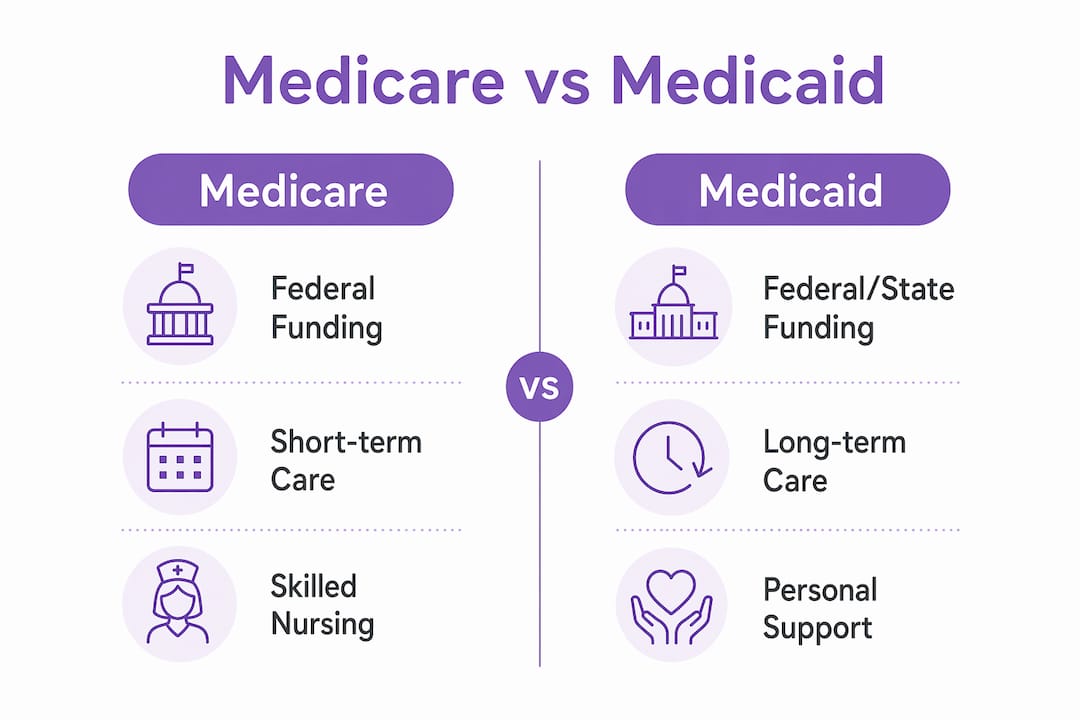
Medicaid covers nearly two-thirds of home care spending in the United States, focusing on long-term personal care and daily living assistance that Medicare excludes. Medicaid eligibility is income and asset based, and services vary by state. For a deeper look at how these home care types compare, the distinctions in duration and service scope are significant.
Private home care agencies provide non-medical support, such as companionship, housekeeping, and personal care, without requiring a physician’s order or a skilled care need. Families pay out of pocket or through long-term care insurance.
| Feature | Medicare | Medicaid | Private home care |
|---|---|---|---|
| Who pays | Federal government | Federal and state | Family or insurance |
| Service type | Skilled nursing and therapy | Personal care and daily living | Non-medical support |
| Duration | Short-term, episodic | Long-term | Ongoing, flexible |
| Eligibility basis | Medical need, homebound status | Income and assets | No requirements |
| Physician order required | Yes | Varies by state | No |
| Covers custodial care | No | Yes | Yes |
Pro Tip: Medicare and Medicaid can work together. A patient can receive Medicare-covered skilled nursing while simultaneously receiving Medicaid-funded personal care aide hours. Coordinating both programs requires proactive communication with the care team and the state Medicaid office.
How long does Medicare cover home health care?
Medicare home health coverage is organized into care episodes, not open-ended authorizations. Understanding the timeline helps families plan before coverage ends.
- The 60-day certification period. A Medicare home health plan covers a 60-day period and may be renewed if the skilled care need continues. The physician must recertify the plan at the start of each new period.
- No fixed maximum. There is no hard cap on the number of 60-day periods Medicare will cover. Coverage continues as long as the patient remains homebound, has a skilled care need, and a physician certifies the plan.
- The coverage cliff. Coverage ends when the patient’s condition stabilizes or improves to the point where skilled care is no longer needed. This can happen quickly after a surgery or illness. Many families are caught off guard by this sudden stop, which experts call the “coverage cliff.”
- What triggers the end. If the patient plateaus and no longer shows progress in therapy, or if the patient is no longer homebound, Medicare stops paying. The agency is required to give written notice before ending services.
- Planning for the transition. Once Medicare coverage ends, families need a plan. Options include Medicaid Home and Community Based Services, private pay home care, or a combination. Reviewing financial assistance options for elderly care early gives families more choices and less stress when the transition arrives.
The most common mistake families make is waiting until coverage ends to start planning. Start the conversation with the home health agency and the physician at the beginning of the second or third certification period, not after the termination notice arrives.
Key takeaways
Medicare home care covers short-term skilled nursing and therapy services at home with no cost to the patient, but it excludes custodial care, making early planning for Medicaid or private alternatives critical.
| Point | Details |
|---|---|
| Full coverage with conditions | Medicare pays 100% for skilled home care when homebound and physician-certified criteria are met. |
| Skilled care only | Coverage includes nursing, therapy, and aide services tied to skilled care, not ongoing personal assistance. |
| Medicare vs. Medicaid gap | Medicaid covers long-term custodial care that Medicare excludes; both programs can run simultaneously. |
| 60-day episodes | Care renews every 60 days if skilled need continues, but ends abruptly when the patient stabilizes. |
| Plan before the cliff | Families should explore Medicaid and private home care options before Medicare coverage ends. |
What I’ve learned from watching families navigate Medicare home care
I have spent years watching families go through this process, and the pattern is almost always the same. They learn about Medicare home care after a hospital discharge, assume it covers everything their relative needs, and then face a jarring reality check when the aide stops showing up because the skilled nursing visits ended.
The hardest part is not the paperwork or the eligibility rules. The hardest part is the emotional whiplash. A family member is recovering well, which is good news, and then Medicare stops paying because recovery is exactly what triggers the coverage cliff. Progress ends the benefit.
What actually works is treating Medicare home care as phase one of a longer plan, not as a complete solution. Use the 60-day periods to stabilize your relative and simultaneously build the next layer of support. That might mean applying for Medicaid Home and Community Based Services, arranging private pay hours through a trusted agency, or both. Families who do this early have far more options than those who wait.
The other thing I tell families is to document everything. Keep records of every physician visit, every certification, and every communication with the home health agency. If Medicare denies a claim or ends coverage prematurely, you have the right to appeal. A well-documented case wins far more often than a verbal complaint.
— Michael
How Helping-hands-home-care supports your family through Medicare home care
Navigating Medicare home care is complex, and coverage gaps are real. Helping-hands-home-care provides professional home health aide services that work alongside Medicare-covered skilled care, filling the personal care hours Medicare does not pay for. When Medicare coverage ends, Helping-hands-home-care can step in with a personalized care plan that keeps your relative safe and supported at home. Whether your family needs skilled care coordination, daily personal assistance, or supplemental services, the team at Helping-hands-home-care is ready to help you build a plan that fits.

Contact Helping-hands-home-care today to discuss your relative’s care needs and find out how professional home care support can complement Medicare benefits.
FAQ
What is Medicare home care in simple terms?
Medicare home care is a benefit that pays for skilled nursing, therapy, and related services delivered in a patient’s home by a Medicare-certified agency. Coverage is 100% with no copays when the patient is homebound and under a physician’s certified plan of care.
Does Medicare cover personal care like bathing and dressing?
Medicare covers personal care aide services only when the patient is also receiving skilled nursing or therapy at the same time. It does not cover ongoing personal care or custodial assistance when no skilled medical need exists.
How is Medicare home care different from Medicaid home care?
Medicare covers short-term skilled care for medically necessary conditions, while Medicaid covers long-term personal care and daily living assistance for income-eligible individuals. Medicaid is the primary payer for custodial home care that Medicare excludes.
How long will Medicare pay for home health care?
Medicare covers home health care in 60-day certification periods that can renew indefinitely as long as the patient remains homebound and has a continuing skilled care need. Coverage ends when the patient stabilizes or no longer qualifies as homebound.
Can a patient receive both Medicare and Medicaid home care at the same time?
Yes. A patient can receive Medicare-covered skilled nursing and therapy while simultaneously receiving Medicaid-funded personal care aide hours. Coordinating both programs requires communication with the physician, the home health agency, and the state Medicaid office.
Recommended
- Home Care Services for Seniors: A Family Guide | Helping Hands Home Care
- Difference Between Home Care Types: Family Guide 2026 | Helping Hands Home Care
- Financial Assistance for Home Care of Elderly Loved Ones | Helping Hands Home Care
- Macomb County In-Home Care Options: 2026 Guide | Helping Hands Home Care