
The Role of Insurance in Home Care: 2026 Guide
The Role of Insurance in Home Care: 2026 Guide

Insurance covers far less home care than most families expect. Medicare pays $0 for approved skilled home health services when you qualify, but it draws a hard line at custodial and personal care. Long-term care insurance and Medicaid fill much of that gap, though each comes with its own rules, waiting periods, and asset requirements. Here is what every family planning care for an elderly loved one needs to know in 2026.
What insurance typically covers and what it does not:
- Medicare: Covers skilled nursing, physical therapy, speech therapy, and occupational therapy for homebound patients at no cost, but excludes 24-hour care, meal delivery, and personal care when that is the only need
- Private health insurance: Mirrors Medicare in focusing on acute, medically necessary care; rarely covers long-term custodial services
- Long-term care (LTC) insurance: Designed specifically for non-medical and custodial home care, but includes elimination periods and provider requirements
- Medicaid: Covers home and community-based services for low-income individuals who meet strict asset and income thresholds
- Out-of-pocket: Families often absorb costs during insurance waiting periods or for services no policy covers
As NAIC and AARP both emphasize, the single biggest misconception families carry into care planning is assuming Medicare covers long-term custodial care. It does not.
How the role of insurance in home care plays out under Medicare and private plans
Medicare’s home health benefit is genuinely useful, but only within a defined lane. To qualify, a physician or allowed provider must certify you as homebound and order a care plan. Covered services include skilled nursing on a part-time or intermittent basis, physical therapy, speech-language pathology, occupational therapy, medical social services, and home health aide support when skilled care is already in place. Coverage is capped at part-time or intermittent care under normal circumstances.
Cost-sharing is minimal for most services. You pay $0 for Medicare-approved home health visits. The one exception: durable medical equipment requires a 20% coinsurance after the Part B deductible.
What Medicare will not pay for:
- 24-hour-a-day care at home
- Meal delivery or homemaker services unrelated to the care plan
- Custodial or personal care (bathing, dressing, toileting) when that is the only service needed
Medicare-certified agencies are required to issue an Advance Beneficiary Notice (ABN) before providing any service Medicare might deny. Signing that notice means you accept financial responsibility if the claim is rejected. Read it carefully before signing.
Private health insurance generally follows the same logic as Medicare, covering acute and medically necessary home health services while excluding long-term custodial care. Coverage details vary by plan, so checking your specific policy’s home health benefit is worth doing before a care need arises. Medigap policies help with Medicare cost-sharing but do not extend coverage to long-term care. For in-home care eligibility specifics, the criteria across insurance types follow a consistent pattern: medical necessity, physician oversight, and certified providers.

Using long-term care insurance and Medicaid to finance home care
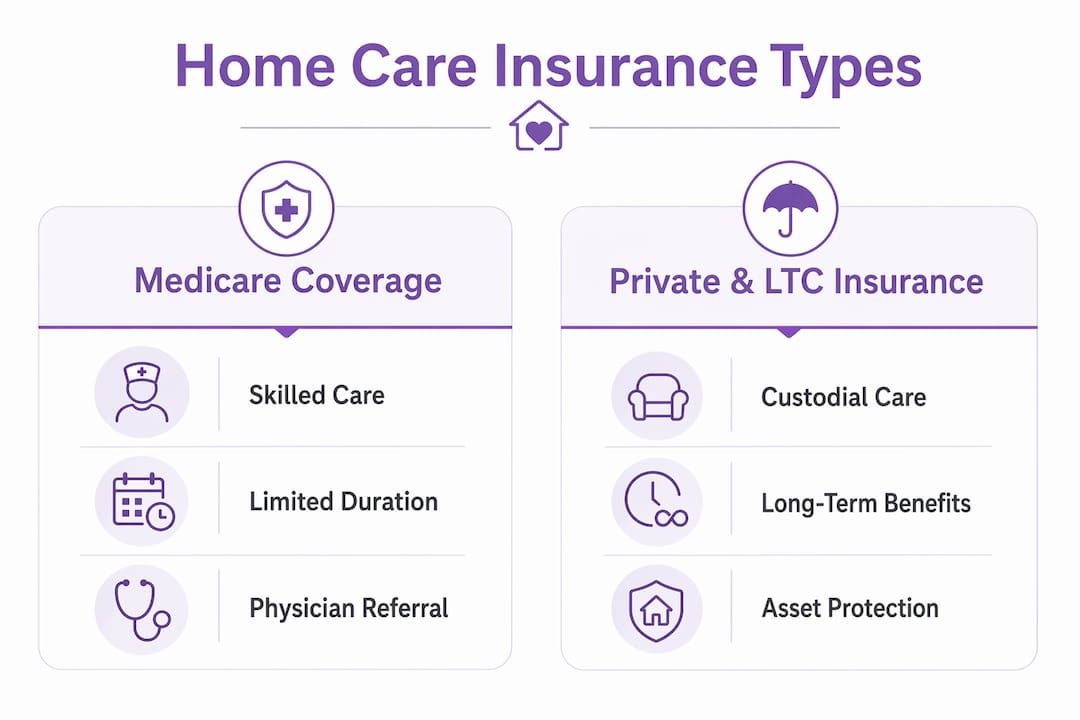
Long-term care insurance exists precisely because Medicare and standard health plans leave custodial care uncovered. A typical LTC policy pays for skilled and non-skilled nursing, home health aides, physical therapy, homemaker services, and sometimes adult day care, provided through state-licensed or Medicare-certified agencies. Policies vary between reimbursement models (you submit receipts and get paid back) and cash benefit models (you receive a daily or monthly amount to spend as needed).
The elimination period is the detail families most often overlook. Most LTC policies start benefits after a 90-day waiting period, though some policies offer shorter or longer windows at different premium levels. During that window, you pay out of pocket. For families without reserves, that gap can be financially painful.
Key LTC insurance features to understand:
- Benefit triggers: Most policies require inability to perform two or more activities of daily living (ADLs) such as bathing, dressing, eating, toileting, or transferring, or a diagnosis of cognitive impairment like Alzheimer’s disease
- Provider requirements: LTC policies typically require care from state-licensed or Medicare-certified agencies, not unlicensed family members
- Inflation protection: Some policies include inflation riders that raise benefit amounts over time to keep pace with rising care costs, though premiums increase accordingly
- Hybrid policies: The majority of LTC policies sold since 2010 combine long-term care coverage with life insurance or an annuity, according to NAIC
Medicaid is the safety net for families who cannot afford private LTC insurance. Medicaid pays for nearly one-third of nursing home care nationally and covers some home and community-based services. Qualifying requires meeting strict federal and state income and asset limits. Many families spend down their savings until they reach eligibility, a process that can take years. Medicaid allows a spouse remaining at home to retain specified levels of assets and income.
State partnership programs offer one way to protect assets. A partnership-approved LTC policy lets you shelter assets equal to what the policy has already paid, so you can qualify for Medicaid without exhausting everything you own. Check with your state insurance department to see whether these programs are available where you live. For a full breakdown of financial assistance programs, including Medicaid waiver options by state, that resource covers the specifics.
Planning and paying out-of-pocket for home care
Out-of-pocket spending is unavoidable for most families at some point, whether during an LTC insurance elimination period, for services no policy covers, or while waiting for Medicaid approval. The families who manage it best plan for it in advance rather than scrambling when care starts.
Practical steps for managing home care costs:
- Build a cash reserve specifically for the elimination period. If your LTC policy has a 90-day wait, calculate the likely daily care cost and set that amount aside before you need it
- Verify provider credentials before hiring. Insurance reimbursement depends on using licensed or certified agencies. An unlicensed caregiver, however skilled, may disqualify a claim entirely
- Track every claim with dates, service logs, and receipts. LTC insurance claims processes can be complex, and documentation gaps delay or deny payment
- Assign power of attorney early. A caregiver managing insurance paperwork on behalf of an elderly parent needs legal authority to do so, and setting that up after a health crisis is far harder
- Combine funding sources. Medicare may cover the skilled nursing phase, LTC insurance the custodial phase, and personal savings the gaps in between. A single source rarely covers everything
Pro Tip: Working with a professional home care agency from the start simplifies insurance navigation considerably. Licensed agencies know which services qualify under Medicare, how to document care for LTC insurance claims, and how to coordinate with Medicaid case managers. That institutional knowledge saves families real money and time.
For a detailed look at combining these approaches, the 2026 payment options guide from Helping-hands-home-care walks through each funding source and how to sequence them.
Helping-hands-home-care makes insurance navigation part of the service
Families who have just learned that Medicare will not cover their parent’s daily personal care needs often feel stuck between a coverage gap and a care gap. Helping-hands-home-care closes both at once.

Helping-hands-home-care provides professional home health aid services staffed by licensed caregivers who meet the provider requirements of Medicare, long-term care insurance, and Medicaid programs. That matters because using a non-certified caregiver can void an insurance claim entirely. Beyond skilled care, the team also offers house cleaning and massage therapy tailored to seniors, services that support daily comfort and wellbeing. Families get one trusted point of contact who understands the insurance side of care, not just the caregiving side. Reach out to Helping-hands-home-care to discuss your loved one’s needs and learn which services your current coverage supports.
Key Takeaways
Insurance covers skilled, medically necessary home health services, but families must combine Medicare, long-term care insurance, Medicaid, and personal savings to fund comprehensive elder care.
| Point | Details |
|---|---|
| Medicare covers skilled care only | Approved home health visits cost $0, but 24-hour and custodial care are excluded entirely. |
| LTC insurance fills the custodial gap | Most policies start benefits after a 90-day elimination period requiring out-of-pocket payment first. |
| Medicaid is the low-income safety net | Medicaid pays for nearly one-third of nursing home care and some home services, but asset spend-down is often required. |
| Provider certification affects reimbursement | LTC insurance and Medicare both require state-licensed or Medicare-certified agencies to qualify for payment. |
| Helping-hands-home-care | Licensed caregivers meet Medicare and LTC insurance provider requirements, simplifying claims and closing coverage gaps. |
Recommended
- Home Care Payment Options for Seniors: 2026 Guide | Helping Hands Home Care
- In-Home Care Eligibility Explained: 2026 Guide | Helping Hands Home Care
- Home Care Services for Seniors: A Family Guide | Helping Hands Home Care
- How to Prepare Home for Caregiver: 2026 Safety Guide | Helping Hands Home Care