
Michigan Power of Attorney for Elder Care: Family Guide
Michigan Power of Attorney for Elder Care: Family Guide

To protect an aging parent’s finances and medical decisions in Michigan, you need two separate legal documents: a financial power of attorney (durable by default under the Michigan Uniform Power of Attorney Act, MCL 556.201–556.505) and a Designation of Patient Advocate for medical decisions, governed by MCL 700.5506. Neither document covers the other’s territory. A financial agent cannot authorize surgery. A patient advocate cannot pay bills.
Quick reference:
- Financial POA covers property, bank accounts, retirement plans, taxes, and real estate
- Designation of Patient Advocate covers medical, mental health, and end-of-life treatment decisions
- “Durable” matters because without that clause, the agent’s authority ends the moment your parent loses capacity, forcing your family into guardianship proceedings
- Immediate steps: confirm your parent has legal capacity now, choose an agent and a successor, sign before a notary, have the agent sign an acceptance, and deliver copies to banks and health providers
- Institutional friction is real: banks can take up to seven business days to verify a POA and may refuse it while they investigate
Table of Contents
- How do you create both documents step by step in Michigan?
- How do you choose the right agent for elder care?
- When does a POA end, and what happens without one?
- What does it cost and how long does it take?
- When should you hire a Michigan elder law attorney?
- What mistakes do Michigan families most often make?
- How do you update Michigan POA documents over time?
- What specific language should Michigan elder care POA forms include?
How do you create both documents step by step in Michigan?
Financial POA checklist:
- Draft the document naming your agent, successor agent, and the specific powers granted (real property, bank accounts, retirement plans, etc.) using the Michigan Statutory Form or a custom document aligned with MCL 556.205
- Sign it dated, before a notary public or in front of two adult witnesses (neither can be the agent)
- Have the agent sign a written acceptance of authority before acting
- Deliver certified copies to every bank, brokerage, and insurer your parent uses
- If real estate is involved, file a copy at the county register of deeds
Designation of Patient Advocate checklist:
- Draft the document per MCL 700.5506, naming the patient advocate and specifying the scope of medical decisions
- Sign before two adult witnesses. Witnesses cannot be the patient advocate, a family member who may inherit, an employee of the patient’s health insurer, or a health facility employee involved in the patient’s care
- Give the advocate a copy; the advocate must sign an acceptance of designation before acting
- Deliver copies to your parent’s primary care physician and any specialist teams
Pro Tip: Sign both documents in front of a notary and two witnesses simultaneously. Notarization creates a legal presumption of genuineness under MCL 556.205 and dramatically reduces bank pushback, even when witnesses alone would technically suffice.
How do you choose the right agent for elder care?
Trust is the baseline, not the finish line. The agent you name for a financial POA must keep meticulous records, act in the principal’s best interest, and avoid any conflict that could compromise that duty. The Michigan Statutory Form spells out these duties explicitly: the agent must act loyally, with care and diligence, and cooperate with whoever holds medical decision authority.

For the patient advocate role, add one more filter: can this person hold their ground in a hospital room? Advocates regularly face pressure from providers, insurers, and other family members. Name someone who can communicate clearly with medical staff and make hard calls under stress. Name a successor for both roles. If your first choice becomes unavailable, a gap in authority can mean court intervention.
Choosing two different people for the financial and medical roles often works well, as long as they can coordinate. The Michigan Statutory Form requires the financial agent to cooperate with whoever holds health care authority.
When does a POA end, and what happens without one?
A financial POA terminates when the principal dies, revokes it in writing, or a court invalidates it. The patient advocate’s authority ends at death or when the principal regains capacity and revokes the designation. Revocation requires a signed, dated written notice delivered to the agent and to any institution relying on the document.
If no valid POA exists when your parent loses capacity, a Michigan probate court must appoint a guardian and/or conservator. That process takes months, costs thousands of dollars in legal fees, and removes the family’s ability to choose who manages their loved one’s affairs. The State Bar of Michigan is direct about this: a durable clause is not optional for elder care planning.
What does it cost and how long does it take?
A Michigan elder care attorney typically charges $300–$800 to draft both documents, depending on complexity. Notary fees run $10–$25 per signature in most Michigan counties. Online notarization through a service like remote notary platforms can reduce travel barriers for families whose parent has limited mobility.
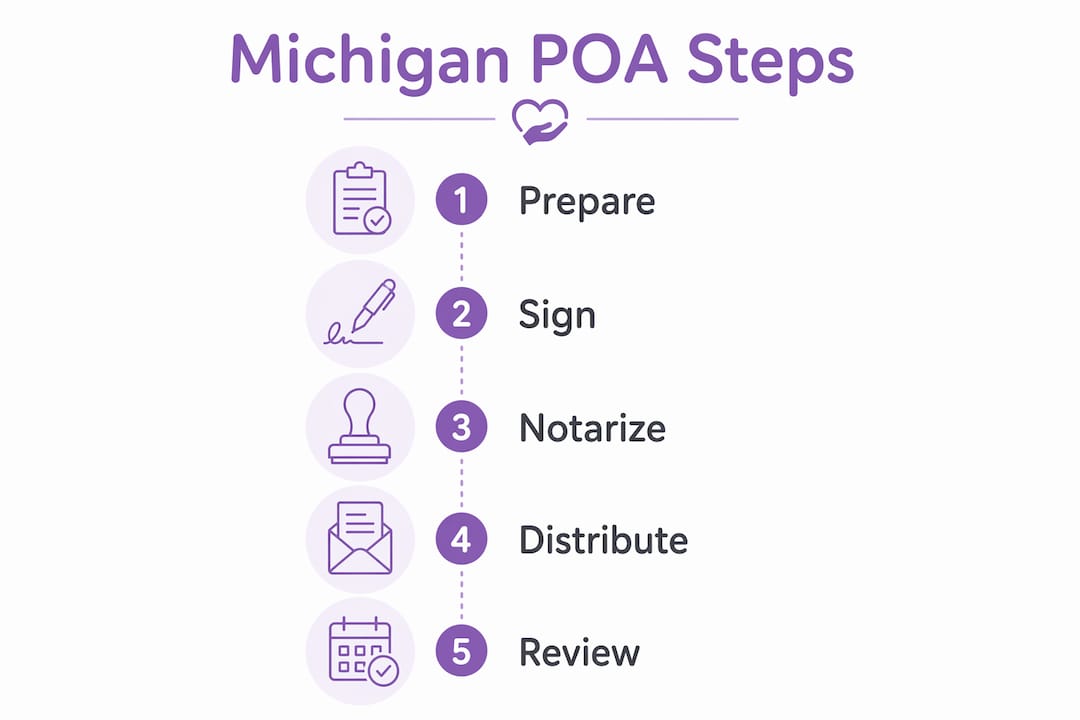
Timeline from start to signed documents: one to three weeks when working with an attorney, or a few days if using a vetted statutory form and a notary. Allow an additional week for banks to complete their verification period.
When should you hire a Michigan elder law attorney?
Self-help forms work for straightforward situations. Hire an attorney when any of these apply: your parent owns real estate in multiple counties or states, there are blended-family disputes over who should serve as agent, capacity is already in question (a contested signing can invalidate the entire document), the estate includes a business, or a prior POA needs to be revoked and replaced cleanly.
Elder law attorneys in Michigan can also advise on Medicaid planning, which intersects directly with how the financial agent manages assets. That overlap is where DIY documents most often create expensive problems later.
What mistakes do Michigan families most often make?
Skipping the durable clause. A non-durable POA is nearly useless for elder care. Under Michigan’s Uniform Power of Attorney Act, a properly executed POA is durable by default, but only if it meets all execution requirements under MCL 556.205. A document with a defect in signing or witnessing may not carry that presumption.
Forgetting the agent’s acceptance. The agent cannot legally act until they sign an acceptance. Many families execute the POA and never complete this step, then discover the problem at a bank counter.
Using a generic out-of-state form. Michigan’s witness restrictions for the Designation of Patient Advocate are stricter than most states. A form drafted for another jurisdiction may not satisfy MCL 700.5506.
Not delivering copies proactively. Waiting until a crisis to hand a POA to a bank or hospital adds days of delay. Give copies to every relevant institution now, and keep the originals in a fireproof location your agent can access.
How do you update Michigan POA documents over time?
Revoke the old document in writing, notify every institution holding a copy, and execute a new one. There is no amendment process in Michigan; you replace, not edit. Common triggers for updating: a change in the named agent (death, divorce, estrangement), a major change in assets (selling a home, inheriting property), a move to a memory care facility, or a significant change in your parent’s medical condition that requires broader or narrower authority.
Review both documents every two to three years as a baseline. After any major life event, review immediately.
What specific language should Michigan elder care POA forms include?
For the financial POA, include this durability clause verbatim: “This power of attorney is not affected by the principal’s subsequent disability or incapacity, or by the lapse of time.” Without this exact language or its functional equivalent, durability is not guaranteed.
For gifting authority, add explicit language if you want the agent to make gifts to family members or fund a trust. Michigan’s UPOAA requires express authorization for gifts; a general grant of authority does not cover them automatically.
For the Designation of Patient Advocate, include a clear statement of the principal’s wishes on life-sustaining treatment, artificial nutrition, and organ donation. MCL 700.5506 permits the advocate to make anatomical gift decisions if the document expressly authorizes it. Vague language here creates exactly the family conflicts these documents are meant to prevent.
Once both documents are signed and distributed, the legal framework is in place. The practical side of elder care still requires day-to-day coordination. Helping-hands-home-care works with Michigan families to provide in-home caregiver support that complements the authority your agent holds on paper, from daily assistance to care coordination with medical teams. For families navigating Michigan senior care programs alongside legal planning, having a trusted local care team makes the agent’s job considerably more manageable.
This article provides general information about Michigan law and is not legal advice. Confirm current statutes and your specific situation with a licensed Michigan attorney or the relevant primary source before executing any legal document.
Recommended
- Michigan Senior Care Programs Explained for Families | Helping Hands Home Care
- Michigan Winter Home Care Challenges: A Caregiver’s Guide | Helping Hands Home Care
- Michigan Veteran Home Care Benefits: 2026 Guide | Helping Hands Home Care
- Home Care Services for Seniors: A Family Guide | Helping Hands Home Care