
In-Home Care Eligibility Explained: 2026 Guide
In-Home Care Eligibility Explained: 2026 Guide

In-home care eligibility is defined by four core criteria: medical need, homebound status, financial qualifications, and certification from licensed healthcare providers and agencies. Medicare, Medicaid, and long-term care insurance each apply distinct but overlapping standards to determine who qualifies. Understanding these criteria helps your family avoid costly mistakes, access the right benefits, and choose a care path that actually fits your loved one’s situation. This guide breaks down in home care eligibility explained clearly, so you can act with confidence rather than confusion.
What are the core medicare criteria for home health care?
Medicare home health eligibility rests on four requirements that must all be met simultaneously. Miss one, and coverage is denied regardless of how much care your loved one needs.
The four requirements are:
- Homebound status: Your loved one must find it difficult to leave home without considerable effort or assistance. Importantly, homebound status does not mean bedridden. Brief, infrequent outings for medical appointments or religious services are permitted. Many families miss this distinction and wrongly assume their parent does not qualify.
- Skilled care need: The patient must require intermittent skilled nursing or therapy services. Skilled services include nursing, physical therapy, occupational therapy, and speech-language pathology. Home health aide services are only covered when provided alongside these skilled services.
- Physician-certified plan of care: A doctor or qualifying nurse practitioner must formally certify medical necessity and establish a written plan of care. A professional home care plan documents the specific services, goals, and frequency of care required.
- Medicare-certified agency: Care must be delivered by an agency that meets CMS quality and participation standards. Not all agencies are Medicare-certified, so verifying this before starting care is critical.
One detail that surprises most families: Medicare home health covers all costs for qualifying services with no deductible or copay. That is a significant financial benefit that goes unclaimed when families assume cost is a barrier.
Coverage does not expire on a fixed schedule. Medicare continues benefits as long as eligibility criteria are met, with physician recertification required every 60 days to maintain service eligibility.

Pro Tip: Ask your loved one’s physician to document homebound status explicitly in the medical record before applying. Vague documentation is the most common reason Medicare home health claims are delayed or denied.
How does medicaid eligibility differ from medicare?
Medicaid home care eligibility adds a financial layer that Medicare does not require. The qualifications for in home care under Medicaid combine medical need with strict income and asset limits.
| Criteria | Medicare | Medicaid |
|---|---|---|
| Income limit | None | Low income required |
| Asset limit | None | Often under $2,000 in countable resources |
| Age requirement | 65+ or disability | Usually 65+ or qualifying disability |
| Skilled care required | Yes | Not always |
| Functional assessment | Not standard | Commonly required |
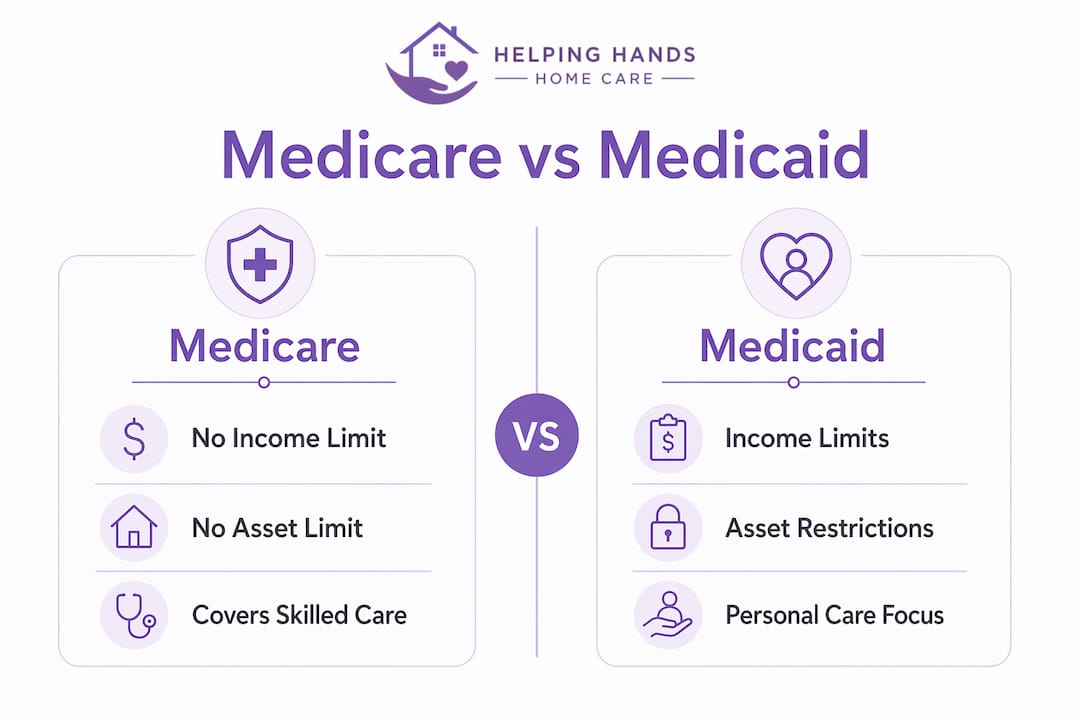
Medicaid home care eligibility typically requires low income and limited assets, often no more than $2,000 in countable resources. That asset threshold is strict, and many families are caught off guard when savings or a second vehicle disqualifies a loved one.
Medicaid also separates two distinct service types:
- Skilled home health services: Similar to Medicare, covering nursing and therapy for medically necessary care.
- Personal care services: Assistance with bathing, dressing, meal preparation, and mobility. These do not require skilled care but do require documented functional impairment.
Medicaid personal care eligibility typically excludes individuals who require skilled nursing care. The program focuses on those who can be managed with personal assistance and who can direct their own care or have a representative to do so. This self-direction model gives families more control over scheduling and caregiver selection.
State rules vary significantly. Some states offer expanded home and community-based waiver programs with different income thresholds. Coordinating with your local Medicaid office is the only reliable way to confirm current home care assistance eligibility in your state.
What triggers long-term care insurance benefits?
Long-term care insurance operates on a trigger system rather than a medical certification process. Benefits activate when specific functional or cognitive thresholds are crossed.
The standard triggers are:
- The insured cannot perform at least 2 out of 6 Activities of Daily Living (ADLs) independently. ADLs include bathing, dressing, eating, toileting, transferring, and continence.
- The insured has severe cognitive impairment, such as Alzheimer’s disease, that requires supervision for safety.
Once triggered, most policies do not pay immediately. An elimination period of typically 90 days requires families to pay fully out of pocket before benefits begin. This period functions like a deductible measured in time rather than dollars. Families who do not plan for this gap often face financial strain at the most stressful point of the care process.
A second common misconception involves who can provide care. Most long-term care insurance policies require care to be delivered by state-licensed agencies. Family members and informal caregivers are not reimbursable under standard reimbursement policies. Indemnity policies differ and may offer more flexibility, but they are less common.
Pro Tip: Pull out your loved one’s long-term care policy now, before a crisis occurs. Confirm the elimination period length, the ADL trigger count, and whether the policy requires a licensed agency. These three details determine your actual out-of-pocket exposure.
What documentation do families need to apply?
The requirements for receiving in home care involve more paperwork than most families expect. Preparing documentation in advance prevents delays that can leave your loved one without care for weeks.
Key documents and steps include:
- Face-to-face encounter: Medicare requires a face-to-face visit with a qualified provider within 90 days before or 30 days after the start of home health care. This visit establishes medical necessity and certifies the plan of care. Missing this window invalidates the claim.
- Functional assessment records: For Medicaid, a formal assessment documenting which ADLs your loved one cannot perform independently is required. Gather physician notes, hospital discharge summaries, and therapy evaluations.
- Financial documentation: Medicaid applicants need bank statements, asset records, and income verification. Organize at least three months of financial records before applying.
- Agency certification verification: Confirm the agency is Medicare-certified or Medicaid-approved before signing any care agreement. You can verify Medicare-certified agencies through the Medicare.gov Care Compare tool.
- Recertification planning: Medicare requires physician recertification every 60 days. Build a calendar reminder to avoid gaps in coverage caused by missed recertification deadlines.
Reviewing financial assistance options early in the process helps families understand which funding source to pursue first and how to layer benefits when one source does not cover all needs.
Home health vs. personal care: why the difference matters
The distinction between medically licensed home health and non-medical personal care is the most misunderstood aspect of home care assistance eligibility. Confusing the two leads to denied claims, unmet needs, and in some cases, safety risks.
Home health care is medical in nature. Licensed nurses perform skilled nursing tasks such as wound care, medication management, and IV therapy. Physical, occupational, and speech therapists deliver rehabilitative services. Home health aides cannot administer medications or perform skilled nursing tasks. Those duties are reserved for licensed nurses or therapists. This distinction directly affects how services are classified and what insurance will cover.
Non-medical personal care covers assistance with bathing, dressing, grooming, meal preparation, and light housekeeping. These services do not require a physician order under most programs, but they also do not qualify for Medicare coverage on their own.
| Service Type | Provider | Medicare Covered | Medicaid Covered |
|---|---|---|---|
| Skilled nursing | Licensed RN or LPN | Yes | Yes |
| Physical therapy | Licensed therapist | Yes | Yes |
| Home health aide | Certified aide | Only with skilled care | Often yes |
| Personal care | Trained caregiver | No | Often yes |
| Housekeeping | Support worker | No | Limited |
State training and certification requirements for home health aides vary widely. Families should verify an agency’s training standards when selecting a provider. An aide who is not properly trained for your loved one’s specific needs creates both safety and liability risks. Understanding the full range of home care types before signing a care agreement prevents costly mismatches between what you pay for and what your loved one actually receives.
Pro Tip: Ask any agency you interview to provide written documentation of their aides’ certifications and training hours. A reputable agency will provide this without hesitation.
Key takeaways
Qualifying for in-home care requires meeting distinct medical, functional, and financial criteria that vary by funding source, and families who prepare documentation early and verify agency certification avoid the most common and costly delays.
| Point | Details |
|---|---|
| Medicare requires four criteria | Homebound status, skilled care need, physician plan of care, and a certified agency must all be met. |
| Medicaid adds financial limits | Asset limits often cap at $2,000 in countable resources; state rules vary and require local verification. |
| Insurance triggers ADL thresholds | Benefits activate when 2 out of 6 ADLs cannot be performed; a 90-day elimination period applies. |
| Documentation prevents delays | Face-to-face encounter, functional assessments, and financial records must be gathered before applying. |
| Care type affects coverage | Home health aides are only Medicare-covered alongside skilled services; personal care follows different rules. |
What i’ve learned watching families navigate this system
Most families arrive at the eligibility process believing Medicare covers everything indefinitely. That assumption costs them. Medicare does not cover ongoing personal care unless skilled services are also being provided. When skilled care ends, home health aide coverage ends with it. Families who did not plan for this transition suddenly face full out-of-pocket costs.
The second pattern I see repeatedly is underestimating what “homebound” means. Families assume their parent does not qualify because they occasionally attend church or visit a doctor. CMS guidelines are more flexible than most people realize. If leaving home requires considerable effort or assistance, your loved one likely meets the standard. Advocate for that documentation with the physician.
Early documentation is not just paperwork. It is protection. Every delay in gathering records, every missed face-to-face encounter, every uncertified agency is a potential denial. Families who treat the eligibility process like a project, with checklists and deadlines, get better outcomes than those who rely on the healthcare system to manage it for them.
The emotional weight of this process is real. You are simultaneously managing a loved one’s declining health and learning a complex benefits system. My strongest advice: do not do it alone. Connect with a local Area Agency on Aging, a social worker, or a certified home care agency that knows how to navigate these requirements. Advocacy matters more than most families realize.
— Michael
How Helping-hands-home-care supports families through this process
Figuring out who qualifies for home care services is hard enough. Finding a provider you can trust should not be.
Helping-hands-home-care works with families to match care needs with the right level of service, whether that means certified home health aide support, personal care assistance, or supplemental services like housekeeping and massage therapy. Every care plan is built around your loved one’s specific eligibility status and documented needs. Helping-hands-home-care’s aides meet state certification standards, and the team can walk you through what documentation you need before your first appointment. Reach out today for a no-obligation care assessment and start the process with a team that knows how to get it right.
FAQ
Who qualifies for medicare home health care?
To qualify, a patient must be homebound, require skilled nursing or therapy services, have a physician-certified plan of care, and receive care from a Medicare-certified agency. There is no copay or deductible for covered services.
What is the asset limit for medicaid home care?
Medicaid home care typically requires countable assets of no more than $2,000, though limits vary by state. Income must also fall below state-specific thresholds for eligibility to apply.
Does long-term care insurance cover family caregivers?
Standard reimbursement policies do not cover family members or informal caregivers. Benefits are generally paid only for care delivered by state-licensed home care agencies.
How long does medicare home health coverage last?
Medicare home health coverage has no preset time limit. Coverage continues as long as eligibility criteria are met, with physician recertification required every 60 days.
What is the difference between home health care and personal care?
Home health care involves skilled medical services provided by licensed nurses or therapists. Personal care covers non-medical assistance such as bathing, dressing, and meal preparation, and follows different eligibility and coverage rules.
Recommended
- Difference Between Home Care Types: Family Guide 2026 | Helping Hands Home Care
- Home Care Services for Seniors: A Family Guide | Helping Hands Home Care
- Financial Assistance for Home Care of Elderly Loved Ones | Helping Hands Home Care
- What Is the Home Care Industry? A 2026 Family Guide | Helping Hands Home Care