
Hospice vs Home Care: A Family Guide
Hospice vs Home Care: A Family Guide

Hospice is end-of-life comfort care focused on symptom management and family support; non-medical home care is ongoing, custodial help with daily living so your loved one can stay safely at home. Those two goals rarely overlap, and knowing which one fits your situation right now can change everything about the next call you make.
Immediate next steps:
- If a doctor has mentioned a life expectancy of six months or less, ask your physician about hospice eligibility under Medicare Part A.
- If your loved one needs help with bathing, meals, or housekeeping but is not facing a terminal prognosis, contact a non-medical home care agency like Helping-hands-home-care for a care assessment.
- If you are unsure which applies, the National Institute on Aging has a plain-language FAQ that walks families through both options.
Table of Contents
- Hospice vs home care: side-by-side comparison
- How hospice works: eligibility, services, and what to expect
- What non-medical home care covers and how to arrange it
- How home health care differs from both hospice and non-medical care
- How to decide between hospice and non-medical home care
- Helping-hands-home-care supports families who need non-medical in-home help
- Key Takeaways
- What families get wrong about hospice and home care
- Trusted U.S. sources for further reading
Hospice vs home care: side-by-side comparison
| Dimension | Hospice | Non-Medical Home Care |
|---|---|---|
| Primary goal | Comfort and quality of life; symptom control | Maintain daily independence and safety |
| Typical services | Pain management, nursing, chaplaincy, bereavement counseling, medications/equipment for terminal diagnosis | Bathing, dressing, meal prep, housekeeping, transportation, companionship |
| Who provides care | Interdisciplinary team: RNs, social workers, chaplains, hospice aides, physicians | Caregivers, home health aides, CNAs (no clinical license required for non-medical tasks) |
| Eligibility | Terminal prognosis with physician certification; patient elects comfort care | No medical eligibility threshold; arranged directly with an agency |
| Payment/coverage | Medicare Part A pays for hospice when a Medicare-approved provider delivers care; Medicaid also covers hospice | Primarily private pay; Medicaid waivers, VA benefits, long-term care insurance may help |
| Usual timing | When curative treatment is no longer the goal | Any time a senior needs daily living support |
| Common settings | Home, assisted living, nursing home, inpatient hospice facility | Private home (occasionally assisted living) |
| Family/bereavement support | Bereavement counseling, social work, spiritual support — core services, not add-ons | Companionship for the patient; family support varies by agency |
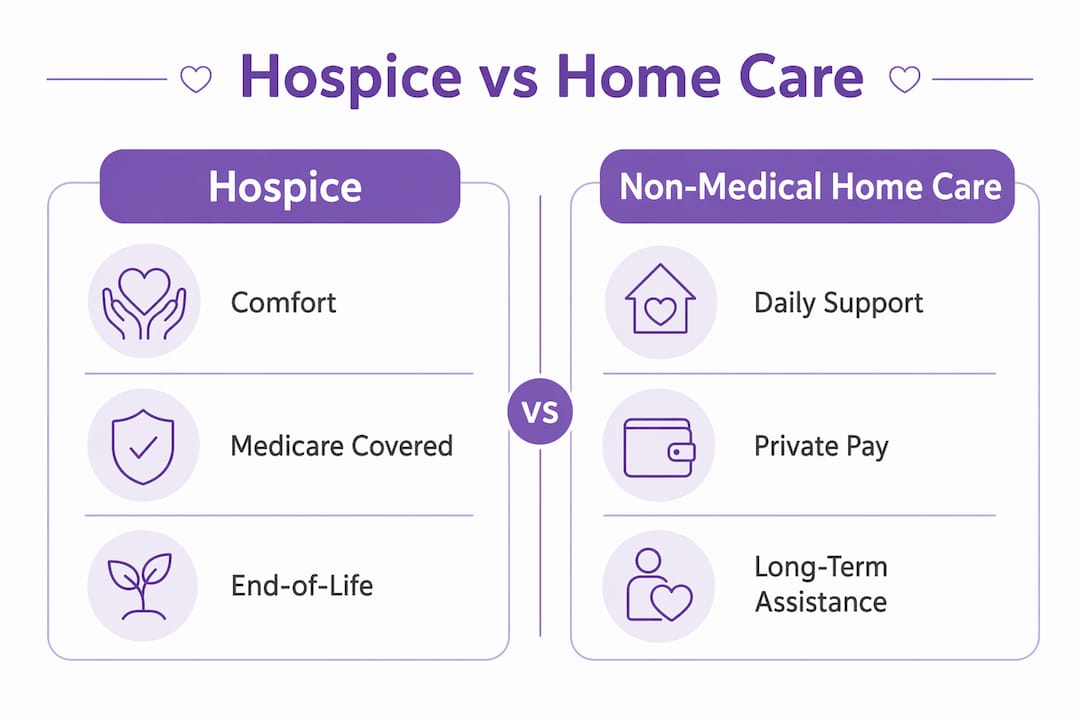
The two most consequential differences: Medicare pays for hospice in full when a Medicare-approved provider delivers care, while non-medical home care is almost always private pay. And hospice requires a physician to certify a terminal prognosis — non-medical home care does not.
Pro Tip: Hospice patients are not required to be homebound. Unlike Medicare-covered home health, a hospice patient can still take outings, attend family events, or visit a restaurant when they feel up to it. Many families don’t realize this until weeks into care.
How hospice works: eligibility, services, and what to expect
Hospice is for people who have accepted comfort-focused care and whose physician has certified a terminal prognosis — specifically, a life expectancy of six months or less if the illness runs its normal course. Physician certification is normally required for the Medicare hospice benefit to activate.
Core hospice services typically include:
- Pain and symptom management (medications, equipment)
- Skilled nursing visits
- Hospice aide and homemaker services
- Medical social work
- Chaplaincy and spiritual care
- Dietary counseling
- Grief and bereavement counseling for both patient and family
The Medicare hospice benefit is structured as two 90-day benefit periods, followed by unlimited 60-day periods with periodic physician recertification. Families should plan for those recertification checkpoints — if a patient’s condition stabilizes, the hospice team will reassess eligibility.
One thing families consistently underestimate: bereavement counseling and social work are not optional extras. Per CMS hospice conditions of participation, counseling services must be available to both patient and family throughout the care period. The NIA reinforces this — hospice supports the whole family, not just the person who is ill.
For families navigating the emotional weight of this decision, the end-of-life home care guide from Helping-hands-home-care walks through what to expect at each stage.
What non-medical home care covers and how to arrange it
Non-medical home care delivers custodial support: help with bathing, dressing, meal preparation, light housekeeping, transportation, and companionship. No clinical treatment, no physician order required. Caregivers, home health aides, and CNAs handle these tasks — formal clinical credentials are not required for non-medical roles.
Typical services include:
- Personal care (bathing, grooming, dressing, toileting)
- Meal planning and preparation
- Light housekeeping and laundry
- Medication reminders (not administration)
- Transportation to appointments
- Companionship and social engagement
Payment options include private pay, Medicaid waiver programs, VA benefits, and long-term care insurance. Consumer guides commonly report national hourly averages in the low-to-mid $30s range, though costs vary significantly by region and the number of hours needed each week.
How to arrange non-medical home care with an agency:
- Call the agency and describe your loved one’s daily needs and schedule.
- Schedule an in-home assessment so the agency can build a care plan.
- Review the care plan, staffing approach, and billing structure before signing.
- Confirm caregiver consistency — ask how the agency handles call-outs.
- Set a 30-day check-in to adjust hours or tasks as needs change.
How home health care differs from both hospice and non-medical care
Home health is a third category that families often conflate with the other two. It is medical, physician-ordered care aimed at recovery or rehabilitation — skilled nursing, physical therapy, occupational therapy, wound care. Medicare covers home health when a doctor orders it and the patient meets homebound status criteria.
Common home health services:
- Skilled nursing assessments and wound care
- Physical and occupational therapy
- Speech-language pathology
- IV therapy or injections
The functional difference from hospice: home health is restorative (the goal is improvement), while hospice is palliative (the goal is comfort). The difference from non-medical home care: home health is clinical and requires a doctor’s order; non-medical care is custodial and requires only a phone call to an agency.
A typical home health scenario: a senior discharged after hip replacement surgery receives PT visits three times a week until they can safely walk independently. Once that goal is met, home health ends. If ongoing daily support is still needed, non-medical home care picks up where home health leaves off.
How to decide between hospice and non-medical home care
One rule of thumb covers most situations: choose hospice when the primary goal is comfort and life expectancy is limited; choose non-medical home care when the goal is maintaining daily function and independence.
Decision checklist:
- Has a physician indicated a prognosis of six months or less? If yes, ask about hospice eligibility.
- Is the primary goal curative treatment, comfort, or daily support?
- What level of medical symptom management is needed (pain control, IV medications)?
- How much caregiver burden is the family carrying — and is respite care needed?
- What does current insurance cover? Check Medicare Part A for hospice; check Medicaid waivers or long-term care insurance for home care.
Questions to ask at intake:
| Area | What to ask | Why it matters |
|---|---|---|
| Medical needs | “Does my loved one meet hospice eligibility?” | Confirms whether a physician certification is needed |
| Staffing | “How do you handle caregiver consistency?” | Turnover disrupts trust and routine |
| Coverage/cost | “What does Medicare or my insurance cover here?” | Prevents billing surprises |
| Availability | “Can you start within the week?” | Urgent needs require fast response |
| Emergencies | “Who do we call at 2 AM?” | After-hours support is non-negotiable |
Red flags to watch for:
- Agency cannot provide references or state licensing information
- Inconsistent or frequently changing caregivers
- Vague or verbal-only billing explanations
- No written care plan after the initial assessment
Start conversations with your primary care physician early — before a crisis forces the decision. That one step, recommended by consumer care guides, gives families time to compare options without the pressure of an emergency discharge.
Helping-hands-home-care supports families who need non-medical in-home help
When your loved one needs daily support at home but is not yet in hospice, Helping-hands-home-care offers personal care, homemaker services, and companionship tailored to seniors. The focus is on preserving independence and reducing caregiver burden — not clinical treatment.


Services include in-home personal care, house cleaning and homemaker support, and massage therapy for comfort and mobility. Helping-hands-home-care is not a hospice provider, but the team coordinates with hospice and home health agencies when those services are also in place — so care does not fall through the gaps.
Ready to talk through what your loved one needs? Request a care assessment and a Helping-hands-home-care team member will walk you through the options.
Key Takeaways
Hospice and non-medical home care serve different goals at different life stages, and knowing which one applies determines both the care your loved one receives and who pays for it.
| Point | Details |
|---|---|
| Hospice eligibility | Requires a physician-certified prognosis of six months or less and a patient election of comfort care. |
| Medicare covers hospice | Medicare Part A pays for hospice services from a Medicare-approved provider; non-medical home care is usually private pay. |
| Non-medical home care | Covers ADLs, housekeeping, and companionship — no doctor’s order needed, arranged directly with an agency. |
| Home health is separate | Physician-ordered, restorative clinical care; requires homebound status for Medicare coverage. |
| Helping-hands-home-care | Provides non-medical in-home personal care, cleaning, and companionship for seniors not yet in hospice. |
What families get wrong about hospice and home care
The assumption I see most often is that choosing hospice means giving up. Families delay the conversation because it feels like a surrender, and that delay costs them weeks of better symptom control, professional support, and rest. Hospice is not the absence of care — it is a different kind of care, one that is often more intensive than what families manage on their own.
The second blind spot is caregiver burnout. Families pour themselves into daily care for months before asking for help, and by the time they call an agency, they are running on empty. Non-medical home care is not a luxury — it is what keeps the primary caregiver functional enough to actually be present for their loved one.
The third thing families consistently miss: these two types of care are not mutually exclusive in every scenario. A senior receiving hospice at home can also have a non-medical caregiver present for companionship and daily tasks. The hospice team handles clinical and emotional support; the home care aide handles the practical daily work. Knowing that opens up options most families never consider.
Trusted U.S. sources for further reading
- Medicare.gov hospice coverage — Use this to verify what Medicare Part A covers, benefit period structure, and how to find a Medicare-approved hospice provider.
- National Institute on Aging hospice FAQs — Plain-language answers on family support, bereavement services, and what to expect emotionally. Bring specific questions from this page to your first hospice intake meeting.
- CMS Hospice Conditions of Participation — The federal regulatory framework governing hospice quality standards; useful if you want to understand what a Medicare-certified hospice is legally required to provide.
- A Place for Mom — non-medical home care — Consumer-friendly overview of non-medical home care services and payment options, including Medicaid waivers and VA benefits.
- Caring.com — home care vs hospice — Practical comparison guide; useful for families still deciding which type of care fits the current situation.
This article is general information, not medical or legal advice. Confirm eligibility, coverage rules, and care options with your physician, a licensed hospice provider, or Medicare directly for your specific situation.