
Home Care vs. Adult Day Programs: Family Guide 2026
Home Care vs. Adult Day Programs: Family Guide 2026

Home care is defined as personalized support delivered inside a senior’s own residence, while adult day programs are community-based centers providing structured daytime supervision, social activities, and health monitoring. Understanding the difference between home care and adult day programs is the most important step families take before committing to a care plan. The wrong choice costs money, strains caregivers, and can reduce a senior’s quality of life. The right choice, or the right combination, can extend independent living by years.
What is the core difference between home care and adult day programs?
Home care and adult day programs differ in three fundamental ways: where care happens, when it happens, and how it is structured. Home care brings a trained aide or nurse into the senior’s home. Adult day programs bring the senior into a community center, typically for weekday daytime hours only.
Home care covers a wide range of personal care assistance tasks: bathing, dressing, meal preparation, medication reminders, and companionship. Skilled nursing visits can be layered on top for seniors with complex medical needs. The care is one-on-one and built around the individual’s schedule and preferences.

Adult day programs operate on a group model. A licensed nurse monitors health on-site, and the daily schedule includes structured activities, peer interaction, and hot meals. The setting is social by design. That distinction matters enormously depending on what your loved one actually needs.
What services do home care and adult day programs each provide?
The service gap between these two options is wider than most families expect. Here is a direct breakdown:
Home care services typically include:
- Personal hygiene assistance (bathing, grooming, dressing)
- Meal preparation and feeding support
- Light housekeeping and laundry
- Medication reminders and management
- Companionship and emotional support
- Transportation to appointments
- Skilled nursing visits for wound care, injections, or health monitoring
Adult day program services typically include:
- Structured group activities (arts, music, exercise, cognitive games)
- Hot meals and snacks served on-site
- On-site licensed nursing for health monitoring
- Social engagement with peers
- Transportation to and from the center (often bundled into the daily rate)
- Caregiver support groups and resources
Adult day programs provide meals and transportation as part of their daily rate, while home care families typically handle groceries and transport separately. That bundling makes adult day care more cost-transparent for weekday coverage.
Home care can be customized to include skilled nursing and specialized behavioral management, which is particularly valuable for seniors with complex medical conditions. Adult day centers have licensed nurses on-site, but they serve the whole group, not one individual.
Pro Tip: Ask any adult day program you tour whether their nursing staff ratio meets your loved one’s specific health monitoring needs. Some centers have one nurse for 20 or more participants.
How do scheduling and flexibility differ?
Scheduling is where these two care types diverge most sharply for working families. The structure of each option shapes your entire week.
Adult day programs operate during fixed weekday hours and exclude overnight care entirely. Most centers run roughly 7:00 a.m. to 6:00 p.m., Monday through Friday. If your loved one needs care on a Saturday, or at 9:00 p.m., an adult day program cannot help.
Home care works on your schedule. Here is how the flexibility breaks down in practice:
- Part-time coverage: A home care aide visits a few hours per week for light assistance and companionship.
- Daytime coverage: An aide works full weekday hours, mirroring what a day program offers but in the home.
- Extended hours: Morning and evening shifts cover the gaps around a day program schedule.
- Live-in or 24/7 care: A full-time aide or rotating team provides around-the-clock support for seniors with high needs.
Adult day care gives caregivers predictable daytime relief, typically 6–8 hours per weekday, allowing family members to work or rest. That predictability is genuinely valuable. Many caregivers underestimate how much they need a reliable, repeating break rather than occasional help.
The practical reality for most families is that neither option alone covers everything. A senior who attends a day program still needs someone to help them get ready in the morning and get to bed at night.
What are the cost differences between the two options?
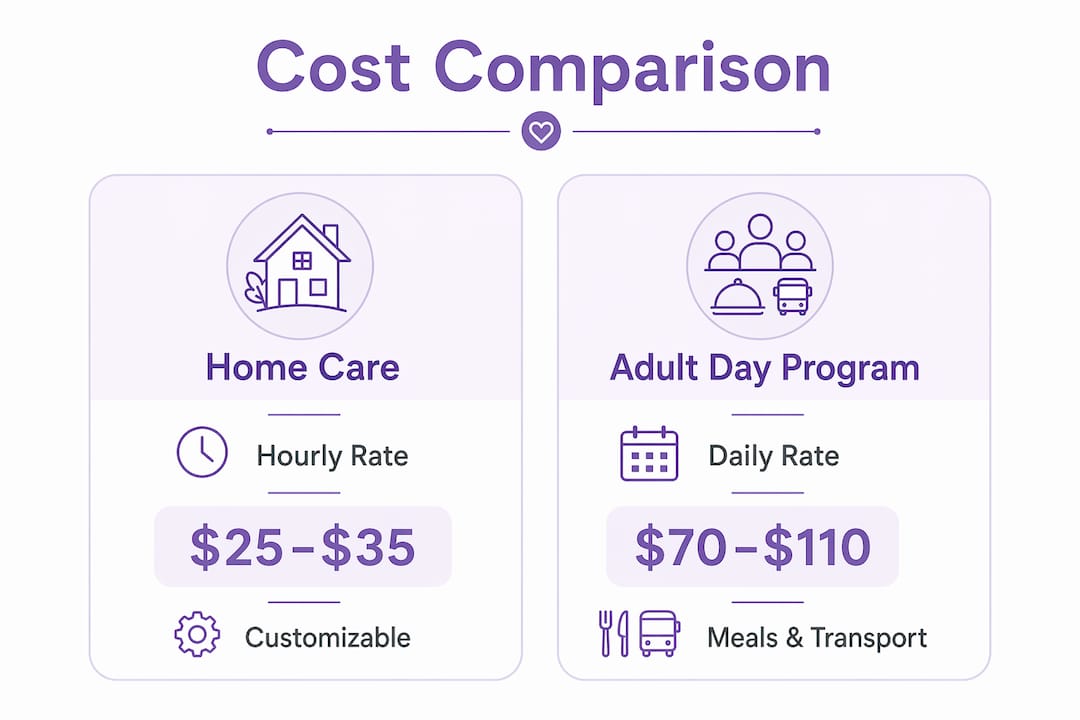
Cost is the deciding factor for many families, and the numbers here are specific enough to plan around.
| Cost Factor | Home Care | Adult Day Program |
|---|---|---|
| Billing structure | Hourly rate | Flat daily rate |
| Typical rate | $25–$35 per hour | $70–$110 per day |
| Meals included | No | Yes |
| Transportation included | No | Often yes |
| Overnight coverage | Yes (additional cost) | No |
| Weekend availability | Yes | Rarely |
Home care hourly rates average $25–$35, while adult day programs charge $70–$110 per day. That math favors day programs for full weekday coverage. Eight hours of home care at $30 per hour costs $240. A full day at an adult day center costs $70–$110, and that includes meals and often transportation.
Medicaid waiver programs in most states cover adult day services for eligible seniors. Veterans’ benefits through the VA also fund adult day health services in many cases. Long-term care insurance policies vary widely, so call your insurer directly to confirm what each care type covers.
Pro Tip: Request a full written fee schedule from any provider before signing. Some home care agencies charge a higher rate for evenings, weekends, and holidays, which can significantly change your monthly total.
Which seniors benefit more from home care or adult day programs?
Matching the right care type to the right person is where families most often go wrong. The decision depends on health status, cognitive condition, personality, and social needs.
Seniors who typically do better with home care:
- Those with advanced Alzheimer’s or severe agitation who find group settings overstimulating
- Seniors experiencing sundowning, where familiar surroundings reduce confusion and distress
- Individuals with complex medical needs requiring one-on-one skilled nursing attention
- Those who are highly introverted or socially anxious and find group environments exhausting
- Seniors with limited mobility who cannot manage daily transportation to a center
Seniors who typically do better with adult day programs:
- Those in early to moderate stages of dementia who still engage socially and benefit from structure
- Seniors experiencing isolation and loneliness that home care alone cannot address
- Individuals who respond well to routine, group activities, and peer relationships
- Seniors whose primary caregiver works full-time and needs reliable weekday coverage
Home care can lead to isolation when a senior spends most of their time with only one aide in a private home. Adult day programs build meaningful social engagement into every day, which research consistently links to better cognitive and emotional outcomes in older adults.
The honest answer is that most seniors fall somewhere in the middle. A senior with moderate dementia who loves music and group activities may thrive at a day program three days per week while needing home care support the other days.
How can families combine both for better elder support?
The most effective community-based senior care plan uses adult day centers on weekdays combined with home care aides during early mornings, evenings, and weekends. This approach fills every gap without the cost of full-time home care or the limitations of a day program alone.
A practical combined schedule looks like this:
- Weekday mornings: Home care aide helps with bathing, dressing, and breakfast before transport to the day program.
- Weekday daytime: Adult day program provides meals, activities, nursing oversight, and social engagement.
- Weekday evenings: Home care aide assists with dinner, medications, and bedtime routine.
- Weekends: Home care aide covers full days, or a family member takes over with aide backup as needed.
Combining adult day services with home care effectively extends seniors’ independent living and reduces premature placement in residential facilities. Families who use this model report lower caregiver burnout and greater confidence in their loved one’s safety.
“The goal is not to choose between home care and a day program. The goal is to build a week that works for the senior and the family.”
When coordinating two providers, share care notes between them. Give the day program staff a written summary of your loved one’s morning routine, medications, and behavioral triggers. Give your home care aide a summary of what activities the senior did at the center that day. Continuity of information is what makes combined care feel seamless for the senior.
Key takeaways
The most effective elder care plan treats home care and adult day programs as complementary tools, not competing options, matched to a senior’s specific health, social, and scheduling needs.
| Point | Details |
|---|---|
| Setting defines the difference | Home care happens at home; adult day programs happen at community centers on weekday schedules. |
| Cost favors day programs for weekdays | Adult day rates of $70–$110 per day beat equivalent home care hours and include meals and transport. |
| Social needs matter | Seniors with isolation risk benefit from adult day programs; those with severe dementia often do better at home. |
| Combined care fills every gap | Pairing home care for mornings, evenings, and weekends with a day program covers the full week affordably. |
| Flexibility is home care’s strength | Home care scales from a few weekly hours to 24/7 coverage, adapting as a senior’s needs change. |
What i’ve learned after years of watching families navigate this choice
Most families come to this decision exhausted. They have already been providing informal care for months, sometimes years, and they are looking for one answer. My honest observation is that the search for a single solution is usually the first mistake.
I have seen families choose full-time home care because it felt more personal, only to watch their loved one become increasingly withdrawn and depressed from lack of social contact. I have also seen families push a senior with severe dementia into an adult day program because it was cheaper, and the daily agitation and confusion that resulted made everyone’s life harder.
The families who get this right are the ones who start with the senior’s actual daily experience, not the cost spreadsheet or the logistics. They ask: does my loved one need quiet and familiarity, or do they need people and structure? Then they build the schedule around that answer and adjust the budget to fit.
Combining home care services with a day program is not a compromise. It is often the most thoughtful and sustainable plan available. The families I have seen do this well treat the two providers as a team, communicate between them, and revisit the plan every few months as the senior’s needs evolve.
— Michael
How Helping-hands-home-care supports families through every stage
Choosing the right care setup is hard enough without also worrying about whether your home care provider can adapt as needs change. Helping-hands-home-care builds flexible home health aide plans designed to work alongside adult day programs, not compete with them. Whether your loved one needs morning and evening support around a day program schedule, or full-time in-home care, the team at Helping-hands-home-care tailors coverage to fit your family’s actual week.
Helping-hands-home-care also offers supplemental services including professional home cleaning and massage therapy to support senior comfort and independence at home. If you are ready to build a care plan that covers every gap, contact Helping-hands-home-care to discuss your options with a care coordinator today.
FAQ
What is the main difference between home care and adult day programs?
Home care delivers personalized support inside a senior’s residence with flexible hours, while adult day programs provide structured group activities, meals, and health monitoring at a community center during weekday daytime hours only.
Are adult day programs cheaper than home care?
Adult day programs typically cost $70–$110 per day and include meals and transportation, making them more cost-effective than equivalent hours of home care, which averages $25–$35 per hour billed separately.
Can a senior use both home care and an adult day program?
Yes. Many families combine adult day programs for weekday daytime coverage with home care aides for mornings, evenings, and weekends, creating a full-week care plan that extends independent living.
Is home care better for seniors with dementia?
Seniors with advanced dementia or severe agitation often do better with home care in a familiar, quiet environment. Those in earlier stages of dementia may benefit from the structure and social engagement of an adult day program.
Does insurance cover adult day programs or home care?
Medicaid waiver programs cover adult day services in most states, and VA benefits often fund adult day health services for veterans. Long-term care insurance policies vary, so confirm coverage directly with your insurer for both care types.
Recommended
- Home Care Services for Seniors: A Family Guide | Helping Hands Home Care
- Difference Between Home Care Types: Family Guide 2026 | Helping Hands Home Care
- What Is the Home Care Industry? A 2026 Family Guide | Helping Hands Home Care
- Why Hire a Professional Home Caregiver for Your Family | Helping Hands Home Care