
Caregiver Background Check: What Families and Employers Must Run
Caregiver Background Check: What Families and Employers Must Run

A caregiver background check is a set of criminal, registry, and identity verifications you run before allowing anyone unsupervised access to a vulnerable adult or child. The single most important first step: get written consent from the candidate and decide which checks the role actually requires.
Before you order anything, confirm you have these in place:
- Written disclosure and consent signed by the candidate (required under the FCRA if you use a Consumer Reporting Agency)
- Identity/SSN trace to confirm the person is who they claim to be and to surface address history
- Criminal records search covering counties where the candidate lived and worked
- Sex-offender registry check via the National Sex Offender Public Website (NSOPW)
- State abuse and neglect registry search for every state where the candidate provided care
- OIG/LEIE exclusion check if the caregiver will be paid through Medicare or Medicaid
The scope expands from there depending on the role, the state, and whether you are a licensed agency or a private household employer. The sections below walk through each component, the legal rules that govern them, and the practical steps to get it done right.
Key Takeaways
A compliant caregiver background check requires written consent first, then criminal, registry, OIG, and identity checks matched to the role and state, with FCRA adverse-action steps followed if you decline to hire.
| Point | Details |
|---|---|
| Consent before the check | Written FCRA disclosure and signed authorization must come before any CRA report is ordered. |
| Registry checks are not optional | Search state abuse/neglect registries and OIG/LEIE in addition to criminal records for every caregiver role. |
| Fingerprints for regulated roles | Medicaid/Medicare-funded agencies in CMS-participating states typically require fingerprint-based FBI checks. |
| FCRA adverse-action is two steps | Send a pre-adverse notice with the report, wait at least five business days, then send the final notice if declining. |
| Helping-hands-home-care | Provides pre-vetted home health aides in metro Detroit with screening, documentation, and renewal tracking handled for families. |
Table of Contents
- What actually shows up on a caregiver background check
- How to run a compliant caregiver background check, step by step
- U.S. legal requirements every employer needs to understand
- Fingerprinting, interstate checks, and out-of-state work history
- How long checks take, what they cost, and when to renew
- Interpreting results and following the adverse-action process
- Practical templates and checklists you can use right now
- Agency vs. private hire: who is responsible for what
- What we actually recommend in practice
- Helping-hands-home-care handles the screening so you can focus on care
- Primary sources to verify requirements
- Sources
What actually shows up on a caregiver background check
A background screening for caregivers pulls from several distinct data sources, and understanding which ones you ordered matters as much as reading the results.
Criminal records
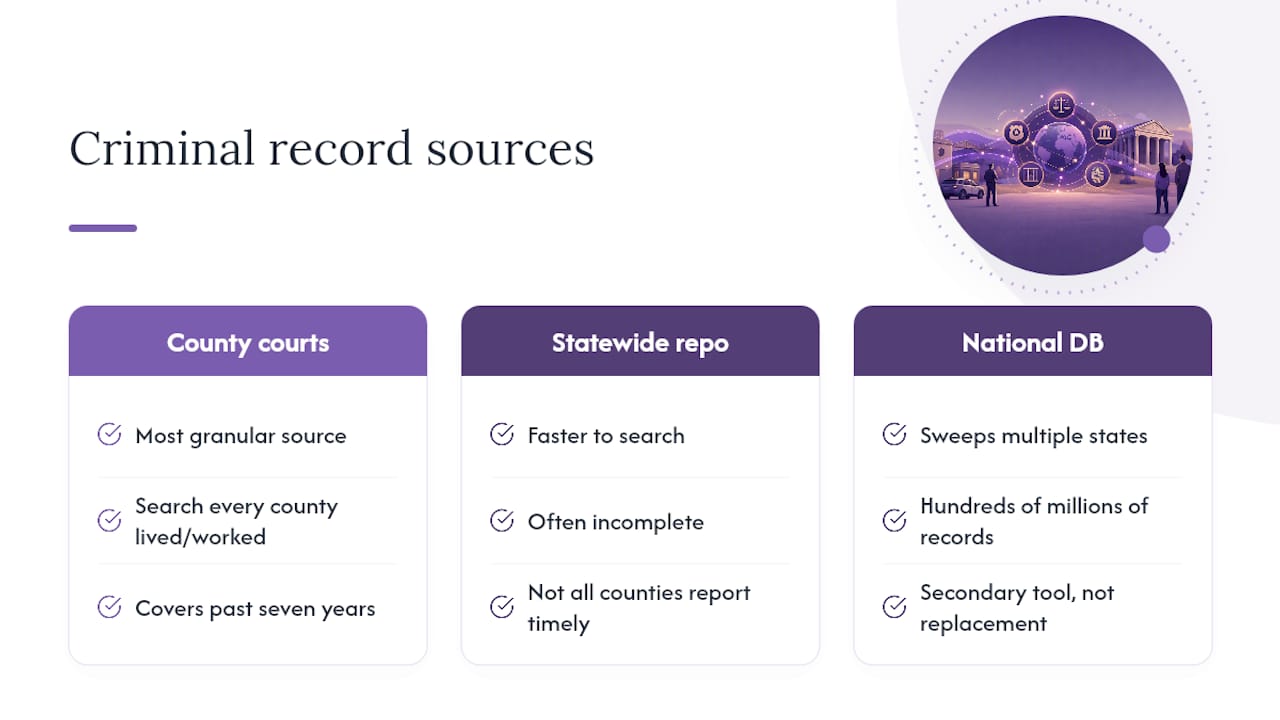
County criminal court records are the most granular source. A thorough search covers every county where the candidate lived or worked in the past seven years, not just a single statewide database. Statewide repository searches are faster but often incomplete because not every county court reports to the state system on time. A national criminal database search sweeps across hundreds of millions of records from multiple states, but it is a secondary tool, not a replacement for county-level pulls, because coverage and update frequency vary widely.
Sex-offender registry
The NSOPW aggregates state sex-offender registries into a single searchable portal. Reputable Consumer Reporting Agencies query it as a standard component. Listings on the sex-offender registry are typically indefinite, so a conviction from decades ago still appears.
State adult and child abuse and neglect registries
These registries track substantiated findings of abuse or neglect by caregivers and are maintained separately from criminal courts. A caregiver can have a clean criminal record and still appear on an abuse registry. Critically, each state runs its own registry with its own access rules, so you may need to submit requests to multiple states if the candidate worked in more than one. Fingerprint-based checks and state abuse-registry queries are the most reliable ways to find substantiated abuse findings that often do not appear in commercial name-based searches.
OIG/LEIE and GSA exclusions
The Office of Inspector General’s List of Excluded Individuals and Entities (LEIE) identifies people barred from participating in federally funded health programs. If your caregiver is paid through Medicare or Medicaid, hiring someone on this list exposes you to significant civil monetary penalties. The GSA’s System for Award Management (SAM.gov) covers a broader set of federal exclusions. Both are free to search and should be checked monthly for ongoing employees in regulated settings.
Identity and SSN trace
An SSN trace is not a background check itself; it is the foundation for one. It confirms the Social Security Number belongs to the candidate, surfaces aliases, and returns a list of addresses and counties to search. Without it, you may miss records filed under a maiden name or a previous address.
Motor vehicle records, professional licenses, and employment verification
If the caregiver will drive a client, an MVR is non-negotiable. Professional license verification confirms that a certified nursing assistant (CNA) or home health aide (HHA) holds a current, unrevoked credential. Employment verification catches gaps or misrepresentations in work history that might signal undisclosed terminations for cause.
The gap most families miss: Commercial multi-state database searches feel thorough, but they routinely miss abuse-registry findings and records from courts that do not report electronically. A clean database result is not the same as a clean record.
Pro Tip: Ask any CRA you hire to list every specific source they searched, by name and jurisdiction. “National criminal database” is not a source; it is a marketing label. You want county names, registry names, and confirmation that the NSOPW and OIG/LEIE were included.
How to run a compliant caregiver background check, step by step
The process differs slightly depending on whether you are a private household employer or a licensed home care agency, but the core sequence is the same.
-
Extend a conditional offer. Do not run a background check before making an offer. Checking first and then deciding whether to interview is a practice that can create legal exposure under ban-the-box laws in many states.
-
Provide a written FCRA disclosure. If you are using a Consumer Reporting Agency, you must give the candidate a standalone written disclosure that a background report may be obtained for employment purposes. It cannot be buried in an application or an employee handbook. The Fair Credit Reporting Act requires this disclosure to be a separate document.
-
Obtain written authorization. The candidate signs the disclosure form, giving you permission to run the check. Keep the signed copy in the hiring file.
-
Gather candidate information. Collect full legal name, date of birth, Social Security Number, current and previous addresses for the past seven years, and any aliases or name changes. This information drives the SSN trace and county search list.
-
Choose a CRA or state system. Agencies subject to state licensing typically must use state-designated systems or approved vendors. Private household employers can use any FCRA-compliant CRA. Confirm the CRA searches the specific registries your state requires.
-
Request the specific searches. Order the components appropriate to the role: criminal (county plus statewide), sex-offender registry, state abuse/neglect registries, OIG/LEIE, SSN trace, and MVR or license verification if applicable.
-
Collect fingerprints if required. Some states and all CMS-funded programs require a fingerprint-based FBI check. Coordinate with a Live Scan provider or a state-designated fingerprint collection site.
-
Review results carefully. A hit is not automatically disqualifying. Evaluate the nature of the offense, how long ago it occurred, and its relevance to the caregiver role. Document your reasoning.
-
Follow the adverse-action process if you are not moving forward. This is a two-step requirement under the FCRA:
- Send a pre-adverse action notice with a copy of the report and a summary of the candidate’s rights. Wait a reasonable period (typically five business days) for the candidate to dispute inaccuracies.
- If you still decide not to hire, send a final adverse action notice stating the decision, the CRA’s name and contact information, and the candidate’s right to obtain a free copy of the report within 60 days.
-
Document and store records. Keep the signed consent, the report, and your written hiring decision (including the reasoning) for at least five years. For regulated agencies, check your state’s specific retention requirements.
For privately hired caregivers: You bear full responsibility for ordering, reviewing, and documenting every check. There is no agency compliance team behind you. The FCRA still applies if you use a CRA, even for a single household hire.
For agency-placed caregivers: The agency typically runs the checks and carries the compliance burden, but you should ask for written confirmation of what was searched and when. Agencies serving Medicaid or Medicare clients may be required to run expanded checks under CMS’s National Background Check Program.
U.S. legal requirements every employer needs to understand
FCRA essentials
The Fair Credit Reporting Act governs any employer who uses a third-party CRA to obtain a background report. The key obligations are disclosure, written consent, and the two-step adverse-action process described above. Skipping the pre-adverse notice step is one of the most common FCRA violations and creates real legal exposure, even for small household employers.
EEOC guidance on arrest and conviction records
The Equal Employment Opportunity Commission has issued guidance making clear that blanket policies excluding anyone with a criminal record can violate Title VII if they create a disparate impact on protected groups. The required approach is an individualized assessment: consider the nature of the crime, how much time has passed, and whether the offense is directly relevant to the caregiver role. Document your reasoning in writing. A theft conviction from 15 years ago is a different risk calculation than a recent assault conviction for someone who will be alone with a frail adult.
EEOC individualized assessment in practice: The question is not “does this person have a record?” but “does this specific record create an unacceptable risk for this specific role?” Document the connection between the offense and the job duties every time you decline a candidate based on a conviction.
CMS National Background Check Program
The Centers for Medicare and Medicaid Services funds state programs that require expanded background checks for employees with direct patient access in Medicaid and Medicare-funded settings. Under CMS’s program, participating states may require fingerprint-based FBI checks, state registry searches, and OIG/LEIE verification. If your agency bills Medicare or Medicaid, check whether your state participates and what the specific requirements are.
State registry requirements
Every state maintains its own abuse and neglect registry with its own access rules, disqualifying offenses, and renewal schedules. Some states require registry checks before a caregiver’s first day; others allow a provisional hire while the check is pending. For home care background check requirements by state, states differ widely on required check types, who pays, and renewal frequency. Check your state’s Department of Health or Department of Social Services for the exact mandate.
Fair-chance hiring laws
More than a dozen states and many cities have enacted ban-the-box or fair-chance hiring laws that restrict when in the hiring process you can ask about or run criminal checks. These laws interact with caregiver screening requirements in ways that can be genuinely complicated. When in doubt, consult an employment attorney familiar with your state’s rules.
Fingerprinting, interstate checks, and out-of-state work history
When fingerprint-based checks are required
Fingerprint-based FBI checks, typically collected via Live Scan, are more comprehensive than name-based searches because they match against a national criminal database using biometric identifiers rather than name and date of birth. They are less susceptible to false negatives from name changes or aliases. States participating in the CMS National Background Check Program often require them for direct-care workers in licensed facilities. Some states, including California and Florida, require fingerprint checks for home care workers regardless of funding source.

The interstate gap problem
A caregiver who lived in three states over the past decade has criminal and registry records spread across three separate systems. A name-based search limited to your current state will miss records from the others. An SSN trace solves part of this by returning a full address history, which tells you which counties and states to search. But state abuse registries are not interconnected; you must submit a separate request to each state where the caregiver worked in a care role.
Privately hired caregivers may not be subject to the same fingerprint or registry searches that agencies use, creating coverage gaps for families who rely solely on commercial background checks. This is the single biggest risk for families who hire independently.
Practical options for private households
- Run a multi-state commercial criminal database search as a starting point, but treat it as a screening tool, not a final answer.
- Submit abuse-registry requests directly to every state where the candidate provided care. Most states have an online request process.
- Ask any agency the candidate previously worked for to confirm their clearance status in writing.
- If the candidate’s role involves driving, order an MVR for every state where they held a license.
Pro Tip: At the start of the hiring process, ask the candidate to write out every address and employer for the past seven to ten years. This takes five minutes and gives you the exact jurisdictions to search, which is far more reliable than guessing from a resume.
How long checks take, what they cost, and when to renew
Turnaround times
The speed of a background check depends entirely on what you ordered. An instant database search returns results in minutes, but it is only as current as the database’s last update. County criminal court searches that require a court runner or a manual pull take one to seven business days. Fingerprint-based FBI checks vary by state, ranging from a few days to several weeks depending on the state’s processing volume and whether the candidate’s prints are already in the system.
State abuse-registry requests are the most variable. Some states respond within a few days; others take two to four weeks. Plan for this when setting a start date.
Typical costs
Per-hire screening costs range roughly $30–$150 depending on scope. A basic package covering a national database search and sex-offender registry sits at the low end. A comprehensive package adding county-level criminal pulls, SSN trace, abuse-registry requests, OIG/LEIE, and license verification lands in the middle to upper range. Fingerprint-based FBI checks add state-specific fees on top of that.
Renewal schedules
Renewal frequency depends on your state and the funding source. Many states require annual rechecks for licensed home care workers. Others set a two-to-four-year cycle. CMS-funded programs often require ongoing OIG/LEIE monitoring monthly, not just at hire. A practical approach for agencies: use scheduling software or a simple spreadsheet to track each caregiver’s clearance date and set a 60-day advance reminder. Automating background-check renewals and using software to track expiration dates reduces compliance risk for agencies managing multiple caregivers.
For provisional hires, most states allow a caregiver to begin work while a check is pending, provided they are supervised and the check was initiated before the first day. Confirm your state’s specific provisional-hire rules before relying on this.
Interpreting results and following the adverse-action process
Not every hit on a background report is a disqualifier. Reading results correctly protects you legally and ensures you are making fair, defensible decisions.
-
Convictions vs. arrests. An arrest without a conviction is not proof of wrongdoing. The EEOC’s guidance discourages using arrests alone as a basis for adverse action. A conviction is a different matter, but the individualized assessment still applies.
-
Sealed or expunged records. Under most state laws, sealed or expunged records should not appear on a background report. If one does, it may be a reporting error. Flag it and ask the CRA to investigate before taking action.
-
Sex-offender registry hits. Confirm the match is the same person by verifying name, date of birth, and physical description. False positives from common names do occur. A confirmed match is typically an absolute disqualifier for any caregiver role.
-
Abuse-registry findings. A substantiated finding on a state abuse or neglect registry is among the most serious results you can receive. Many states make it a legal bar to employment in a care role. Verify the finding is correctly matched to your candidate before acting.
-
OIG/LEIE exclusions. If a candidate appears on the LEIE and the role involves Medicare or Medicaid billing, you cannot hire them without risking federal penalties. This is not a judgment call.
-
Identity mismatches. If the SSN trace returns a name or date of birth that does not match what the candidate provided, ask for clarification before proceeding. Innocent explanations exist (a legal name change, a data entry error), but so do fraudulent ones.
Handling disputes: Before sending a final adverse-action notice, give the candidate a genuine opportunity to dispute the findings. Errors in background reports are more common than most people expect. The candidate has the right to contact the CRA directly to dispute inaccuracies, and the CRA must investigate within 30 days.
Adverse-action timing: Send the pre-adverse notice with the report and the candidate’s rights summary. Wait at least five business days. If you still decide not to hire, send the final adverse-action notice. Document both steps with dates.
Conditional hiring: For borderline findings, consider whether supervision, restricted duties (no solo visits, no access to finances), or a probationary period adequately manages the risk. Document the plan in writing and revisit it at a defined date. A home safety review of the care environment can also inform how much supervision is practical.
Practical templates and checklists you can use right now
FCRA disclosure and consent language (sample)
The following is a starting-point template. Have an employment attorney review it before use.
Background Investigation Disclosure and Authorization
In connection with your application for employment (or continued employment), [Employer Name] (“Company”) may obtain a consumer report (background report) about you from [CRA Name], a consumer reporting agency. This report may include information about your character, general reputation, personal characteristics, mode of living, and criminal history.
This document is a disclosure made to you before the report is obtained. It is provided to you as a separate document, as required by the Fair Credit Reporting Act (15 U.S.C. § 1681 et seq.).
By signing below, you authorize the Company and its designated agents to obtain such a report.
Candidate signature: _____________ Date: _________
Pre-adverse action notice (required elements)
Send this before making a final decision. Include:
- A copy of the background report
- A copy of “A Summary of Your Rights Under the Fair Credit Reporting Act” (available from the FTC)
- A statement that you are considering an adverse action based on the report
- The CRA’s name, address, and phone number
- A statement that the CRA did not make the hiring decision
Allow at least five business days for the candidate to respond before sending the final notice.
Final adverse action notice (required elements)
- Statement that an adverse action has been taken
- The CRA’s name, address, and phone number
- A statement that the CRA did not make the decision and cannot explain why
- Notice of the candidate’s right to a free copy of the report within 60 days
- Notice of the candidate’s right to dispute the accuracy of the report with the CRA
Hiring checklist
- [ ] Conditional offer extended before check initiated
- [ ] FCRA disclosure provided as a standalone document
- [ ] Written authorization signed and filed
- [ ] Candidate information collected (name, DOB, SSN, address history, aliases)
- [ ] CRA selected and searches ordered (criminal, sex-offender, abuse registry, OIG/LEIE, SSN trace)
- [ ] Fingerprints collected if required by state or program
- [ ] Results reviewed with individualized assessment documented
- [ ] Pre-adverse notice sent (if applicable) with report and rights summary
- [ ] Five-business-day waiting period observed
- [ ] Final adverse notice sent (if applicable) or hire confirmed
- [ ] All documents filed: consent, report, decision memo, notices
Pro Tip: Store the signed consent form, the background report, and your written hiring rationale in a single folder per employee, physical or digital. If you are ever audited or face a legal challenge, having everything in one place is the difference between a quick resolution and a prolonged headache.
On documentation: The National Institute on Aging documents elder abuse as a serious public-health concern. Thorough screening and careful recordkeeping are not bureaucratic exercises; they are the primary protection you have for the people in your care. A well-documented hiring process also demonstrates good faith if a hiring decision is ever challenged.
Agency vs. private hire: who is responsible for what
The screening burden shifts significantly depending on how you bring a caregiver into your home.
Key differences at a glance
Licensed home care agency: The agency runs the background checks, maintains compliance with state licensing requirements, and carries the legal liability for screening gaps. They typically run a broader set of checks, including state registry searches and, in many states, fingerprint-based FBI checks. You should ask for written confirmation of what was searched and when. Reviewing how to choose the right home care agency before you commit helps you ask the right questions.
Private household employer: You are the employer of record. Every compliance obligation falls on you: FCRA disclosure, consent, adverse-action process, registry searches, and recordkeeping. You also have limited access to fingerprint-based checks unless your state offers a public portal. The scope of checks you can realistically run is narrower than what a licensed agency can access.
Self-directed Medicaid worker: The worker is technically employed by the Medicaid recipient or a fiscal intermediary. Background check requirements vary by state Medicaid program. Some states require the same checks as licensed agencies; others have lighter requirements. Check your state’s Medicaid agency for the specific mandate.
Questions to ask any agency before you hire
- Which specific criminal databases, counties, and states did you search for this caregiver?
- Did you run a fingerprint-based FBI check? If not, why not?
- Which state abuse and neglect registries did you search, and for which states?
- Did you check the OIG/LEIE and GSA exclusion lists?
- When was the most recent background check completed, and what is your renewal schedule?
- Can you provide written documentation of the clearance?
- What is your policy if a caregiver’s renewal check returns a disqualifying finding?
- Do you conduct ongoing OIG/LEIE monitoring between hire dates?
A reputable agency answers all of these without hesitation. Vague answers or resistance to providing written clearance documentation are red flags worth taking seriously.
What we actually recommend in practice
The minimum scope for any unsupervised home care role should include a county-level criminal search covering all recent addresses, sex-offender registry, state abuse and neglect registry for every state where the candidate provided care, OIG/LEIE exclusion check, and an SSN trace. For Medicaid-paid roles, add a fingerprint-based FBI check where your state requires or allows it.
On the fairness side: follow the EEOC’s individualized assessment framework every time a conviction appears. Document the specific connection between the offense and the job duties. A blanket “no criminal history” policy is both legally risky and practically counterproductive in a field where the labor pool is already tight.
For families who want pre-vetted caregivers without managing this process themselves, Helping-hands-home-care handles screening and compliance so you do not have to.
Helping-hands-home-care handles the screening so you can focus on care
Running a compliant caregiver background check takes time, access to the right registries, and a working knowledge of FCRA rules. Most families did not sign up to become HR compliance officers.
Helping-hands-home-care provides pre-vetted home health aides in the metro Detroit area, with background screening handled before any caregiver enters your home. Every aide goes through criminal history checks, registry verification, and identity confirmation as part of the onboarding process. You can request documentation of clearance, and renewals are tracked on your behalf. No paperwork to manage, no registry portals to navigate, and no adverse-action notices to draft. Contact Helping-hands-home-care to confirm availability and get started with a caregiver who has already been cleared.
Primary sources to verify requirements
Use these official sources to confirm the rules that apply to your specific state, role, and funding source.
- Fair Credit Reporting Act (FTC): The full text of the FCRA, including disclosure, consent, and adverse-action requirements. Consult this for any question about your obligations when using a CRA.
- EEOC — Title VII guidance: The EEOC’s enforcement guidance on using arrest and conviction records in employment decisions. Required reading before you set a criminal-record policy.
- CMS National Background Check Program: CMS resources on state background check programs for Medicare and Medicaid-funded direct-care workers. Check here if your agency bills either program.
- OIG List of Excluded Individuals/Entities (LEIE): Free, searchable database of individuals excluded from federal health programs. Search every new hire and recheck monthly for ongoing employees in regulated settings.
- National Sex Offender Public Website (NSOPW): The federal portal aggregating state sex-offender registries. Free to search and should be part of every caregiver screening.
- National Institute on Aging — Elder Abuse: Authoritative information on the prevalence and impact of elder abuse, supporting the public-health case for rigorous caregiver screening.
- State-by-state home care background check requirements (Aveecare): A practical summary of how requirements differ by state, including renewal schedules and cost ranges.
- Your state’s Department of Health or Department of Social Services: The definitive source for your state’s specific registry access procedures, disqualifying offenses, provisional-hire rules, and renewal mandates. Search “[your state] caregiver background check requirements” on your state agency’s official .gov site.
This article is general information, not a substitute for advice from a qualified lawyer. Consult a qualified legal professional about your own circumstances before acting on anything here.
Sources
- Fair Credit Reporting Act — FTC
- Title VII, Civil Rights Act enforcement and related guidance — EEOC
- Background check resources — CMS
- Caregiver Background Checks: What to Require and Why — National Caregiver Authority
- Elder abuse — National Institute on Aging
Recommended
- How to Hire an In-Home Caregiver Step by Step | Helping Hands Home Care
- Why Hire a Professional Home Caregiver for Your Family | Helping Hands Home Care
- The Role of Home Caregiver: Responsibilities and Support | Helping Hands Home Care
- How to Choose the Right Home Care Agency for Your Family | Helping Hands Home Care