
Detroit In-Home Physical Therapy Guide for Families
Detroit In-Home Physical Therapy Guide for Families

In-home physical therapy is defined as licensed rehabilitation delivered inside a patient’s home by a credentialed physical therapist, replacing clinic visits with treatment in the patient’s actual living environment. This detroit in-home physical therapy guide covers every step Detroit families need: who qualifies, how Medicare pays, what sessions look like, and how to choose a provider. Helping-hands-home-care works alongside these services to give Detroit residents coordinated, skilled support at home. The standard industry term is “home health physical therapy,” and you will see both terms used throughout.
What is the Detroit in-home physical therapy guide for eligibility?
Home health physical therapy in Detroit is not available to every patient who wants it. Medicare and most insurers apply specific criteria before approving a single visit.

Homebound status is the first and most critical requirement. A patient is homebound when leaving home requires a considerable effort, such as needing a wheelchair, walker, or the help of another person. Occasional short trips for medical appointments do not disqualify someone, but regular outings do.
The core qualifying criteria include:
- Physician or nurse practitioner order. A licensed provider must write a referral before therapy begins. No order means no coverage.
- Medical necessity. The therapy must address a skilled clinical need, not just general fitness or maintenance exercise.
- Qualifying condition. Common triggers include recent hospital discharge after surgery or stroke, a fall resulting in fracture or mobility loss, and progressive conditions like Parkinson’s disease or severe arthritis.
- Skilled care requirement. The treatment must require the judgment of a licensed physical therapist, not just a caregiver performing routine tasks.
- Medicaid and private insurance. Michigan Medicaid follows similar homebound rules. Private plans vary, so families should call the insurer directly to confirm prior authorization requirements before scheduling.
The Medicare eligibility rules for home health services are detailed and worth reviewing before contacting any agency. Knowing the criteria in advance prevents delays and denied claims.
How does Medicare and insurance coverage work for in-home physical therapy in Detroit?
Medicare is the primary payer for most Detroit seniors receiving home physical therapy, and the rules are specific enough to affect every family’s budget.
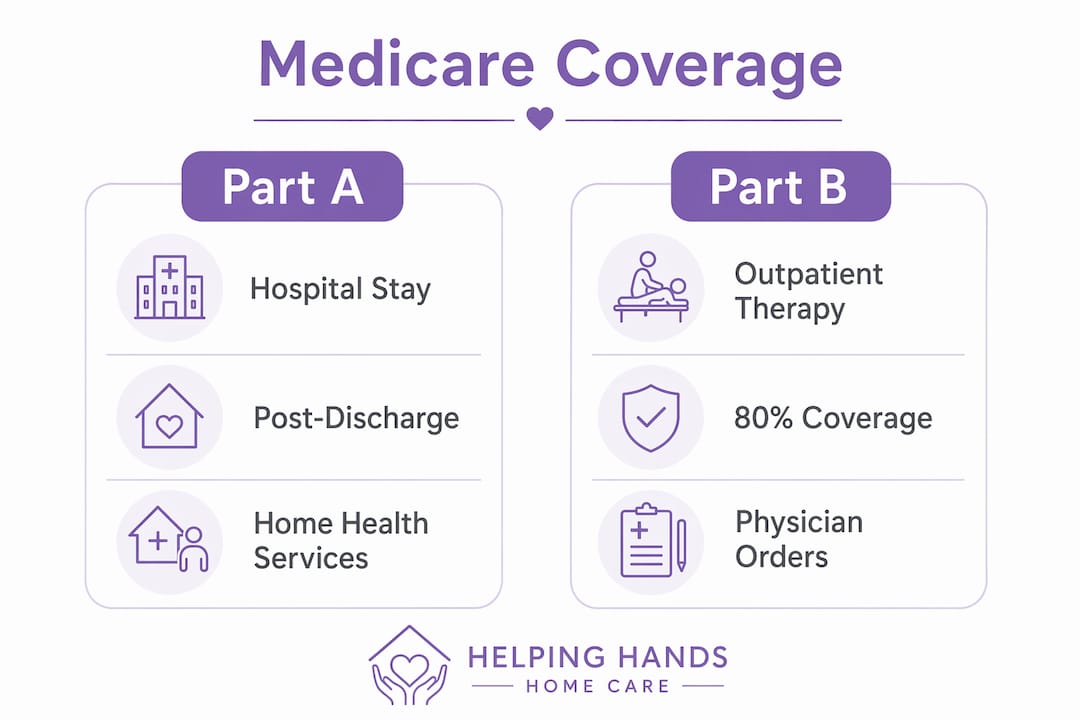
Medicare Part A vs. Part B
Medicare Part A covers home health services when a patient is discharged from a hospital stay of at least three days. Medicare Part B covers intermittent, medically necessary in-home physical therapy for patients who qualify as homebound, typically paying 80% of approved costs after the annual deductible is met. Out-of-pocket costs depend on whether the patient holds a Medigap supplement policy, which can cover the remaining 20%.
The $2,410 spending threshold
Medicare sets a $2,410 spending threshold on physical therapy services per year in 2025, after which a physician must certify that continued therapy is medically necessary. This does not mean therapy stops at that dollar amount. It means the documentation burden increases, and families should expect their therapist to coordinate with the referring physician at that point.
Documentation and claim denials
Medicare requires skilled documentation on every therapy visit showing why a licensed therapist’s unique clinical judgment was necessary. Notes that simply list exercises performed are not sufficient. Claims get denied when notes fail to explain the therapist’s reasoning, the patient’s response, and the plan going forward.
Pro Tip: Ask any agency you consider how their therapists document visits. Agencies with strong internal auditing processes have far lower denial rates than those that leave documentation entirely to individual therapists.
Medicare Advantage plans
Medicare Advantage plans sold through private insurers follow their own rules on prior authorization, visit limits, and in-network providers. A Detroit family whose loved one holds an Advantage plan should confirm network status and authorization requirements before the first visit. Failing to do so is the single most common reason families receive unexpected bills.
| Coverage type | What it pays | Key condition |
|---|---|---|
| Medicare Part A | Home health after qualifying hospital stay | 3-night inpatient stay required |
| Medicare Part B | 80% of approved costs after deductible | Homebound status and physician order |
| Medigap supplement | Covers remaining 20% in most plans | Must be enrolled before claim |
| Medicare Advantage | Varies by plan | Prior authorization often required |
What should families expect during a typical in-home physical therapy session in Detroit?
A home physical therapy session is not a casual exercise class. It is a structured clinical encounter with measurable goals and formal documentation.
A standard course of treatment follows this sequence:
- Initial evaluation. The therapist assesses range of motion, muscle strength, balance, gait, and fall risk using standardized tools. This visit takes 60–90 minutes and sets the baseline for all future progress tracking.
- Home environment assessment. Therapists assess home environments thoroughly, checking stair safety, bathroom grab bars, and furniture placement. These findings directly shape therapy goals and fall prevention plans.
- Treatment activities. Sessions include therapeutic exercise, transfer training (moving from bed to chair, for example), balance training, and manual therapy techniques when appropriate.
- Family coaching. The therapist teaches family members or caregivers how to assist with transfers and exercises safely between visits.
- 30-day reassessment. Initial and 30-day reassessments by a qualified physical therapist, not an assistant, are mandatory under Medicare’s defined-point measurement requirements. These reassessments document objective progress and justify continued coverage.
“In-home physical therapy enables therapists to perform functional assessments in a patient’s actual home, identifying real-world safety hazards like missing grab bars or uneven flooring that a clinic visit would never reveal. That context produces safer, more targeted treatment plans.”
The therapist communicates findings to the referring physician after each reassessment. Families should ask to receive a copy of progress notes so they can track goals alongside the clinical team.
How to choose a qualified in-home physical therapy provider in Detroit?
Choosing the right provider shapes the entire recovery experience. Detroit families have access to a range of home health agencies, and the differences between them matter.
Key criteria for vetting any provider:
- Therapist credentials. Look for a Doctor of Physical Therapy (DPT) degree and a current Michigan state license. Both are verifiable through the Michigan Department of Licensing and Regulatory Affairs.
- Agency Medicare certification. Only Medicare-certified agencies can bill Medicare directly. Confirm certification before signing any agreement.
- Continuity of care. Ask whether the same therapist will conduct every visit. State licensing laws govern how many assistants a supervising therapist may oversee, and rotating staff disrupts the therapeutic relationship and slows progress.
- Communication practices. Families should explicitly ask providers about their communication frequency. Agencies that send weekly progress summaries to both families and physicians produce better care coordination than those that communicate only when problems arise.
- Insurance compatibility. Confirm the agency accepts the patient’s specific plan, including any Medicare Advantage network requirements.
- Patient reviews and referrals. Ask the referring physician or hospital discharge planner for agency recommendations. Online reviews on Google and Medicare’s Care Compare tool provide additional perspective.
Pro Tip: Request a list of the specific therapists who would serve your family member before committing to an agency. A strong agency with a weak individual therapist assignment still produces poor outcomes.
The Detroit home care options available in 2026 vary significantly in quality and cost. Doing this vetting work upfront saves families from switching agencies mid-treatment, which resets the documentation process and can delay insurance approvals.
What are common challenges and tips for maximizing therapy success?
Even well-planned home therapy programs run into obstacles. Knowing the most common ones in advance lets families prepare rather than react.
- Insurance approval delays. Prior authorization for Medicare Advantage and private plans can take days. Submit the physician order and clinical documentation to the insurer the same day the referral is written. Waiting costs therapy time.
- Unclear documentation. If a claim is denied, request the denial reason in writing immediately. Most denials are correctable through an appeal with additional clinical notes. Do not accept a denial as final without reviewing it with the agency.
- Preparing the home environment. Clear pathways of clutter, secure loose rugs, and install grab bars in bathrooms before the first visit. Home environment preparation directly affects what the therapist can accomplish and how safely sessions proceed.
- Caregiver engagement. Caregiver involvement during therapy improves patient adherence and reduces rehospitalization. Attend sessions when possible, ask the therapist to demonstrate exercises, and practice them with your family member between visits.
- Recognizing the transition point. Home therapy is designed for patients who are homebound. When a patient regains the ability to travel safely, the appropriate next step is outpatient physical therapy, which offers more equipment and group exercise options. Staying in home therapy past that point can limit progress.
Key Takeaways
Effective in-home physical therapy in Detroit requires verified eligibility, accurate Medicare documentation, and a provider who maintains consistent therapist assignment and clear family communication.
| Point | Details |
|---|---|
| Homebound status is required | Patients must need considerable effort to leave home before Medicare approves coverage. |
| Documentation drives coverage | Every visit note must explain clinical reasoning, not just list exercises, or claims get denied. |
| The $2,410 threshold triggers review | Spending beyond this amount requires physician recertification, not automatic termination of therapy. |
| Same therapist improves outcomes | Continuity of care produces faster progress than rotating staff assignments. |
| Caregiver involvement matters | Families who participate in sessions and practice exercises between visits reduce rehospitalization risk. |
What home therapy in Detroit taught me about getting it right
Most families I speak with assume the hardest part of arranging home physical therapy is finding a therapist. The hardest part is actually the documentation. Therapists who write strong, clinically detailed notes get claims approved. Therapists who write vague notes get claims denied, and families end up paying out of pocket for care they believed was covered.
The second thing families consistently underestimate is the value of the home environment assessment. A clinic therapist sees a patient on a treatment table. A home therapist sees the actual stairs, the actual bathroom, the actual path from the bedroom to the kitchen. That context produces a completely different, and far more useful, treatment plan. I have seen patients discharged from outpatient therapy still falling at home because nobody ever looked at their environment.
My honest advice: do not choose a provider based on which agency calls you back first after a hospital discharge. Ask specifically about therapist credentials, documentation practices, and whether you will see the same therapist every visit. Those three questions separate strong agencies from weak ones faster than any review site will.
Home-based rehabilitation is not a lesser version of clinic care. For elderly patients and those recovering from surgery or injury, it is often the better option. The therapy meets the patient where the patient actually lives.
— Michael
Helping-hands-home-care supports Detroit families through recovery
Detroit families managing a loved one’s recovery at home need more than a single service. Helping-hands-home-care provides skilled home health aide services that work alongside in-home physical therapy to cover the full picture of daily care.

Home health aides from Helping-hands-home-care assist with personal care, mobility support, and daily routines between therapy visits, reinforcing the progress therapists work to build. The team also coordinates with insurance plans and can help families prepare documentation for coverage requests. For families who want additional comfort during recovery, home massage therapy is available as a complementary service. Contact Helping-hands-home-care directly to discuss a care plan built around your family member’s specific needs.
FAQ
Who qualifies for home physical therapy in Detroit?
Patients qualify when they are homebound, have a physician’s order, and require skilled physical therapy for a medically necessary condition. Common qualifying situations include post-surgical recovery, stroke rehabilitation, and significant mobility decline.
How much does in-home physical therapy cost with Medicare?
Medicare Part B covers 80% of approved costs after the annual deductible, leaving patients responsible for the remaining 20% unless a Medigap policy covers it. Medicare Advantage plans vary, so confirming costs with the specific plan before starting therapy is necessary.
How often does a physical therapist visit at home?
Visit frequency depends on the physician’s order and the patient’s clinical needs, typically ranging from two to five visits per week in the early phase of recovery. The treating therapist adjusts frequency based on progress and insurance authorization.
What happens at the first home physical therapy visit?
The first visit is a full evaluation covering range of motion, strength, balance, gait, fall risk, and a thorough assessment of the home environment for safety hazards. It takes 60–90 minutes and produces the treatment plan that guides all future sessions.
Can a family member stay during therapy sessions?
Family members are not only welcome but encouraged to attend sessions. Engaged caregivers improve functional outcomes and reduce rehospitalization by learning how to assist safely with exercises and transfers between visits.