
Home Care Accreditation Explained for Families in 2026
Home Care Accreditation Explained for Families in 2026

Home care accreditation is defined as a voluntary, third-party validation that confirms a home care agency meets nationally recognized standards for clinical care, operations, and regulatory compliance. Understanding home care accreditation matters because it separates agencies that simply hold a state license from those that have passed rigorous independent review. For families choosing care for an elderly loved one, that distinction carries real weight. This article breaks down what accreditation means, which bodies grant it, how the process works, and what it actually guarantees.
What is home care accreditation and why does it matter?
Home care accreditation is a voluntary third-party process that validates agencies against national standards for clinical care, operations, and compliance, frequently exceeding what state licensure requires. State licensure is mandatory and sets the legal floor. Accreditation is optional and raises the bar above that floor. That distinction matters enormously when you are choosing who enters your parent’s home every day.
The three primary accrediting bodies recognized with CMS deeming authority in the United States are the Accreditation Commission for Health Care (ACHC), the Community Health Accreditation Partner (CHAP), and The Joint Commission. CMS deeming authority means an accreditor’s survey can substitute for the federal CMS survey that Medicare-certified agencies must otherwise undergo. This gives accreditation real regulatory teeth, not just a marketing badge.
Accreditation is required in roughly 50% of states for managed-care and Medicaid contracting as of 2026. That means accredited agencies can access a wider network of insurance and government payment programs. For families, this translates to more coverage options and a stronger signal that the agency operates at a high standard.

What are the main accrediting bodies for home care agencies?
ACHC, CHAP, and The Joint Commission each serve different agency profiles, and each accreditor suits a different agency type. ACHC fits mid-sized personal care agencies well. CHAP focuses on outcome-based certifications and appeals to community-oriented providers. The Joint Commission is the choice for large, hospital-linked home health systems. Knowing which body accredited an agency tells you something about the agency’s size and care model.
All three bodies assess agencies across similar core categories:
- Clinical standards: Care planning, medication management, infection prevention, and patient safety protocols
- Operational standards: Staff credentialing, supervision, training, and caregiver background screening
- Compliance standards: Documentation systems, complaint resolution, and adherence to federal and state regulations
- Quality improvement: Ongoing outcome tracking, internal audits, and corrective action processes
Accreditation timelines run 12 to 18 months from initial application through survey completion. That timeline reflects the depth of preparation required. Agencies cannot simply apply and pass a checklist. They must demonstrate sustained, documented performance across every standard category.
The table below summarizes the three main accreditors at a glance.
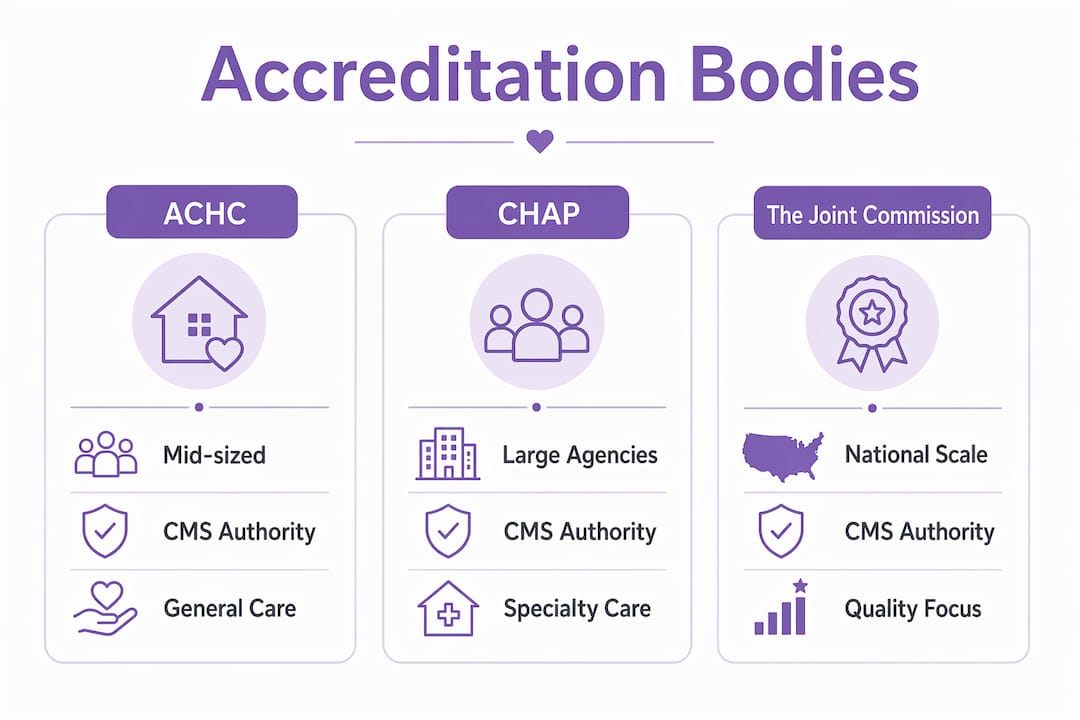
| Accreditor | Best fit | CMS deeming authority | Specialty focus |
|---|---|---|---|
| ACHC | Mid-sized personal care agencies | Yes | Personal and home health care |
| CHAP | Community-based providers | Yes | Outcome-focused certifications |
| The Joint Commission | Large, hospital-linked systems | Yes | Clinical excellence and safety |
For families, the practical takeaway is simple. Check which body accredited the agency, then verify that accreditation status directly through the accreditor’s public directory. All three maintain searchable online databases.
Pro Tip: Always verify an agency’s accreditation status on the accreditor’s official website, not just the agency’s own marketing materials. Status can lapse between re-survey cycles.
How does the home care accreditation process work?
The accreditation process follows a clear sequence from preparation through ongoing maintenance. Agencies that understand each stage avoid costly delays and failed surveys. Here is how it works from start to finish.
-
Pre-application preparation. The agency audits its existing policies, personnel files, and documentation systems against the accreditor’s published standards. Gaps get addressed before the application goes in. This phase often takes six months or more for agencies starting from scratch.
-
Application submission. The agency submits a formal application, pays the initial fee, and provides documentation of its services, staffing model, and geographic coverage. The accreditor reviews the submission and schedules the onsite survey.
-
Onsite survey. Surveyors visit the agency’s office and may conduct home visits with clients. They review clinical records, interview staff, observe care delivery, and verify that written policies match actual practice. This is where paper compliance meets real-world operations.
-
Plan of correction. If surveyors identify deficiencies, the agency must submit a written plan of correction within a set timeframe. The plan details how each deficiency will be resolved and by what date. Accreditation is not awarded until the plan is accepted.
-
Accreditation decision. The accreditor reviews all survey findings and issues a formal accreditation decision. Agencies that pass receive accreditation for a defined period, typically three years.
-
Re-survey cycle. Every three years, the agency undergoes a full re-survey. Between surveys, agencies must maintain documentation, complete required training, and respond to any complaints or incidents that trigger interim review.
Pro Tip: Agencies that assign a dedicated accreditation coordinator, even part-time, move through the process faster and maintain better documentation between survey cycles.
The survey process includes documentation review, staff interviews, and onsite inspections. Families can ask any agency they are considering how recently they completed their last survey and what the outcome was. A confident, transparent answer is itself a quality signal.
What benefits does accreditation offer families choosing home care?
Accreditation is a positive quality signal, but it is not a safety guarantee. That distinction matters. An accredited agency has demonstrated compliance with national standards at the time of its last survey. It has not guaranteed that every caregiver on every shift will perform perfectly. Families who understand this use accreditation as one filter among several, not as the final word.
“Accreditation should be seen as a helpful quality indicator, not a substitute for family due diligence. Verifying caregiver employment method, background checks, and complaint processes remains the family’s responsibility regardless of accreditation status.”
The importance of W-2 employment cannot be overstated. Agencies that employ caregivers as W-2 employees carry liability insurance, withhold taxes, and maintain direct supervisory control. Agencies that use independent contractors shift legal and financial risk. Accreditation does not specify which employment model an agency must use, so families must ask directly.
Beyond accreditation, families should verify these factors when evaluating any agency:
- State license status, confirmed through the state health department’s public portal
- Caregiver employment model (W-2 employee vs. independent contractor)
- Background check policy, including what databases are searched and how often checks are renewed
- Individualized care plan process, including how plans are updated as needs change
- Complaint resolution process, including who handles complaints and in what timeframe
- Supervisor visit frequency and how the agency monitors caregiver performance in the home
Learning how home care quality is measured gives families a fuller picture beyond the accreditation badge. Accreditation confirms structure and process. Family involvement confirms that the care being delivered actually matches what was promised.
What costs and commitments do agencies face for accreditation?
Initial accreditation fees for home care agencies range from $3,000 to $8,000, and that figure covers only the application and survey. It excludes the ongoing annual maintenance fees and the significant indirect costs that represent the true financial weight of accreditation.
The indirect costs are where agencies feel the real pressure. Staff spend 400 to 800 internal hours per accreditation cycle on documentation, training, and internal audits. At any reasonable labor rate, that time investment dwarfs the direct application fees. Agencies that underestimate this burden often struggle to maintain compliance between surveys.
| Cost category | Typical range | Notes |
|---|---|---|
| Initial application and survey fee | $3,000–$8,000 | Paid at application; varies by accreditor and agency size |
| Annual maintenance fees | Varies by accreditor | Ongoing; required to maintain active status |
| Internal staff hours per cycle | 400–800 hours | Documentation, training, and audit preparation |
| Quality system infrastructure | Varies | Policy software, training platforms, record systems |
Accreditation pays off most clearly for agencies pursuing managed-care and Medicaid contracts. These contracts represent major revenue streams that state-licensed-only agencies cannot access in many markets. For smaller agencies serving only private-pay clients, the return on investment is less clear and depends heavily on local market competition.
Pro Tip: Agencies considering accreditation should map their target payer mix first. If managed-care or Medicaid contracts are a growth priority, accreditation pays for itself quickly. If the agency serves only private-pay clients in a low-competition market, the calculus is different.
The home care industry best practices that accreditation enforces, including infection prevention protocols and documentation standards, also reduce liability exposure. That risk reduction has real financial value even when it does not show up directly on a fee schedule.
Key Takeaways
Accreditation is a voluntary, nationally recognized quality credential that families should treat as one important filter among several when choosing a home care agency.
| Point | Details |
|---|---|
| Accreditation vs. licensure | Licensure is mandatory; accreditation is voluntary and certifies performance above state minimums. |
| Three main accreditors | ACHC, CHAP, and The Joint Commission each hold CMS deeming authority and serve different agency profiles. |
| Process takes 12–18 months | Agencies must prepare policies, pass an onsite survey, and complete a plan of correction before earning status. |
| Verify beyond the badge | Families should confirm W-2 employment, background checks, and complaint processes alongside accreditation status. |
| Costs are significant | Direct fees run $3,000–$8,000, with 400–800 internal staff hours per cycle adding the real financial weight. |
Accreditation is a starting point, not a finish line
I have spoken with enough families navigating home care decisions to know that accreditation creates a false sense of security for many of them. They see the logo on an agency’s website and assume the vetting work is done. It is not.
What accreditation actually tells you is that an agency built the right systems, documented them properly, and passed a survey on a specific date. It does not tell you whether the caregiver who shows up on Tuesday morning is supervised, trained, and genuinely invested in your parent’s wellbeing. That requires a different kind of inquiry.
The question I always recommend families ask is this: “Are your caregivers W-2 employees, and can I speak with the supervisor who oversees my parent’s care?” An accredited agency that hesitates on either question deserves more scrutiny, not less. Accreditation is a floor, not a ceiling.
The growing role of accreditation in managed-care contracting is real and worth understanding. As more Medicare Advantage plans and Medicaid managed-care organizations require accreditation from their network providers, the credential becomes a practical filter for families using those plans. An agency without accreditation may simply not be available to you through your insurance. That is a practical reason to prioritize accredited providers, separate from any quality argument.
My honest advice: use accreditation as your first screen, then do the work of a thorough family interview. The home care assessment process gives you a framework for those conversations. Accreditation tells you an agency is serious. Your questions tell you whether it is the right fit.
— Michael
Quality care from Helping-hands-home-care
Helping-hands-home-care holds itself to the standards that accreditation requires, with vetted, W-2 employed caregivers who are background-checked and supervised by experienced care coordinators. Every client receives an individualized care plan, and the agency maintains transparent complaint and quality review processes.
Families who want quality care without the guesswork of sorting through unvetted providers can explore Helping-hands-home-care’s home health aid services for a full picture of what accreditation-aligned care looks like in practice. The agency also offers house cleaning and massage therapy services, supporting the whole-person wellbeing of elderly clients at home. Contact Helping-hands-home-care directly to discuss your family’s specific needs and get matched with the right level of care.
FAQ
What is home care accreditation?
Home care accreditation is a voluntary third-party process that validates an agency against national standards for clinical care, operations, and compliance. It goes beyond mandatory state licensure and is granted by bodies such as ACHC, CHAP, or The Joint Commission.
Is accreditation the same as a state license?
No. State licensure is mandatory and sets the legal minimum for operating. Accreditation is voluntary and certifies that an agency performs above those minimums, often enabling access to managed-care and Medicaid contracts.
How long does the accreditation process take?
The process typically takes 12 to 18 months from initial application through survey completion and accreditation decision. Agencies then undergo a full re-survey every three years to maintain their status.
What should families check beyond accreditation status?
Families should verify state license status through the state health department, confirm that caregivers are W-2 employees, ask about background check policies, and review the agency’s complaint resolution process.
How much does accreditation cost a home care agency?
Initial fees range from $3,000 to $8,000, with additional annual maintenance costs and 400 to 800 internal staff hours per accreditation cycle for documentation, training, and audits.
Recommended
- In-Home Care Eligibility Explained: 2026 Guide | Helping Hands Home Care
- Home Care Industry Best Practices for Quality and Compliance | Helping Hands Home Care
- Home Care Assessment Process Explained for Families | Helping Hands Home Care
- VA Home Care Program Explained for Veterans in 2026 | Helping Hands Home Care