
Home Care Assessment Process Explained for Families
Home Care Assessment Process Explained for Families

A home care assessment is a structured, in-home evaluation that identifies an elderly person’s physical, cognitive, emotional, and safety needs to build a personalized care plan. The home care assessment process explained here covers every stage, from the first visit to ongoing plan adjustments, so you can advocate confidently for your relative. Understanding home care assessment is the single most effective step a family can take before committing to any care arrangement. Helping-hands-home-care conducts these evaluations with trained care coordinators who treat the process as a partnership, not a formality.
What happens during a home care assessment visit?
A standard home care assessment is a 60 to 90 minute face-to-face conversation conducted at home by a registered nurse or care coordinator. That time frame is deliberate. It gives the assessor enough room to observe, ask follow-up questions, and build rapport without rushing your relative.
The visit covers several distinct areas:
- Daily routines and personal care: The assessor asks how your relative manages bathing, dressing, grooming, and meal preparation. These are formally called Activities of Daily Living, or ADLs, and they form the backbone of any care plan.
- Medical history and medications: The assessor reviews current diagnoses, recent hospitalizations, and the full medication list, checking for adherence and potential interactions.
- Cognitive and emotional status: Short conversational questions reveal memory gaps, confusion, or signs of depression that a medical chart alone would miss.
- Home safety walkthrough: The assessor physically moves through the home, noting loose rugs, poor lighting, bathroom grab bar placement, and staircase hazards.
- Social support review: Who visits regularly? Does your relative drive? Are there community programs in use? These answers shape how much formal care is actually needed.
The tone throughout is conversational, not clinical. A skilled assessor makes your relative feel heard, not examined.
Pro Tip: Ask the assessor to explain each observation out loud as they make it. This keeps you informed in real time and gives your relative a chance to correct any misunderstandings before they enter the written record.

How to prepare for a home care assessment
Preparation directly improves the accuracy of the care plan that follows. Families should document care needs, including recent changes in ADLs and medication adherence, before the assessment visit. A rushed or incomplete picture leads to a care plan that misses real problems.
Follow these steps before the assessor arrives:
- Write down all medications. Include the drug name, dose, prescribing doctor, and how often your relative actually takes each one, not just how often they are supposed to.
- List recent health changes. Falls in the past six months, new diagnoses, weight loss, and changes in sleep or appetite all belong on this list.
- Note home safety concerns. Walk through the home yourself first. Identify the bathroom, kitchen, and any stairs as priority areas.
- Gather medical contacts. Have the names and numbers of the primary care physician, any specialists, and the pharmacy ready to share.
- Invite a family member to attend. A second set of ears catches details and can speak to behaviors the assessor might not observe in a single visit.
One point families often get wrong: do not clean or rearrange the home before the visit. Assessors need to see the actual living environment. A spotless, staged home hides the clutter, the expired food in the refrigerator, and the medication bottles left on the bathroom floor. Those details matter.
Pro Tip: Keep a simple notebook for two weeks before the assessment. Jot down any moment your relative struggled with a daily task. That log is more useful to an assessor than any verbal summary you can give on the day.
For a detailed look at preparing the home environment before a caregiver arrives, Helping-hands-home-care has published a dedicated safety guide.
What does a home care needs assessment actually evaluate?
The home care needs assessment covers six core domains. Each one feeds directly into the care plan.
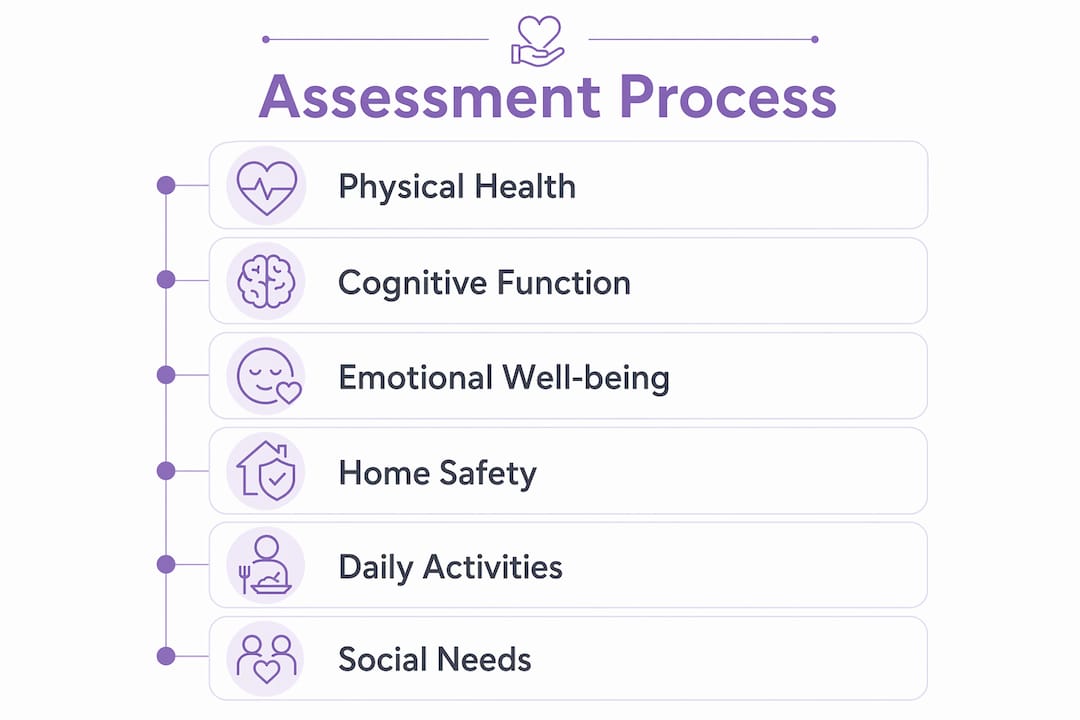
| Domain | What the assessor looks for |
|---|---|
| Physical health | Mobility, strength, fall history, chronic conditions, wound care needs |
| Cognitive function | Memory, decision-making ability, orientation to time and place |
| Emotional well-being | Signs of depression, anxiety, social isolation, or grief |
| Medication management | Adherence, storage, understanding of dosage instructions |
| Home environment | Fall risks, lighting, accessibility, emergency exit routes |
| Social support | Family involvement, community programs, transportation access |
Falls are the leading cause of injury in home care clients. That fact alone explains why the home environment review is never skipped, even when a family believes the home is safe. Assessors are trained to spot risks that residents stop noticing because they have lived with them for years.
Cognitive function evaluation deserves special attention. Assessors do not administer formal neuropsychological tests during a home visit, but they do ask questions that reveal whether your relative can safely manage medications, respond to emergencies, and make decisions about their own care. The answers determine whether supervision or hands-on assistance is the right level of support.
Emotional and social well-being rounds out the picture. An elderly person who is physically capable but deeply isolated carries a different risk profile than someone with strong family contact. The care plan addresses both dimensions.
What happens after the assessment?
The assessment produces a written, personalized care plan that specifies visit frequency, tasks the caregiver will perform, safety protocols, and emergency contacts. That document is the operating guide for every caregiver who enters the home.
Several things happen in the days following the assessment:
- Caregiver matching: The agency selects a caregiver whose skills and personality align with the assessment findings. A client with dementia needs a caregiver with specific experience, not just availability.
- Orientation visit: The assigned caregiver often meets the client before the first official care day. This reduces anxiety and gives the caregiver a chance to ask questions about the home and routine.
- Digital tracking setup: Agencies using care management software track caregiver arrival and departure, task completion, and flag missed care events. This creates accountability that a paper log cannot match.
- Family communication protocol: A good agency establishes how and when it will contact you, whether that is a weekly summary, a phone call after each visit, or access to a real-time app.
- Scheduled reassessment: Care plans must be adaptable, with adjustments made as health and social needs change over time. Most agencies schedule a formal reassessment every 60 to 90 days, or sooner after a hospitalization or significant health event.
Your role as a family member does not end when the care plan is signed. Regular check-ins with the caregiver and the agency keep the plan accurate and give your relative a voice in their own care.
Common questions families have during the home care evaluation steps
Families often arrive at the assessment with questions they feel awkward asking. Ask them anyway. The answers reveal a great deal about an agency’s quality.
What is the difference between medical and non-medical home care? Medical home care involves licensed professionals such as registered nurses or physical therapists and is typically ordered by a physician. Non-medical home care covers personal care, companionship, and household tasks. Most elderly clients need both at different points. Understanding which type you are arranging prevents gaps in coverage.
How do you verify an agency’s licensing? State health departments maintain public registries of licensed home care agencies. Check the registry before signing anything. Ask the agency directly for proof of liability insurance and worker’s compensation coverage.
What backup plan exists if the caregiver calls in sick? Families should ask agencies about backup protocols for caregiver absences, including response times and available substitutes. A vague answer here is a red flag. High-quality agencies maintain documented on-call protocols with rapid substitute deployment.
What do the contract terms say about ending care? Families should review contract termination clauses carefully to avoid unexpected penalties during care transitions. Notice periods of 7 to 14 days are common. Know yours before you sign.
Pro Tip: Ask the agency for references from families who have used their services for more than six months. Short-term satisfaction is easy to fake. Long-term relationships reveal how an agency handles problems.
For a broader look at home care services for seniors, Helping-hands-home-care has published a family guide that covers service types, costs, and what to expect from ongoing care.
Key Takeaways
A thorough home care assessment, followed by a written care plan and regular reassessments, is the most reliable foundation for safe, effective elderly care at home.
| Point | Details |
|---|---|
| Assessment structure | A 60 to 90 minute in-home visit covers physical, cognitive, emotional, and safety needs. |
| Preparation matters | Document medications, ADL changes, and home hazards before the assessor arrives. |
| Six core domains | Physical health, cognition, emotional well-being, medications, home safety, and social support all feed the care plan. |
| Post-assessment accountability | Agencies using care management software track task completion and alert families to missed care. |
| Ongoing reassessment | Care plans must be reviewed and adjusted as health needs change, not treated as permanent documents. |
What I have learned about the assessment process after years in home care
The families who get the most out of a home care assessment are the ones who treat it as the beginning of a conversation, not a box to check. I have seen families arrive at the assessment exhausted, relieved that someone else is finally taking charge, and then disengage entirely once the care plan is signed. That is the moment things go wrong.
The collaborative approach to assessment works because it keeps the family in the loop. Your relative’s needs will change. A fall, a new diagnosis, a change in mood, any of these can make a six-month-old care plan obsolete overnight. The families who stay involved catch those changes early.
The emotional weight of this process is real. Arranging care for a parent or spouse forces you to confront their vulnerability, and sometimes your own limits. That is hard. But the assessment itself is not something to fear. It is a structured way of saying, “Here is what my relative needs, and here is how we are going to meet it.” That clarity is worth every uncomfortable question it requires.
Ask the assessor what they are writing down. Ask why. Ask what would change the care plan. The best assessors welcome those questions because they know that an informed family produces better care outcomes.
— Michael
How Helping-hands-home-care supports families through the assessment
Helping-hands-home-care brings trained care coordinators to every in-home evaluation, covering all six assessment domains and producing a written care plan the same week.
Families receive transparent updates through digital care tracking, so you always know what happened during each visit. Beyond personal care, Helping-hands-home-care also offers home health aide services for hands-on daily support, as well as house cleaning and massage therapy for clients who benefit from a fuller range of in-home support. Contact Helping-hands-home-care to schedule a no-obligation consultation and get a care plan built around your relative’s actual needs.
FAQ
What is a home care assessment?
A home care assessment is a 60 to 90 minute in-home evaluation conducted by a registered nurse or care coordinator to identify an elderly person’s physical, cognitive, emotional, and safety needs. The findings produce a personalized care plan.
How long does a home care assessment take?
Most assessments take 60 to 90 minutes, though complex cases with multiple health conditions may require a follow-up visit to complete the full evaluation.
What should I bring to a home care assessment?
Bring a complete medication list, names and contact numbers for all physicians, and a written summary of recent changes in your relative’s daily functioning or health status.
How often should a care plan be reassessed?
Care plans should be reviewed every 60 to 90 days at minimum, and immediately after any hospitalization, fall, or significant change in health or cognitive status.
What is the difference between a home care assessment and a home health evaluation?
A home care assessment focuses on daily living needs, safety, and support services. A home health evaluation is ordered by a physician and involves licensed clinical staff assessing medical conditions that require skilled nursing or therapy.
Recommended
- Home Care Services for Seniors: A Family Guide | Helping Hands Home Care
- In-Home Care Eligibility Explained: 2026 Guide | Helping Hands Home Care
- Palliative Care at Home Explained for Families | Helping Hands Home Care
- Examples of Personal Care Assistance for Elderly Families | Helping Hands Home Care