
Licensed Home Care Agency: What Families Need to Know
Licensed Home Care Agency: What Families Need to Know

A licensed home care agency is a state-authorized organization that directly employs caregivers to provide personal care and homemaker services in a client’s home, with the agency itself acting as the legal employer responsible for payroll taxes, workers’ compensation, background checks, and supervision. Three things matter most for families: the agency pays and manages the caregiver (not you), the agency carries liability and workers’ comp insurance, and you get a licensed complaint channel with your state if something goes wrong. Registries look similar but shift most of those obligations onto you. Helping-hands-home-care is a licensed home care agency serving the metro Detroit area, and the questions in this article are exactly the ones you should ask any agency before signing a contract.
Table of Contents
- What a licensed home care agency actually does
- Services a licensed agency typically provides and what it doesn’t
- How state licensing works and what it requires
- Agency vs registry vs independent caregiver vs home health agency
- How licensed home care agencies get paid
- What a licensed agency handles for your family and why that matters
- How to verify a license and file a complaint
- The real cost gap between agencies and registries is smaller than it looks
- Key Takeaways
- Why licensed agencies are the right default for most families
- Helping-hands-home-care serves families in metro Detroit
- Useful sources for verification and deeper research
What a licensed home care agency actually does
The legal employer distinction is the whole ballgame. When a licensed home care agency employs a caregiver, it issues W-2s, withholds Social Security and Medicare taxes, pays federal and state unemployment taxes, and carries workers’ compensation and general liability insurance. If the caregiver slips on your mother’s kitchen floor and files a workers’ comp claim, that claim goes to the agency’s insurer, not to your family.
Day-to-day, the agency recruits, screens, and hires caregivers; runs criminal background checks and reference verification; trains staff on personal care techniques and safety protocols; schedules shifts; and sends a replacement when the regular caregiver calls in sick. It also keeps employment records, handles HR disputes, and documents incidents for state reporting. That administrative load is substantial, and it is one reason agency hourly rates run higher than registry rates.
What agencies typically do not handle: skilled nursing visits, physical therapy, occupational therapy, or any Medicare-billable clinical service. Those require a separately licensed home health agency. A standard licensed home care agency stays in the nonmedical lane.
Pro Tip: Before signing any service agreement, ask the agency in writing: “Do you issue W-2s to your caregivers, carry workers’ compensation insurance, and provide replacement staff when a caregiver is unavailable?” Vague or evasive answers are a red flag that the arrangement may be a hybrid or registry model, not a true employer model.
Services a licensed agency typically provides and what it doesn’t
Licensed home care agencies cover the personal and household support that keeps someone safely at home. Common services include:
- Activities of daily living (ADLs): bathing, dressing, grooming, toileting, and mobility assistance
- Instrumental ADLs: meal preparation, light housekeeping, laundry, and grocery shopping
- Companionship and social engagement: conversation, accompaniment to appointments, and recreational activities
- Medication reminders: prompting clients to take prescribed medications (not administering injections or IV medications)
- Respite care: temporary relief for family caregivers
- Transportation assistance: rides to medical appointments or errands
- Personal care aide services: hands-on physical assistance tailored to individual care plans
Services agencies generally cannot provide unless they hold additional certification include skilled nursing assessments, wound care requiring a licensed nurse, physical or occupational therapy, and any service billed directly to Medicare as a clinical home health benefit. Home health agencies are the only providers that may legally deliver Medicare-billable skilled services such as nursing and therapy.
When a client needs both personal care and skilled nursing, the practical solution is coordinating two providers: a licensed home care agency for daily personal support and a certified home health agency for clinical visits. Many hospital discharge planners help families set this up before a patient leaves the facility.
How state licensing works and what it requires
Licensing is a state-level process, and the rules vary more than most families expect. That said, most states follow a recognizable pattern.
A typical application requires proof of business formation, a designated administrator with qualifying credentials, written policies and procedures covering client intake, care planning, caregiver training, incident reporting, and emergency protocols. The agency must demonstrate it carries liability insurance and workers’ compensation coverage. Many states require fingerprint-based background checks for owners and administrators, not just caregivers. An initial inspection or desk review by the state agency usually follows before a license is issued.
California’s Home Care Services Branch within the Department of Social Services oversees home care organizations (HCOs) and requires separate registration for individual home care aides. New York uses the Licensed Home Care Services Agency (LHCSA) designation, administered by the NY Department of Health, and requires a Certificate of Need (CON) application reviewed by the Public Health and Health Planning Council before a license is granted. Pennsylvania’s Department of Health licenses home care agencies and home health agencies under separate categories, with distinct application requirements for each.
State licensing names differ, so “licensed” can mean different things depending on where you live. Always verify what the specific license permits — nonmedical personal care, skilled nursing, or both — rather than relying on the label alone.
Ongoing compliance typically includes annual renewals, maintaining training records for all caregivers, incident reporting within specified timeframes, and responding to state complaint investigations. Colorado’s Home Care Agencies program, run by the Colorado Department of Public Health and Environment, is another example of a state that maintains a public registry families can search.
Agency vs registry vs independent caregiver vs home health agency
| Dimension | Licensed Agency | Registry / Referral | Independent Caregiver | Home Health Agency |
|---|---|---|---|---|
| Legal employer | Agency | Family (usually) | Family | Agency |
| Services allowed | Nonmedical personal care, homemaker | Nonmedical (varies) | Nonmedical | Skilled nursing, therapy, clinical |
| Supervision and training | Agency-managed, documented | Minimal or none after placement | None | Agency-managed, clinically supervised |
| Workers’ comp and liability | Agency carries both | Family’s responsibility | Family’s responsibility | Agency carries both |
| Billing | Agency invoices family or insurer | Family pays caregiver directly | Family pays caregiver directly | Bills Medicare, Medicaid, or insurer |
| Hidden family obligations | Minimal | Payroll taxes, Schedule H, HR risk | Payroll taxes, Schedule H, HR risk | Minimal |
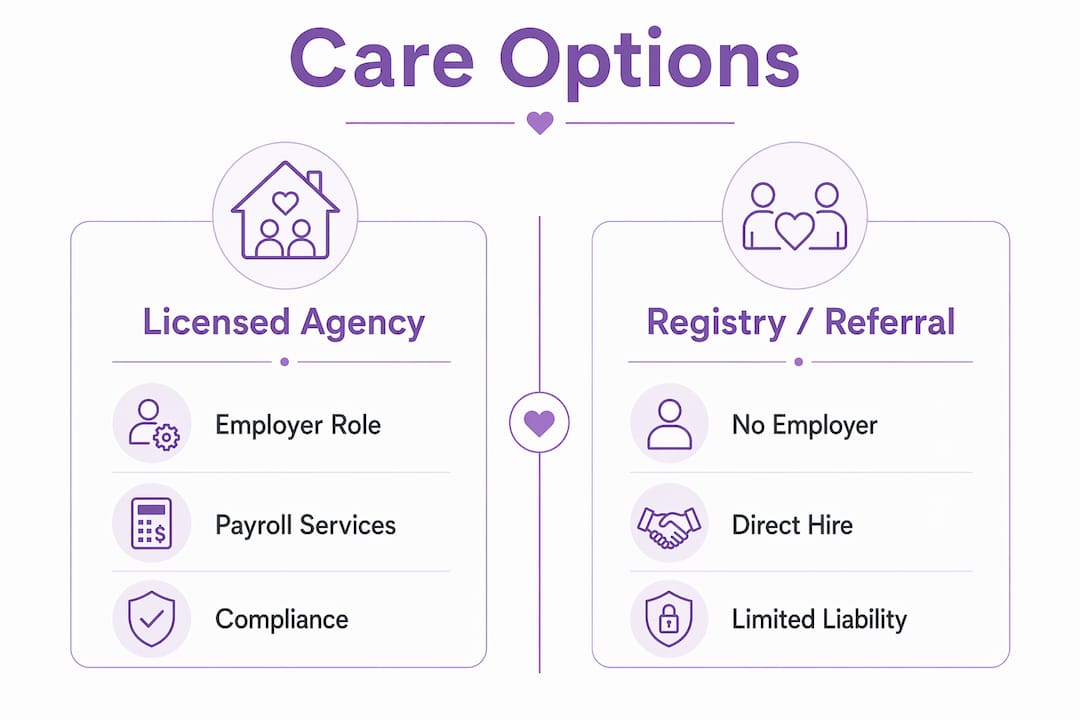
The practical implication: a registry or referral service often looks cheaper per hour, but once a family pays a caregiver directly, IRS rules can make them a household employer responsible for Social Security and Medicare withholding, federal unemployment taxes, and Schedule H reporting. That is a compliance burden most families do not anticipate.
The Department of Labor’s Wage and Hour Division is explicit that employer status depends on facts, not labels. A registry that controls pay rates, sets schedules, or supervises caregivers on the job may legally be an employer even if it calls itself a referral service. Families should confirm control and payroll practices in writing before assuming the registry bears no employer obligations.
For a deeper look at how these models compare in practice, the home care types guide at Helping-hands-home-care walks through each option with family-facing examples.
How licensed home care agencies get paid
Payment sources for licensed home care services generally fall into four categories:
- Private pay: the most common for nonmedical home care; families pay the agency directly, usually at an hourly rate with a minimum shift requirement (often two to four hours)
- Long-term care insurance: most policies cover licensed agency care; the agency typically bills the insurer directly or provides invoices for reimbursement
- Medicaid waivers: many states offer Home and Community-Based Services (HCBS) waivers that cover personal care from licensed agencies for eligible low-income clients; New York’s LHCSA system, for example, explicitly allows agencies to contract with Medicaid managed care plans
- VA benefits: eligible veterans may access the Aid and Attendance benefit or other VA programs to offset home care costs
Standard Medicare does not cover nonmedical home care. It covers skilled home health services only when a physician certifies medical necessity and a Medicare-certified home health agency provides the care.
Agency billing typically includes an hourly rate that bundles caregiver wages, payroll taxes, insurance, training overhead, and the agency’s margin. Expect minimum shift rules, cancellation fees for late cancellations, and holiday premium rates. These are standard, not hidden, but worth confirming upfront.
Pro Tip: When comparing agency quotes, ask each agency to confirm what is included in the hourly rate: caregiver wages, payroll taxes, workers’ comp, liability insurance, and backup staffing. An agency quoting $28/hour all-in is not directly comparable to one quoting $22/hour before you add the employer costs a registry shifts to you.
What a licensed agency handles for your family and why that matters
When a licensed home care agency is the employer of record, your family is not responsible for payroll tax filings, workers’ compensation claims, wage disputes, or finding a replacement caregiver on short notice. Those obligations transfer to the agency by contract and by law.
The protections are concrete. The agency handles payroll and tax filings, issues W-2s to caregivers, carries workers’ compensation so an injured caregiver does not sue your family, maintains liability insurance, runs background checks before any caregiver enters your home, and provides documented training records. If a caregiver is terminated or quits, the agency sends a replacement rather than leaving your family to scramble.
Families also gain a licensed complaint channel. If care quality falls short, you can report the agency to the state licensing authority, which has the power to investigate, impose corrective action, or revoke the license. That accountability mechanism does not exist with an independent caregiver or a registry that has already handed off responsibility.

The warning worth repeating: some agencies operate as hybrids, outsourcing payroll or using third-party payroll services in ways that blur who is actually the employer. Verification requires specific questions. Ask whether the agency employs the worker under a W-2 or merely invoices as a placement service. The role of insurance in home care is one area where this distinction becomes financially significant for families.
How to verify a license and file a complaint
- Find your state’s license lookup tool. California families use the CDSS Community Care Licensing search. New York families search the NY DOH LHCSA profiles. Pennsylvania families check the PA Department of Health facility search. Colorado uses the CDPHE home care agency registry.
- Confirm the license number. Ask the agency for its license number in writing, then verify it matches the state database entry and that the license is active, not expired or suspended.
- Check complaint history. Many state databases show substantiated complaints or enforcement actions. A single resolved complaint is different from a pattern of unresolved violations.
- Confirm W-2 and insurance practices in writing. Request a written statement that the agency issues W-2s to caregivers, carries workers’ compensation, and maintains general liability insurance. Keep this document.
- Review the service agreement carefully. Confirm the agreement names the agency as the employer, specifies backup staffing procedures, and identifies the state licensing authority.
- File a complaint if needed. In California, contact the CDSS Home Care Services Branch. In New York, contact the NY DOH at the LHCSA licensing unit or call the state health department complaint line. In Pennsylvania, contact the PA Department of Health. For wage or labor violations, contact the Department of Labor’s Wage and Hour Division. For suspected elder abuse or neglect, contact Adult Protective Services in your county.
- Keep your own records. Retain signed service agreements, weekly time sheets, incident reports, and all written correspondence with the agency.
For a structured list of questions to bring to an agency interview, the choosing the right home care agency guide at Helping-hands-home-care is a practical starting point.
The real cost gap between agencies and registries is smaller than it looks
The hourly rate difference between a licensed agency and a registry referral can look significant, but the gap narrows quickly once you account for what the registry shifts to you. When families pay a caregiver directly, IRS rules can make them household employers responsible for Social Security and Medicare withholding, federal unemployment taxes, and Schedule H filing. Add workers’ compensation (required in most states when you employ a household worker above a wage threshold), general liability exposure, and the time cost of recruiting, screening, and managing a replacement when the caregiver is sick, and the apparent savings shrink.
The Department of Labor’s Field Assistance Bulletin 2018-4 makes clear that employer status is determined by facts, not by what a service calls itself. A registry that sets pay rates, controls schedules, or supervises work may be legally an employer regardless of its marketing language. Families who assume they have no employer obligations because they used a “referral service” can face back taxes and penalties.
Pro Tip: To model the true cost of a registry or direct hire, estimate a typical month of service and add: employer payroll taxes (roughly 7.65% of wages for Social Security and Medicare), workers’ comp premium, any overtime or holiday pay, and the cost of one week of replacement care if the caregiver is unavailable. Compare that total to the agency’s all-in monthly invoice. The gap is usually smaller than the hourly rate difference suggests.
Key Takeaways
A licensed home care agency is the employer of record for its caregivers, which means families get built-in payroll, insurance, and compliance protections that registries and direct-hire arrangements do not provide.
| Point | Details |
|---|---|
| Agency is the legal employer | The agency issues W-2s, pays payroll taxes, and carries workers’ comp — your family does not. |
| Verify the license before signing | Check your state’s license lookup, confirm the license number is active, and review complaint history. |
| Confirm W-2 and backup staffing in writing | Ask for written proof of W-2 employment and a replacement caregiver policy before any contract is signed. |
| Total cost, not hourly rate, is the right comparison | Registry savings shrink once you add employer taxes, insurance, and replacement care costs to the calculation. |
| Helping-hands-home-care | A licensed home care agency in metro Detroit offering home health aide, cleaning, meal prep, and massage services. |
Why licensed agencies are the right default for most families
The conventional wisdom in home care shopping is to compare hourly rates and pick the lowest. That framing misses the point entirely. The hourly rate is not the product. The product is a caregiver who shows up, is trained, is supervised, and is replaced when they can’t make it, with zero payroll paperwork landing on your kitchen table.
Families who choose registries or independent caregivers to save money often discover, sometimes after an injury or a tax notice, that they became employers without realizing it. The legal exposure is real, and it is not theoretical. The IRS Schedule H requirement applies to any family that pays a household employee above the annual wage threshold, and most states have parallel workers’ comp obligations.
Licensed agencies cost more per hour because they are absorbing those costs on your behalf. For most families managing care for an aging parent, that trade is straightforward. The exception is a very low-hours arrangement, perhaps a few hours a week with a trusted individual the family has known for years. Even then, understanding the employer obligations and managing them properly matters more than the label on the arrangement.
Helping-hands-home-care’s position is simple: for families who want professional, supervised, licensed care without taking on employer risk, a licensed agency is the right structure. For families who choose another route, the checklist in this article is the minimum due diligence they should complete.
Helping-hands-home-care serves families in metro Detroit
Families in the metro Detroit area who want licensed, professionally managed home care have a local option worth a direct conversation. Helping-hands-home-care provides home health aide services, house cleaning, meal preparation, and in-home therapeutic massage, all delivered by caregivers the agency recruits, trains, and supervises.
The practical next step is straightforward: contact Helping-hands-home-care to request a care assessment, ask the W-2 and workers’ comp questions from this article, and confirm the agency’s license with the state. You can review the full range of available services on the website, or call the office directly to discuss your family member’s specific needs and schedule. If you are also supporting a senior through a housing or living transition, Divine Transitions for Seniors is a local partner resource worth knowing about.
Useful sources for verification and deeper research
| Resource | What it covers | Why use it |
|---|---|---|
| NY DOH LHCSA page | New York LHCSA licensing, eligibility, and Medicaid contracting rules | Verify NY agency licenses and understand LHCSA scope |
| NY DOH LHCSA profiles | Searchable public database of licensed NY home care agencies | Look up complaint history and license status for NY agencies |
| CA CDSS Home Care Services | California HCO licensing, aide registration, and enforcement | Verify CA agency and aide registration status |
| PA Dept. of Health Home Care | Pennsylvania home care and home health agency licensing | Application guidance and PA license verification |
| CO CDPHE Home Care Agencies | Colorado home care agency registry and licensing | Verify CO agency licenses |
| DOL Field Assistance Bulletin 2018-4 | Federal guidance on employer status for home care registries | Understand when a registry may legally be an employer |
| Helping-hands-home-care services | Full overview of Helping Hands services in metro Detroit | Starting point for families evaluating local licensed care |
| Home care accreditation guide | Explains accreditation bodies beyond state licensing | Understand CHAP, ACHC, and other trust signals |
Recommended
- How to Choose the Right Home Care Agency for Your Family | Helping Hands Home Care
- Home Care Accreditation Explained for Families in 2026 | Helping Hands Home Care
- Home Care Services for Seniors: A Family Guide | Helping Hands Home Care
- Difference Between Home Care Types: Family Guide 2026 | Helping Hands Home Care