
Overnight Caregiver Duties: What Families Should Expect
Overnight Caregiver Duties: What Families Should Expect
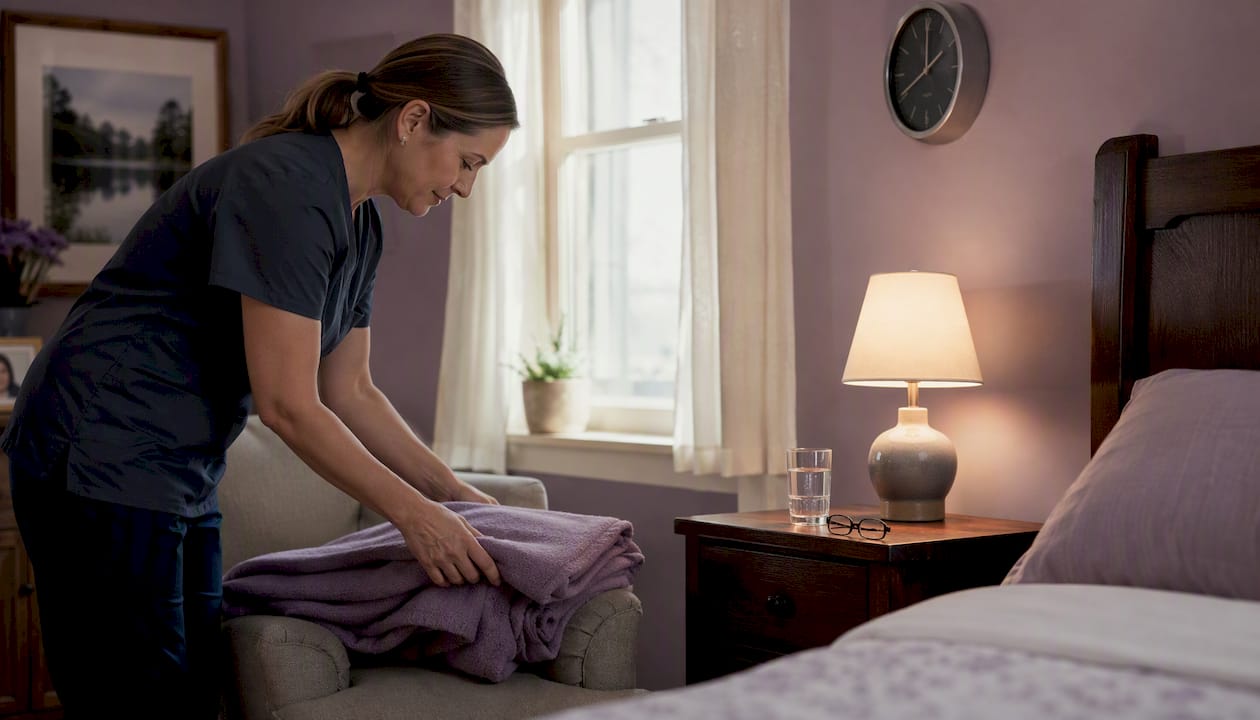
An overnight caregiver stays in the home through the night to handle toileting, medication reminders, fall prevention, and reassurance so an older adult can sleep safely without a family member on call. Families usually need this help right away when someone has fallen more than once at night, has advanced dementia with wandering or sundowning, just got home from the hospital, or when the family caregiver is running on fumes from months of broken sleep.
The job breaks down into a short list of recurring buckets, and every legitimate overnight caregiver job description will touch all of them:
- Personal care and safety supervision: helping with bathroom trips, repositioning in bed, and watching for fall risk.
- Medication and health monitoring: reminding, timing, and documenting doses along with any concerning symptoms.
- Companionship and light household tasks: calming reorientation during confusion, plus tidying or prepping breakfast items before the day shift arrives.
Key Takeaways
Overnight caregiver duties center on five functions: personal care, medication management, safety supervision, companionship, and light household tasks tied to nighttime risk.
| Point | Details |
|---|---|
| Match the model to the need | Choose awake shifts for wandering or frequent falls, sleep-in for lower-risk situations. |
| Track before you hire | A 3 to 7 night log tells you and any agency the real coverage level required. |
| Know the pay rules | Sleep-time deductions only apply to genuinely uninterrupted sleep under DOL Fact Sheet #79B. |
| Vet thoroughly | Require background checks, CPR certification, references, and dementia training when relevant. |
| Helping-hands-home-care’s role | Builds written care plans, trains staff for night scenarios, and follows DOL-compliant scheduling for overnight support. |
Table of Contents
- What Are the Different Types of Overnight Care?
- What Are the Core Overnight Caregiver Duties?
- How Does an Overnight Caregiver Handle a 3 a.m. Emergency?
- Can Overnight Caregivers Sleep, and How Does That Affect Pay?
- What Qualifications Should an Overnight Caregiver Have?
- How Do You Prepare Your Home for Overnight Care?
- Agency vs Private Hire: What Drives Overnight Care Cost?
- When Should You Actually Hire Overnight Care?
- How Helping-hands-home-care Approaches Overnight Care
- Ready for Overnight Care? Here’s How to Start
- Frequently Asked Questions
- Sources
What Are the Different Types of Overnight Care?
Not every overnight arrangement looks the same, and mixing them up is the single most common mistake families make when they start calling agencies. The model you choose determines cost, the caregiver’s alertness level, and how much protection you actually get between midnight and 6 a.m.
An awake overnight shift means the caregiver stays alert the entire night, typically 8 to 12 hours, with no scheduled sleep. This is the model for households managing dementia-related wandering, frequent falls, or a client who needs hands-on help multiple times a night. A sleep-in shift (sometimes called live-in overnight) allows the caregiver to sleep but requires them to be reachable and available if needed. Visiting or check-in overnight care sends someone in for shorter windows, maybe one or two visits to handle a bedtime routine and a morning check, rather than a full night’s presence. Live-in care extends beyond a single night into a 24-hour arrangement, where the same caregiver (or a rotating pair) covers days and nights as part of a broader care plan, explained in more depth in our guide to live-in caregiving.
| Model | Caregiver alertness | Best fit |
|---|---|---|
| Awake overnight | Fully alert, no sleep | Wandering, frequent falls, active medical needs |
| Sleep-in overnight | Sleeps, available if woken | Occasional nighttime needs, lower fall risk |
| Visiting/check-in | Present for set windows only | Stable clients needing bedtime and morning support |
| Live-in (24-hour) | Rotates sleep within a full daily schedule | Ongoing daily and nightly care needs |
Families managing early-stage dementia with occasional confusion often start with sleep-in coverage. Once wandering or repeated falls enter the picture, most agencies recommend moving to an awake shift, since a sleeping caregiver simply cannot supervise someone walking out a door at 3 a.m.
What Are the Core Overnight Caregiver Duties?
Department of Labor. Here’s what each one looks like in practice, night after night.
Personal care covers assisted transfers to a bedside commode or bathroom, repositioning someone in bed on a set schedule to prevent pressure injuries, and helping with incontinence care without stripping away dignity. Medication management means checking the clock against a medication schedule, administering or reminding for nighttime doses, and watching for side effects like dizziness that could cause a fall on the way back to bed.
Safety supervision is the least visible duty and the most important one. It includes checking on someone at set intervals, keeping pathways clear, and intervening before a wobbly walk to the bathroom turns into a fall. For clients with dementia, this extends to door and window monitoring since nighttime wandering and sundowning are documented behaviors that increase risk after dark.

Companionship and reorientation matters more than most families expect. Someone startled awake at 2 a.m. in an unfamiliar mental state needs a calm, familiar voice to reorient them, not a rushed correction. Finally, light household tasks tied to safety include quietly cleaning up a spill before someone slips on it, restocking bedside water, or setting out breakfast items for the morning handoff. Typical services also include assistance getting to and from the toilet and bedside reassurance during restless stretches.

Pro Tip: Ask any overnight caregiver you’re considering to keep a simple night log for the first week, noting exact wake times and reasons. Patterns show up fast, and that log tells you within days whether you actually need an awake shift or if sleep-in coverage is enough.
How Does an Overnight Caregiver Handle a 3 a.m. Emergency?
Reading a duty list is one thing. Picturing how those duties play out at 3 a.m. is another, and it’s usually the part families skip until it’s happening to them.
- Sundowning episode. A client with dementia wakes agitated, insists it’s time to go to work, and starts pulling at bed rails. The caregiver doesn’t argue or correct. They lower the lights, speak slowly, redirect attention to a familiar object or photo, and wait out the confusion rather than fighting it. If the agitation escalates toward wandering, the caregiver checks that exits are secured and stays within arm’s reach until the episode passes.
- Post-surgical pain spike. A client recovering from hip surgery wakes in pain before the next scheduled dose. The caregiver checks the medication chart, confirms timing against the prescription, offers a non-medication comfort measure like repositioning, and calls the on-call nurse or family contact if the pain is outside the expected range.
- Unwitnessed fall. The caregiver hears a thump and finds the client on the floor. They do not attempt to lift the person alone if there’s any sign of injury or if a hoist is needed. Instead, they check for responsiveness, keep the client still, and call 911 if there’s confusion, visible injury, or inability to move safely. Only after ruling out serious injury do they attempt an assisted transfer back to bed, ideally using proper body mechanics or a mechanical lift if one is in the home.
Every legitimate overnight care plan should spell out exactly when a caregiver calls 911 versus a family member versus the on-call nurse line. Ambiguity at 3 a.m. is where care plans fail.
Families should watch for a specific signal: if the caregiver’s post-night notes mention the same issue (agitation, a near-fall, pain) more than twice in a week, it’s a sign the current staffing level isn’t matching the actual risk anymore.
Can Overnight Caregivers Sleep, and How Does That Affect Pay?
Whether an overnight caregiver sleeps depends entirely on which model you hired, and that distinction directly changes how they must be paid under federal law. An awake shift means full pay for every hour, no exceptions. A sleep-in shift can legally include an unpaid sleep-time deduction, but only under specific conditions.
Under Fact Sheet #79B from the U.S. Department of Labor, caregivers must generally be paid for all hours worked, and some live-in arrangements allow sleep-time deductions only when the caregiver has an uninterrupted opportunity for sleep, usually up to 8 hours, and adequate sleeping facilities are provided. If the caregiver is woken repeatedly during that window to handle care tasks, the deduction typically doesn’t apply for those interrupted hours.
Most states permit up to 8 hours of unpaid sleep-time deduction for live-in arrangements when the sleep is genuinely uninterrupted, but the exact rules vary by state and depend heavily on how the employment contract is written. This is not a detail to guess at.
Federal rules exist to prevent families and agencies from underpaying caregivers for hours they’re actually awake and working. A written agreement that spells out shift type, sleep-time terms, and overtime triggers protects both sides.
Before signing anything, families hiring directly should confirm:
- Whether the shift is classified as awake or sleep-in, in writing.
- How many uninterrupted sleep hours are guaranteed, and what happens if that sleep is broken.
- When overtime kicks in, since caregivers are typically non-exempt workers under FLSA rules covering household employers.
- Who tracks and logs actual hours worked versus hours scheduled.
Getting this wrong isn’t just a legal risk. Underpaying an overnight caregiver for interrupted “sleep” hours is one of the fastest ways to burn through caregivers and end up rehiring every few months.
What Qualifications Should an Overnight Caregiver Have?
The stakes at night are higher than during the day, mostly because there’s no one else around to catch a mistake. That makes vetting non-negotiable.
Must-have credentials before anyone spends a night alone with your family member:
- A completed background check, not just a promise one was done somewhere else.
- Verifiable references from actual overnight assignments, not just daytime companion work.
- Current CPR and first aid certification.
- Dementia-specific training if your loved one has any degree of cognitive decline, since managing sundowning safely takes different skills than general companionship, detailed further in our overview of the home caregiver role.
Experience and skills worth prioritizing in an interview:
- Comfort with safe transfer technique, ideally including hands-on experience with a mechanical or Hoyer lift if your loved one has limited mobility.
- Working knowledge of pressure-injury prevention and repositioning schedules.
- Medication awareness, including recognizing common side effects that increase fall risk.
- Willingness and ability to document events clearly, since a vague morning handoff (“she slept okay, I think”) is a red flag, not a report.
Ask directly: “Walk me through the last time you handled a fall or a confused wake-up on an overnight shift.” Vague, generic answers or noticeable gaps in work history are worth pausing over. A caregiver with real overnight experience will have a specific story, not a rehearsed line.
How Do You Prepare Your Home for Overnight Care?
Most of the friction in the first few weeks of overnight care comes from a mismatch between the home setup and the actual duties the caregiver is expected to perform. Fix the environment before the first shift, not after the first fall.
Start with a 3 to 7 night log before you even hire anyone. Track exactly when your loved one wakes, why, and what happens next. This single step gives you and any agency real data instead of guesswork about whether you need awake coverage or sleep-in support.
- Walk the path from bed to bathroom and remove anything that could catch a foot: rugs, cords, low furniture.
- Add night lights along that path and inside the bathroom.
- Consider a bedside commode if bathroom trips are frequent or the walk is long.
- Secure exterior doors and consider door alarms if wandering is a risk, and review broader home safety fixes room by room.
- Write a one-page night care plan covering usual wake times, medication notes, known triggers for agitation, and an escalation contact list with names and numbers in order of who gets called first.
- Set a handoff routine with the daytime caregiver or family member, ideally a five-minute conversation plus a written log entry every morning.
Pro Tip: Keep the night log format identical to what the daytime caregiver already uses. A caregiver switching between different tracking sheets at 6 a.m. after a long night is far more likely to miss something important in the handoff.
Agency vs Private Hire: What Drives Overnight Care Cost?
Families generally choose between hiring through an agency or hiring a caregiver privately, and the trade-offs run deeper than the hourly rate on the quote sheet.
An agency typically handles payroll, taxes, background checks, and replacement coverage if your regular caregiver is sick. That layer of support costs more per hour, but it also means you’re not the one scrambling to find last-minute coverage or verifying tax withholding on your own. Hiring through an agency also usually comes with training assurances and supervision that private hires don’t offer by default.
Private hire can cost less per hour, but the family becomes the employer of record, responsible for payroll taxes, workers’ compensation considerations, and finding backup coverage themselves. It also means the vetting, references, and training checks fall entirely on you.
What actually moves the price:
- Awake shifts cost more than sleep-in shifts, since you’re paying for full alertness across every hour.
- Local market rates vary significantly by region and by how much clinical skill the client’s needs require.
- Overtime and sleep-time deduction rules affect the final bill, especially for longer or more frequent shifts.
- Shift length and frequency: a single occasional overnight costs more per hour than a recurring five-nights-a-week arrangement.
| Cost factor | Typical impact |
|---|---|
| Awake vs sleep-in shift | Awake shifts cost more per hour due to full-time alertness |
| Agency vs private hire | Agency rates run higher but include payroll, vetting, and replacement coverage |
| Shift frequency | Recurring weekly arrangements often price lower per hour than one-off nights |
| Clinical needs | Higher skill requirements (wound care, lift transfers) raise the rate |
When comparing quotes, ask what happens if your regular caregiver calls in sick, whether the rate includes payroll tax handling, and what training the caregiver has specifically for night shifts. A suspiciously low hourly rate is often a warning sign of high turnover down the road. Sustainable overnight coverage depends on realistic pay, not the cheapest number on a flyer.
When Should You Actually Hire Overnight Care?
Some signs mean you need help this week, not next month.
- Repeated nighttime falls or near-falls, even ones that seemed minor at the time.
- Wandering or sundowning episodes that put someone at risk of leaving the house unsupervised.
- Caregiver exhaustion severe enough to affect work, health, or safety during the day. Caregiver stress carries documented health risks, and burned-out family caregivers make more mistakes, not fewer.
- Recent hospitalization with nighttime monitoring needs, especially for medication timing or mobility restrictions during recovery.
- Temporary post-op needs, where round-the-clock coverage is only required for a few weeks of healing.
If the need is occasional, a visiting overnight check might cover it. If falls or wandering are recurring, don’t settle for anything less than awake supervision. For a broader framework on deciding when to step up support, see our guide on increasing care for aging parents.
How Helping-hands-home-care Approaches Overnight Care
We build every overnight arrangement around a written care plan first, not a generic shift assignment. That plan documents wake patterns, medication timing, known triggers, and an escalation contact list before the first night even starts, because guesswork is exactly what causes problems at 3 a.m.
Our overnight caregivers complete background checks, hold current CPR and first aid certification, and receive dementia-specific training when a client’s needs call for it. We coordinate directly with daytime caregivers and family members through consistent handoff documentation, so nothing gets lost between shifts. Scheduling and pay practices follow Department of Labor guidance on hours worked and sleep-time rules, which protects both the family and the caregiver from the kind of ambiguity that leads to turnover.
Matching the right model, whether that’s an awake shift, sleep-in coverage, or occasional visiting checks, to what a client actually needs at night matters more than defaulting to the most expensive option. Preserving someone’s dignity while keeping them safe isn’t a tradeoff. It’s the whole point.
Ready for Overnight Care? Here’s How to Start
If you’ve read this far, you probably already suspect your family needs more than another sleepless week of checking in every few hours. Helping-hands-home-care builds overnight coverage around a real assessment of your loved one’s night patterns, not a one-size-fits-all shift plan, so you’re not paying for more alertness than the situation actually requires.

Our home health aide services include overnight support with caregivers who are background checked, CPR certified, and trained for the exact scenarios covered above, from fall prevention to dementia-related nighttime confusion. Scheduling and pay structures follow Department of Labor guidance on hours worked and sleep-time rules, so there’s no ambiguity in the agreement you sign. If your loved one’s needs also include daytime support, house cleaning, or in-home massage for comfort and mobility, those can be built into the same care plan.
Start with a short assessment call to talk through your loved one’s night patterns and get a written care plan in place before the first shift. Reach out to Helping-hands-home-care to schedule that conversation this week.
Frequently Asked Questions
What does an overnight caregiver do? An overnight caregiver assists with nighttime toileting and transfers, reminds clients about medication, monitors for falls or wandering, offers reassurance during confusion, and handles light tasks like tidying up before the morning shift arrives.
Do overnight caregivers sleep during their shift? It depends on the arrangement. Awake shifts require the caregiver to stay alert the entire night, while sleep-in shifts allow sleep as long as the caregiver is available if needed, with pay rules differing between the two.
How much does overnight care typically cost? Cost depends on whether the shift is awake or sleep-in, local market rates, required clinical skills, and whether you hire through an agency or privately. Awake shifts and higher-skill needs push the rate up.
What should be in a written overnight care plan? A solid plan includes usual wake times, medication schedules, known triggers for confusion or agitation, an escalation contact list, and clear instructions for when to call 911 versus a family member.
When should a family consider hiring overnight care? Consider it when there are repeated nighttime falls, wandering or sundowning episodes, a recent hospitalization requiring nighttime monitoring, or when the family caregiver is showing signs of exhaustion or burnout.
This article is general information, not a substitute for advice from a qualified doctor. Consult a qualified healthcare professional about your own circumstances before acting on anything here.
Sources
- National Institute on Aging – Coping with Alzheimer’s behaviors: wandering and getting lost
- Mayo Clinic – Caregiver stress: Tips for taking care of yourself
Recommended
- What Is a Live-In Caregiver? Your 2026 Family Guide | Helping Hands Home Care
- The Role of Home Caregiver: Responsibilities and Support | Helping Hands Home Care
- What Is an Adult Day Care Service for Families? | Helping Hands Home Care
- Caregiver Background Check: What Families and Employers Must Run | Helping Hands Home Care