
What Is an Adult Day Care Service for Families?
What Is an Adult Day Care Service for Families?

In this article, “adult day care service” means in-home daytime caregiving: a paid caregiver who comes to your older relative’s residence during daytime hours to provide supervision, personal care, meal preparation, companionship, and basic therapeutic support. The result for families is straightforward: your parent stays home, stays safe, and you get real breathing room. This is not about center-based programs where seniors travel to a facility. Every section below is about caregivers who come to the house.
Key Takeaways
In-home daytime caregiving works best when families plan early, hire for fit as much as skill, and put expectations in writing before the first shift.
| Point | Details |
|---|---|
| Core definition | A paid caregiver comes to the home during daytime hours for supervision, personal care, meals, and companionship. |
| Act before a crisis | Families who plan two to three months ahead get better candidates and avoid rushed, costly decisions. |
| Payment reality | Most non-medical in-home care is paid out of pocket; check state Medicaid HCBS programs and the Eldercare Locator for assistance. |
| Hire for fit | Soft skills like reliability and communication predict outcomes better than credentials alone, per AARP guidance. |
| Helping-hands-home-care | Provides home health aide, meal prep, cleaning, and companionship services in metro Detroit with agency-managed vetting and scheduling. |
Table of Contents
- What is an adult day care service, and who actually needs it?
- What do in-home daytime caregivers actually do?
- How in-home daytime care benefits both the older adult and your family
- What does in-home daytime care cost, and who pays?
- How to find, screen, and hire a daytime in-home caregiver
- What a typical day looks like with daytime in-home care
- What safety and training standards should you require?
- A two-week starter plan to get daytime in-home care in place
- What families tend to underestimate about daytime in-home care
- Helping-hands-home-care offers daytime in-home care in metro Detroit
- Useful resources for your next steps
- Sources
What is an adult day care service, and who actually needs it?
Some families wait for a fall or a hospital discharge before they start looking. That usually means rushed decisions, limited options, and higher costs. The signs that daytime in-home care is worth exploring tend to show up well before a crisis.
Watch for these:
- Frequent near-misses at home (stove left on, falls on stairs, missed medications)
- Declining ability to manage basic daily activities like bathing, dressing, or eating
- Visible loneliness or withdrawal, especially on days when no family member visits
- A family caregiver who is missing work, losing sleep, or feeling burned out
- Difficulty getting to medical appointments or preparing consistent meals
- Cognitive changes that make unsupervised hours genuinely risky
Two situations come up constantly. The first: an adult daughter working full-time whose mother has early dementia and cannot safely be alone from 8 AM to 5 PM. The second: a retired spouse who is the primary caregiver but needs two or three mornings a week to manage their own health appointments. In both cases, a daytime caregiver fills a specific, bounded gap without requiring a full residential move.
Pro Tip: Start the search before you need someone urgently. Families who plan two to three months ahead get better candidates, negotiate better rates, and avoid settling for the first available person.
What do in-home daytime caregivers actually do?
HelpGuide’s overview of home care services covers the range well: household chores, personal care, meal prep, transportation, companionship, and some health-related services when coordinated with a clinician. The practical day-to-day list most families rely on looks like this:
- Supervision and safety monitoring throughout the day
- Help with bathing, dressing, grooming, and toileting (ADLs)
- Medication reminders (not administration of injections or clinical procedures)
- Meal planning and preparation
- Light housekeeping: dishes, laundry, tidying
- Transportation to appointments or errands
- Companionship, conversation, and cognitive engagement
- Basic health monitoring: noting changes in mood, appetite, or mobility
What falls outside the scope: wound care, IV management, complex medical procedures, extensive home renovation, legal or financial tasks. Knowing the boundary before you hire prevents the slow drift where a caregiver’s role expands until everyone is frustrated.
The three generic caregiver categories you will encounter:
| Category | Typical tasks | Training level | Best when |
|---|---|---|---|
| Companion / personal aide | Companionship, light housekeeping, meal prep, errands | Basic aide training, varies by state | Older adult is largely independent but needs supervision and social contact |
| Home health aide (HHA) | All of the above plus ADL assistance, basic health monitoring | State-certified HHA training | ADL help is needed; some health monitoring required |
| Skilled home health nurse (LPN/RN) | Clinical care: wound care, injections, medication management | Licensed nursing degree | Medical condition requires clinical oversight at home |
Most families hiring daytime in-home care need an HHA or a companion aide, not a nurse. Reserve clinical staff for situations where a physician has ordered specific skilled care.
How in-home daytime care benefits both the older adult and your family
For the older adult, the benefits are concrete: a consistent daily routine, reduced fall risk through supervision, regular meals, mobility support, and someone to talk to. Isolation is a genuine health risk for older adults, and a daytime caregiver addresses it directly without requiring the person to leave home.

For family caregivers, the math is simple. Daytime coverage means you can keep your job, attend your own medical appointments, and sleep without the low-grade anxiety of wondering what is happening at the house. Respite is not a luxury; caregiver burnout leads to worse outcomes for everyone involved.
One limitation worth stating plainly: daytime in-home care is not a substitute for 24-hour supervision or skilled nursing. If your relative needs round-the-clock monitoring or clinical procedures, the care plan needs to reflect that. Daytime coverage handles a specific window; it does not replace a comprehensive care arrangement.
What does in-home daytime care cost, and who pays?
Costs vary by region, caregiver type, and hours needed. MedlinePlus confirms that most non-medical in-home care is paid out of pocket, with Medicare covering very little for long-term personal care. State Medicaid Home and Community-Based Services (HCBS) programs may cover personal care for eligible low-income individuals, but rules differ significantly by state.
Common payer sources:
- Out of pocket: The default for most families. Hourly rates for companion aides and HHAs vary by market and caregiver type.
- State Medicaid HCBS programs: Eligibility and covered services vary. Check your state’s page on Medicaid or call your local Area Agency on Aging.
- Long-term care insurance: Some policies cover in-home personal care; review the benefit triggers and daily maximum in your policy.
- Veterans benefits: The VA Aid and Attendance benefit and other VA programs can help eligible veterans and surviving spouses.
- Medicare: Covers skilled home health services only when physician-ordered, part-time or intermittent, and arranged through a Medicare-certified agency. Long-term personal care is generally not covered.
For a broader look at home care payment options, including how to layer multiple sources, that guide walks through the combinations families use most.
Action steps: Call the Eldercare Locator (1-800-677-1116) to find your Area Agency on Aging. Ask specifically about HCBS waiver programs in your state. Review any long-term care insurance policy for in-home benefit triggers before assuming it does not apply.
How to find, screen, and hire a daytime in-home caregiver
AARP’s hiring guidance is direct: treat this like professional recruitment. Soft skills matter as much as task lists. A caregiver who is warm, reliable, and communicates well will outperform a technically skilled one who is cold or inconsistent.
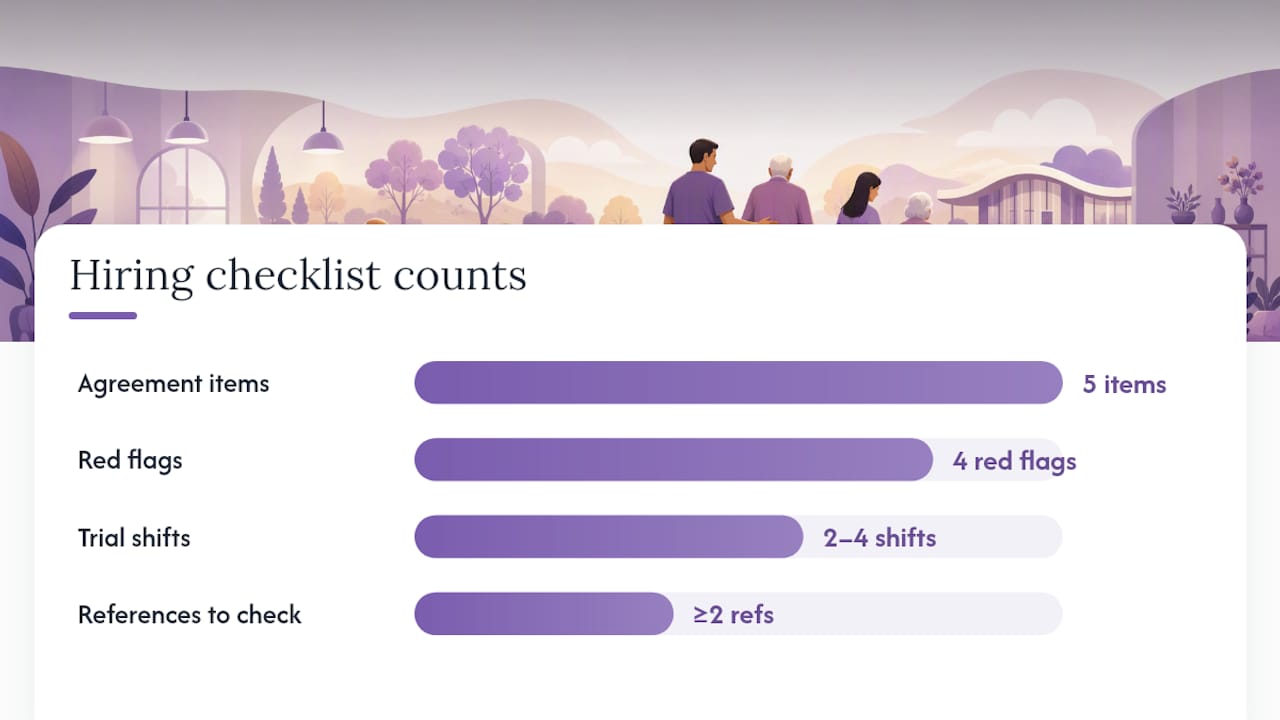
Hiring checklist:
- Write a one-page role description: hours, tasks, explicit out-of-scope items, and pay range.
- Decide: agency or private hire. Agencies handle payroll, backup coverage, and vetting. Private hire gives more control but means you are the employer.
- If hiring privately, understand your obligations. CaringInfo’s guide on employing caregivers legally is clear: most private caregivers are household employees requiring payroll withholding and W-2s, not 1099 contractors.
- Screen candidates with structured interviews. Ask: “Tell me about a time a care situation changed unexpectedly. What did you do?” Listen for calm problem-solving, not just compliance.
- Run a criminal background check and verify any certifications.
- Check at least two references. Ask references specifically about reliability and how the caregiver handled conflict or stress.
- Run a trial period of 2 to 4 shifts with explicit evaluation points: punctuality, empathy, task completion, and communication.
- Put the agreement in writing: hours, pay, duties, notice period, and emergency protocols.
Red flags worth walking away from: no verifiable references, evasive answers about previous employment gaps, inconsistent availability claims, or resistance to a written agreement.
For a deeper checklist on choosing the right home care agency, that guide covers agency-specific vetting questions.
What a typical day looks like with daytime in-home care
A caregiver arrives at an agreed time, typically between 8 and 9 AM. The first 15 minutes cover a check-in: how did the night go, any new symptoms, medications taken. From there, the morning follows a routine: personal care assistance, breakfast preparation, light activity or conversation. Midday brings lunch, medication reminders, and a rest period. Afternoon might include a short outing, cognitive engagement, or light housekeeping. Before leaving, the caregiver writes a brief shift note covering what was done, anything unusual observed, and any items for the family to follow up on.
Communication routines that work:
- A physical or digital shift log the family can read daily
- A clear escalation path: who to call for a medical concern, who to call if the caregiver cannot make a shift
- A weekly 10-minute check-in between the family and caregiver
- A backup coverage plan established before it is ever needed
Track hours and tasks simply: a shared notes app or a printed daily log sheet works fine for most families. The goal is a paper trail that catches problems early and documents the care being delivered.
What safety and training standards should you require?
Minimum expectations by caregiver type:
- Companion aide: Basic first aid and CPR, state-required aide training hours where applicable, clean background check.
- Home health aide: State HHA certification, documented training in ADL assistance and basic health monitoring, CPR.
- LPN/RN: Active state nursing license, verifiable with your state’s nursing board.
Every arrangement needs a written emergency plan before the first shift. That document should include: the older adult’s medication list, primary physician contact, nearest emergency room, family emergency contacts, and any signed consent forms for emergency medical decisions.
Oversight does not stop at hiring. Schedule a structured review after the first month, then quarterly. Verify that certifications are current. Ask your relative directly how they feel about the caregiver. For families managing dementia care at home, the dementia care guide covers additional safety considerations specific to cognitive decline.
A two-week starter plan to get daytime in-home care in place
This sequence gets you from zero to a running trial in 14 days.
- Days 1–2: Write down your relative’s daily needs, current limitations, and the hours you need covered. Note any medical conditions the caregiver must be aware of.
- Days 3–4: Call the Eldercare Locator (1-800-677-1116) or your Area Agency on Aging. Ask about HCBS eligibility and local agency referrals. Contact Helping-hands-home-care or two to three other local agencies for availability and rates.
- Days 5–7: Review candidates or agency proposals. Conduct structured interviews. Check references and run background checks.
- Days 8–10: Schedule one to two trial shifts. Provide the caregiver with the written role description and emergency plan before the first shift.
- Days 11–12: Observe or debrief after each trial shift. Evaluate punctuality, communication, and how your relative responded.
- Days 13–14: Make a hire/no-hire decision. If hiring, sign a written agreement covering hours, pay, duties, and notice terms. Set the first monthly review date.
Trial agreement basics: state the trial length explicitly (2 to 4 shifts), confirm the hourly rate applies during the trial, list the evaluation criteria, and name the emergency contact for the trial period.
What families tend to underestimate about daytime in-home care
The families who get the best outcomes are not the ones who found the most credentialed caregiver. They are the ones who paid attention to fit.
A caregiver who genuinely connects with your relative, who notices when something seems off and says so, and who shows up consistently is worth more than a technically perfect resume. AARP’s research on caregiver hiring backs this up: emotional intelligence and communication predict retention and quality far better than task checklists alone.
The other thing families underestimate is the value of the written care plan. Not as a legal document, but as a communication tool. A clear, one-page plan that the caregiver, the family, and the older adult all understand prevents the slow drift where expectations diverge and resentment builds. Write it before the first shift, not after the first problem.
Helping-hands-home-care offers daytime in-home care in metro Detroit
Families in the metro Detroit area who are ready to move from research to action have a direct option. Helping-hands-home-care provides home health aide services, companionship visits, meal preparation, house cleaning, and catastrophic care, all delivered at the older adult’s residence. The company handles scheduling, caregiver vetting, and backup coverage, which removes the employer-of-record complexity that comes with private hiring.
When you call, have these ready: the hours you need covered, a brief description of your relative’s primary needs, and any insurance or benefit information you have already gathered. Ask the provider three questions: How do you handle missed shifts? How are caregivers matched to clients? What does your trial or evaluation process look like?
To see the full range of services or to schedule a consultation, visit helping-hands-home-care.com or call directly. The first conversation is a needs assessment, not a sales call.
Useful resources for your next steps
- Eldercare Locator (ACL): The federal gateway to local Area Agencies on Aging; use it to find HCBS programs and vetted local providers in any state.
- Medicaid: State-by-state details on Home and Community-Based Services waivers that may cover personal care.
- MedlinePlus: Home care services: Plain-language overview of what home care covers and what Medicare and Medicaid typically pay for.
- EldercareCosts: In-home care vs. day programs: Side-by-side comparison of in-home and center-based models to help families decide which fits their situation.
- In-home care eligibility guide: Helping-hands-home-care’s breakdown of insurance and benefit eligibility for in-home care, including Medicaid HCBS basics.
- Home care vs. adult day programs: A deeper comparison for families weighing both models before committing to one.
Sources
- MedlinePlus: Home care services
- AARP: Hiring an in‑home caregiver
- HelpGuide: Home care services for seniors
- Merck Manuals: Care of older adults in the home
- CaringInfo: How to employ in‑home caregivers legally
Recommended
- Home Care vs. Adult Day Programs: Family Guide 2026 | Helping Hands Home Care
- What Is a Live-In Caregiver? Your 2026 Family Guide | Helping Hands Home Care
- Home Care Services for Seniors: A Family Guide | Helping Hands Home Care
- Licensed Home Care Agency: What Families Need to Know | Helping Hands Home Care